
Join Our JEE Preparation Group
Prep with like-minded aspirants; Get access to free daily tests and study material.
Sign in
Please select an account to continue using cracku.in
↓ →
Join Our JEE Preparation Group
Prep with like-minded aspirants; Get access to free daily tests and study material.
Let $$\mu$$ be the mean and $$\sigma$$ be the standard deviation of the distribution
| $$X_i$$ | 0 | 1 | 2 | 3 | 4 | 5 |
| $$f_i$$ | $$k+2$$ | $$2k$$ | $$k^2-1$$ | $$k^2-1$$ | $$k^2+1$$ | $$k-3$$ |
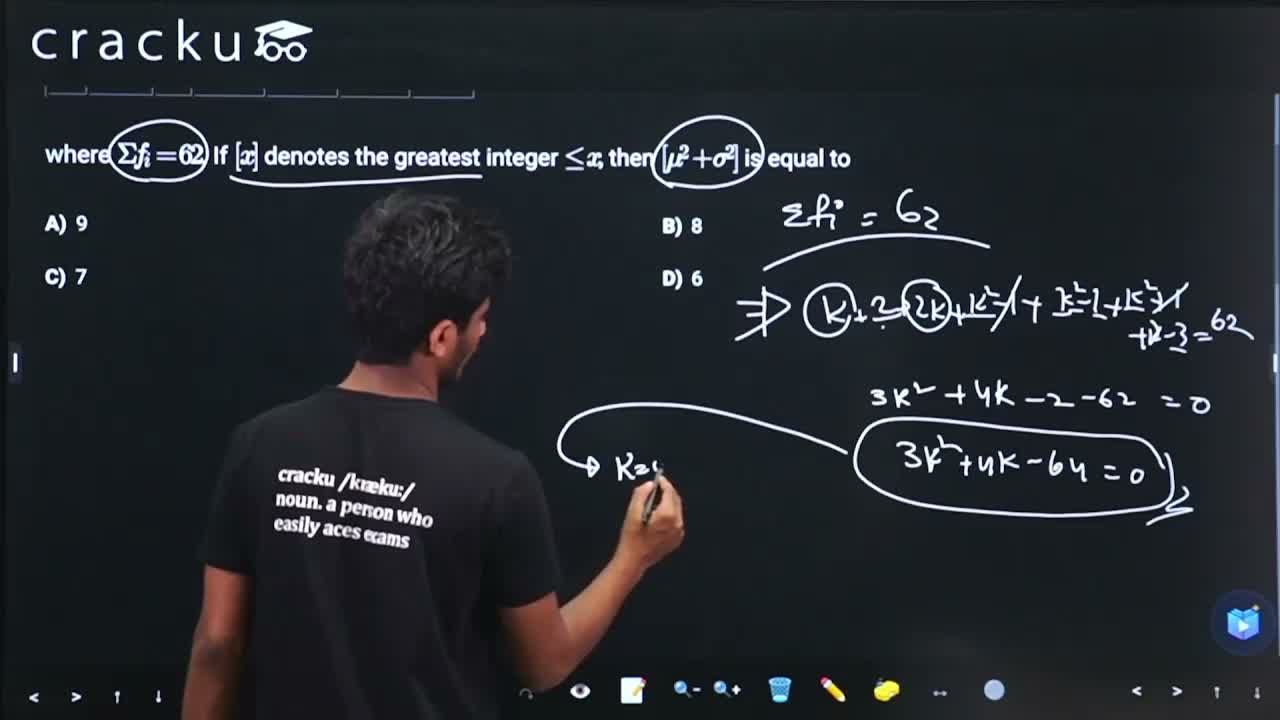
where $$\Sigma f_i = 62$$. If $$[x]$$ denotes the greatest integer $$\leq x$$, then $$[\mu^2 + \sigma^2]$$ is equal to
$$\sum f_i = (k+2) + 2k + (k^2-1) + (k^2-1) + (k^2+1) + (k-3) = 3k^2 + 4k - 2 = 62$$
$$3k^2 + 4k - 64 = 0$$. Using quadratic formula: $$k = \frac{-4 + \sqrt{16+768}}{6} = \frac{-4+28}{6} = 4$$.
Frequencies: 6, 8, 15, 15, 17, 1. Total = 62 ✓
$$\mu = \frac{0(6)+1(8)+2(15)+3(15)+4(17)+5(1)}{62} = \frac{0+8+30+45+68+5}{62} = \frac{156}{62} \approx 2.516$$
$$\sum f_ix_i^2 = 0+8+60+135+272+25 = 500$$. $$\sigma^2 = 500/62 - (156/62)^2 = 8.065 - 6.33 = 1.735$$.
$$\mu^2 + \sigma^2 = 6.33 + 1.735 = 8.065$$. $$[\mu^2 + \sigma^2] = 8$$.
The correct answer is Option 2: 8.
Was this solution helpful?
Click on the Email ☝️ to Watch the Video Solution
Create a FREE account and get:
_1.webp)

Educational materials for JEE preparation

Ask our AI anything

AI can make mistakes. Please verify important information.
AI can make mistakes. Please verify important information.


