
Join Our JEE Preparation Group
Prep with like-minded aspirants; Get access to free daily tests and study material.
Sign in
Please select an account to continue using cracku.in
↓ →
Join Our JEE Preparation Group
Prep with like-minded aspirants; Get access to free daily tests and study material.
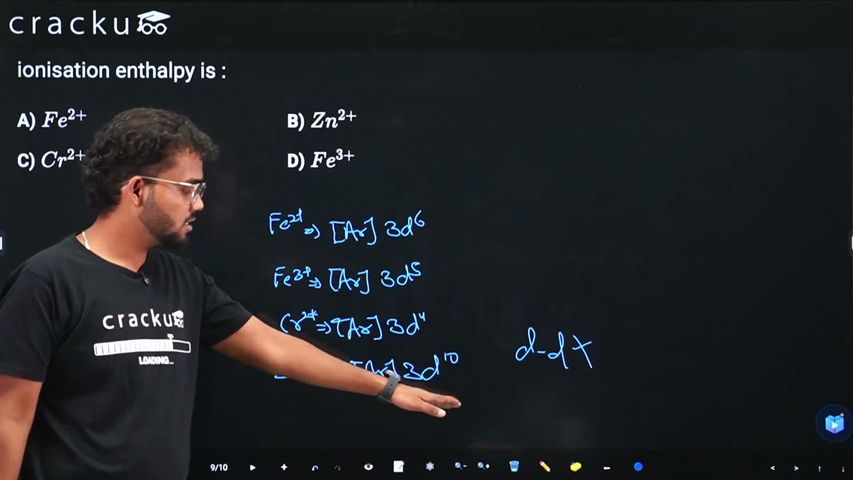
Among $$Fe^{2+}$$, $$Fe^{3+}$$, $$Cr^{2+}$$ and $$Zn^{2+}$$, the ion that shows positive borax bead test and with highest ionisation enthalpy is :
Electronic configurations of the given ions:
$$\begin{aligned} Fe^{2+}&: [Ar]\;3d^{6} \\ Fe^{3+}&: [Ar]\;3d^{5} \\ Cr^{2+}&: [Ar]\;3d^{4} \\ Zn^{2+}&: [Ar]\;3d^{10} \end{aligned}$$
(i) Borax bead test
The coloured borax bead arises when the cation possesses partially filled $$d$$-orbitals; the colour is due to $$d$$→$$d$$ transitions. An ion with a completely filled $$d$$-sub-shell gives either a colourless bead or no distinct colour.
• $$Fe^{2+},\;Fe^{3+},\;Cr^{2+}$$ all have partially filled $$d$$-orbitals ⇒ positive borax bead test.
• $$Zn^{2+}$$ has the completely filled configuration $$3d^{10}$$ ⇒ no (or colourless) borax bead; hence it is treated as a negative test.
(ii) Highest ionisation enthalpy among the ions that give the positive test
Ionisation enthalpy for an ion refers to the energy needed to remove one more electron from that ion. The higher the stability of the electronic configuration, the larger this value.
• $$Fe^{3+}$$ has the exactly half-filled, highly stable $$3d^{5}$$ configuration.
• $$Cr^{2+}$$ is $$3d^{4}$$ (one electron short of half-filled).
• $$Fe^{2+}$$ is $$3d^{6}$$ (one electron more than half-filled).
The most stable (half-filled) arrangement resists further ionisation the most, so $$Fe^{3+}$$ has the greatest ionisation enthalpy among the three.
Therefore, the ion that both shows a positive borax bead test and possesses the highest ionisation enthalpy is $$Fe^{3+}$$.
Option D $$=>$$ $$Fe^{3+}$$
Was this solution helpful?
Click on the Email ☝️ to Watch the Video Solution
Create a FREE account and get:
_1.webp)

Educational materials for JEE preparation

Ask our AI anything

AI can make mistakes. Please verify important information.
AI can make mistakes. Please verify important information.
