
Join Our JEE Preparation Group
Prep with like-minded aspirants; Get access to free daily tests and study material.
Sign in
Please select an account to continue using cracku.in
↓ →
Join Our JEE Preparation Group
Prep with like-minded aspirants; Get access to free daily tests and study material.
Statement - I : When $$\mu$$ amount of an ideal gas undergoes adiabatic change from state $$(P_1, V_1, T_1)$$ to state $$(P_2, V_2, T_2)$$, then work done is $$W = \frac{\mu R(T_2 - T_1)}{1-\gamma}$$, where $$\gamma = \frac{C_p}{C_v}$$ and $$R$$ = universal gas constant.
Statement - II : In the above case, when work is done on the gas, the temperature of the gas would rise.
We need to verify both statements about an adiabatic process for an ideal gas.
Checking Statement I:
For an adiabatic process, $$Q = 0$$.
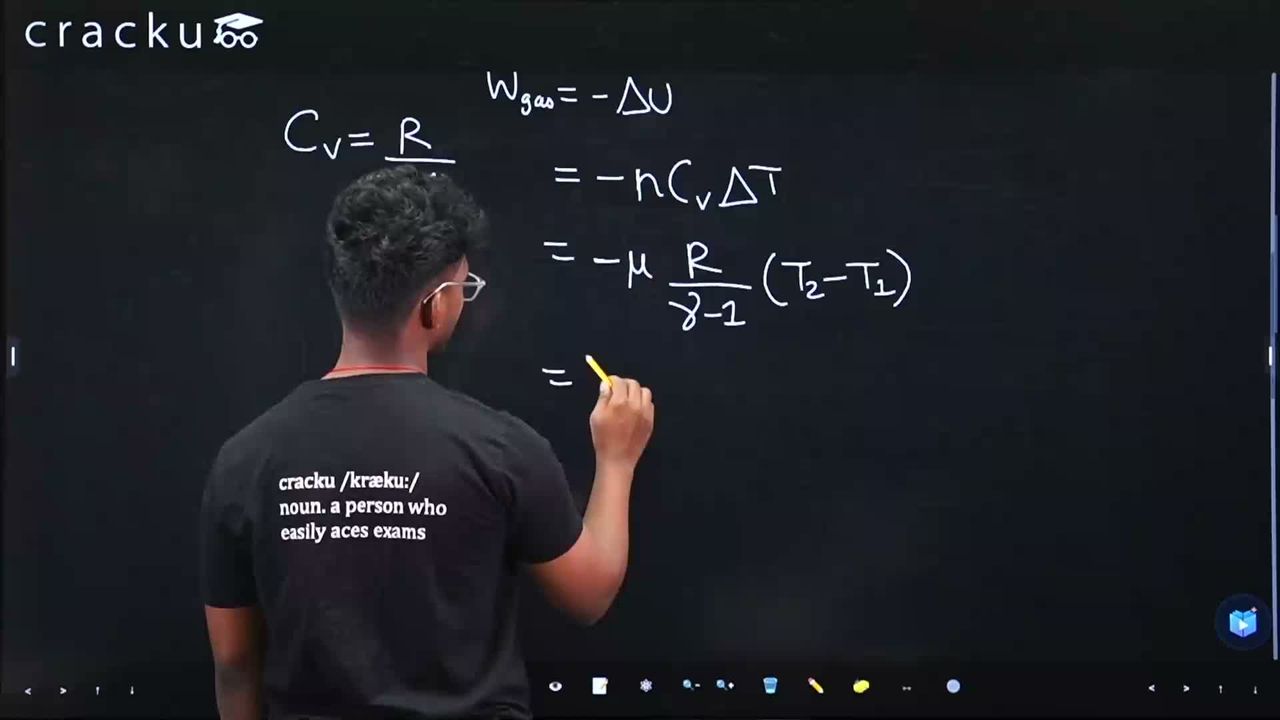
From the first law of thermodynamics: $$W = -\Delta U = -\mu C_v(T_2 - T_1)$$
Since $$C_v = \frac{R}{\gamma - 1}$$:
$$W = -\mu \times \frac{R}{\gamma - 1} \times (T_2 - T_1)$$
$$W = \frac{\mu R(T_1 - T_2)}{\gamma - 1} = \frac{\mu R(T_2 - T_1)}{1 - \gamma}$$
This matches the given formula. Statement I is TRUE.
Checking Statement II:
When work is done ON the gas in an adiabatic process, $$W < 0$$ (work done by gas is negative, meaning work is done on the gas).
From the first law (adiabatic, $$Q = 0$$): $$\Delta U = -W_{\text{by gas}}$$
When work is done on the gas, $$W_{\text{on gas}} > 0$$, so $$\Delta U > 0$$.
Since internal energy increases, $$T_2 > T_1$$, meaning the temperature rises.
Statement II is TRUE.
Both statements are true. The correct answer is Option A.
Was this solution helpful?
Click on the Email ☝️ to Watch the Video Solution
Create a FREE account and get:
_1.webp)

Educational materials for JEE preparation

Ask our AI anything

AI can make mistakes. Please verify important information.
AI can make mistakes. Please verify important information.
