
Join Our JEE Preparation Group
Prep with like-minded aspirants; Get access to free daily tests and study material.
Sign in
Please select an account to continue using cracku.in
↓ →
Join Our JEE Preparation Group
Prep with like-minded aspirants; Get access to free daily tests and study material.
A water drop of diameter $$2$$ cm is broken into $$64$$ equal droplets. The surface tension of water is $$0.075$$ N m$$^{-1}$$. In this process the gain in surface energy will be
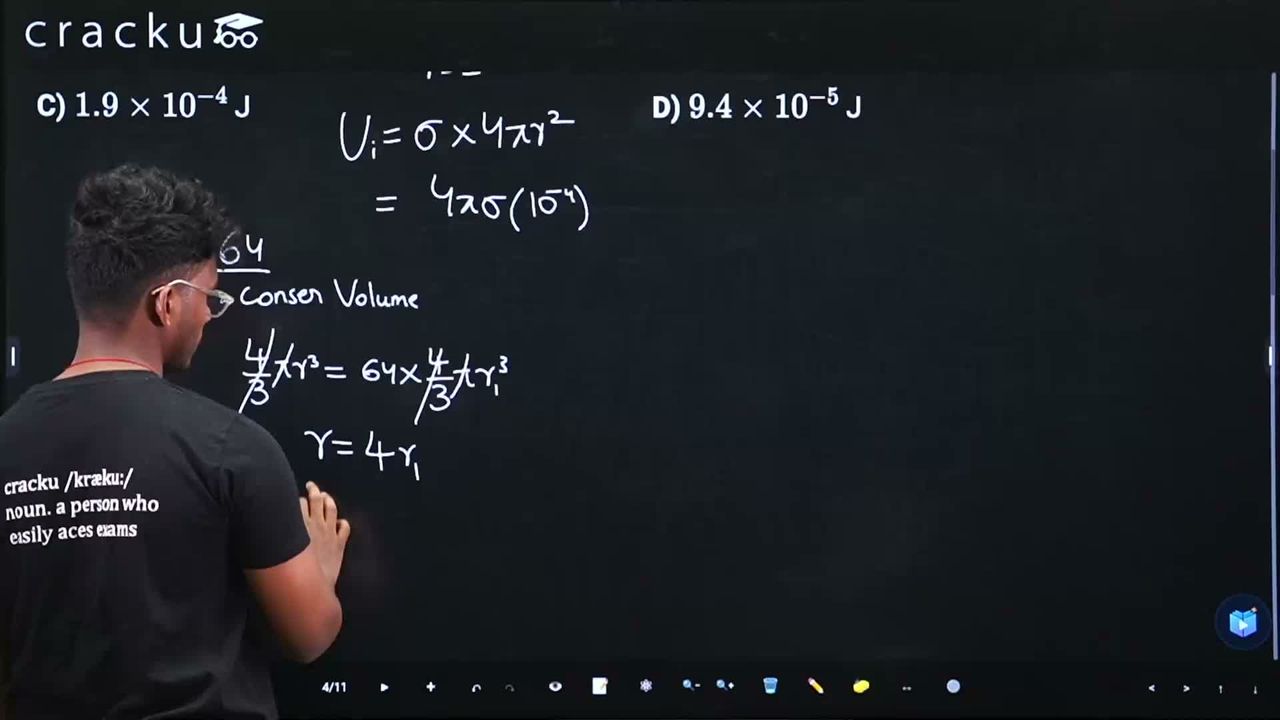
A water drop of diameter 2 cm is broken into 64 equal droplets. The radius of the original drop is $$R = 1$$ cm $$= 0.01$$ m. By conservation of volume:
$$\frac{4}{3}\pi R^3 = 64 \times \frac{4}{3}\pi r^3$$
It follows that $$R^3 = 64r^3$$ and hence $$r = \frac{R}{4} = \frac{0.01}{4} = 0.0025$$ m.
The initial surface area is $$4\pi R^2 = 4\pi (0.01)^2 = 4\pi \times 10^{-4}$$ m$$^2$$, while the final surface area is $$64 \times 4\pi r^2 = 64 \times 4\pi (0.0025)^2 = 64 \times 4\pi \times 6.25 \times 10^{-6}$$
$$= 64 \times 25\pi \times 10^{-6} = 1600\pi \times 10^{-6} = 16\pi \times 10^{-4}$$ m$$^2$$.
The increase in surface area is $$\Delta A = 16\pi \times 10^{-4} - 4\pi \times 10^{-4} = 12\pi \times 10^{-4}$$ m$$^2$$, so the gain in surface energy is given by
$$\Delta E = \text{Surface tension} \times \Delta A = 0.075 \times 12\pi \times 10^{-4}$$
$$= 0.075 \times 12 \times 3.1416 \times 10^{-4}$$
$$= 0.075 \times 37.699 \times 10^{-4}$$
$$= 2.827 \times 10^{-4}$$ J
$$\approx 2.8 \times 10^{-4}$$ J. The correct answer is Option A.
Was this solution helpful?
Click on the Email ☝️ to Watch the Video Solution
Create a FREE account and get:
_1.webp)

Educational materials for JEE preparation

Ask our AI anything

AI can make mistakes. Please verify important information.
AI can make mistakes. Please verify important information.
