
Join Our JEE Preparation Group
Prep with like-minded aspirants; Get access to free daily tests and study material.
Sign in
Please select an account to continue using cracku.in
↓ →
Join Our JEE Preparation Group
Prep with like-minded aspirants; Get access to free daily tests and study material.
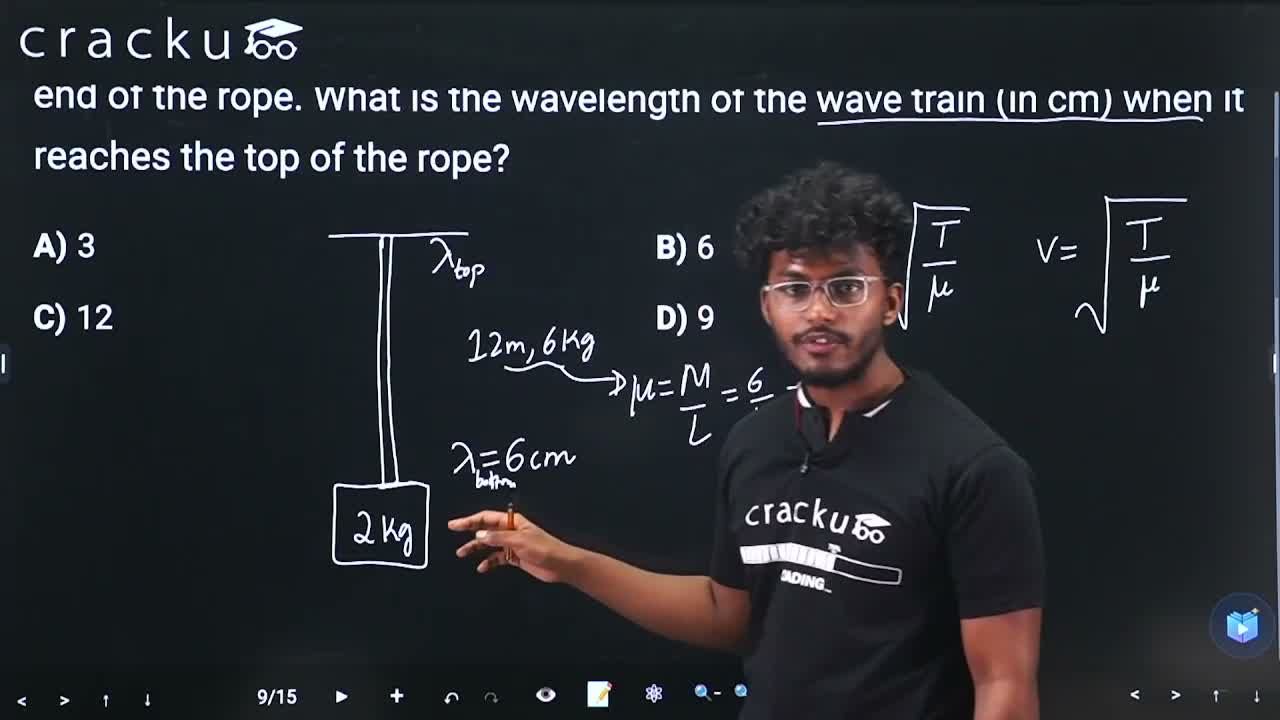
A uniform thin rope of length 12 m and mass 6 kg hangs vertically from a rigid support and a block of mass 2 kg is attached to its free end. A transverse short wave train of wavelength 6 cm is produced at the lower end of the rope. What is the wavelength of the wave train (in cm) when it reaches the top of the rope?
We are given a uniform rope of length $$L = 12$$ m and mass $$M = 6$$ kg hanging vertically from a rigid support. A block of mass $$m = 2$$ kg is attached to its free (lower) end. A transverse wave of wavelength $$\lambda_{\text{bottom}} = 6$$ cm is produced at the lower end. We need to find the wavelength when the wave reaches the top.
The linear mass density of the rope is $$\mu = \frac{M}{L} = \frac{6}{12} = 0.5$$ kg/m.
The speed of a transverse wave on a string is given by $$v = \sqrt{\frac{T}{\mu}}$$, where $$T$$ is the tension at that point.
At the bottom of the rope, the tension is due to the block only: $$T_{\text{bottom}} = mg = 2g$$.
At the top of the rope, the tension supports both the rope and the block: $$T_{\text{top}} = (M + m)g = (6 + 2)g = 8g$$.
Since the frequency of a wave remains constant as it travels through the medium, we have $$f = \frac{v}{\lambda}$$ = constant. Therefore $$\lambda \propto v \propto \sqrt{T}$$.
Taking the ratio: $$\frac{\lambda_{\text{top}}}{\lambda_{\text{bottom}}} = \sqrt{\frac{T_{\text{top}}}{T_{\text{bottom}}}} = \sqrt{\frac{8g}{2g}} = \sqrt{4} = 2$$.
So $$\lambda_{\text{top}} = 2 \times 6 = 12$$ cm.
The wavelength of the wave train when it reaches the top of the rope is $$12$$ cm, which is Option C.
Was this solution helpful?
Click on the Email ☝️ to Watch the Video Solution
Create a FREE account and get:
_1.webp)

Educational materials for JEE preparation

Ask our AI anything

AI can make mistakes. Please verify important information.
AI can make mistakes. Please verify important information.
