
Join Our JEE Preparation Group
Prep with like-minded aspirants; Get access to free daily tests and study material.
Sign in
Please select an account to continue using cracku.in
↓ →
Join Our JEE Preparation Group
Prep with like-minded aspirants; Get access to free daily tests and study material.
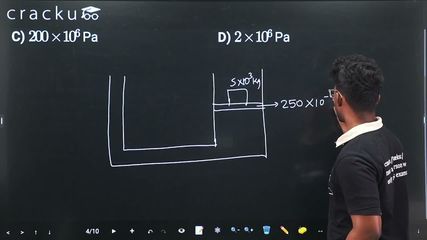
A hydraulic automobile lift is designed to lift vehicles of mass 5000 kg. The area of cross section of the cylinder carrying load is 250 cm$$^2$$. The maximum pressure the smaller piston would have to bear is [Assume $$g = 10$$ m s$$^{-2}$$]
We have a vehicle of mass $$m = 5000$$ kg and the area of cross section of the load-carrying cylinder is $$A = 250$$ cm$$^2 = 250 \times 10^{-4}$$ m$$^2$$, with $$g = 10$$ m/s$$^2$$.
In a hydraulic lift, the pressure is the same throughout the fluid (by Pascal's law). So the maximum pressure the smaller piston would have to bear equals the pressure in the larger cylinder:
$$P = \frac{F}{A} = \frac{mg}{A} = \frac{5000 \times 10}{250 \times 10^{-4}} = \frac{50000}{0.025} = 2000000 \text{ Pa} = 2 \times 10^6 \text{ Pa}$$
Hence, the correct answer is Option 4.
Was this solution helpful?
Click on the Email ☝️ to Watch the Video Solution
Create a FREE account and get:
_1.webp)

Educational materials for JEE preparation

Ask our AI anything

AI can make mistakes. Please verify important information.
AI can make mistakes. Please verify important information.


