
Join Our JEE Preparation Group
Prep with like-minded aspirants; Get access to free daily tests and study material.
Sign in
Please select an account to continue using cracku.in
↓ →
Join Our JEE Preparation Group
Prep with like-minded aspirants; Get access to free daily tests and study material.
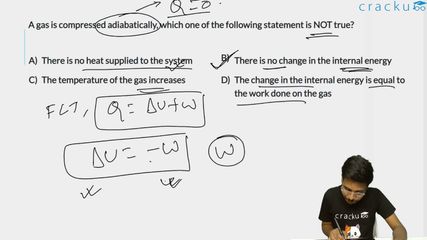
We need to identify which statement is NOT true for adiabatic compression of a gas. An adiabatic process is one in which no heat is exchanged between the system and its surroundings, meaning $$Q = 0$$. The First Law of Thermodynamics states:
$$\Delta U = Q - W$$
For an adiabatic process ($$Q = 0$$):
$$\Delta U = -W$$
Option 1: "There is no heat supplied to the system." This is TRUE. By definition, an adiabatic process has $$Q = 0$$, meaning no heat enters or leaves the system.
Option 2: "There is no change in the internal energy." This is NOT TRUE. From the First Law with $$Q = 0$$, we have $$\Delta U = -W$$. During compression, work is done ON the gas, so the gas does negative work ($$W < 0$$). Therefore:
$$\Delta U = -W = -(\text{negative value}) > 0$$
The internal energy INCREASES during adiabatic compression. The statement $$\Delta U = 0$$ would only hold if $$W = 0$$ (no work done), which contradicts the fact that the gas is being compressed. Note: $$\Delta U = 0$$ is characteristic of an isothermal process for an ideal gas, not an adiabatic one.
Option 3: "The temperature of the gas increases." This is TRUE. Since $$\Delta U > 0$$, and for an ideal gas the internal energy depends only on temperature via $$U = nC_vT$$, an increase in internal energy means an increase in temperature. This is why adiabatic compression heats up a gas, as seen in diesel engines where adiabatic compression raises the air temperature enough to ignite fuel.
Option 4: "The change in internal energy is equal to the work done on the gas." This is TRUE. From $$\Delta U = -W$$, and noting that work done ON the gas is $$W_{on} = -W$$, we get $$\Delta U = W_{on}$$. Since no heat escapes ($$Q = 0$$), all the work done on the gas goes entirely into increasing its internal energy.
The statement that is NOT true is Option 2.
The correct answer is Option 2.
Was this solution helpful?
Click on the Email ☝️ to Watch the Video Solution
Create a FREE account and get:
_1.webp)

Educational materials for JEE preparation

Ask our AI anything

AI can make mistakes. Please verify important information.
AI can make mistakes. Please verify important information.


