
Join Our JEE Preparation Group
Prep with like-minded aspirants; Get access to free daily tests and study material.
Sign in
Please select an account to continue using cracku.in
↓ →
Join Our JEE Preparation Group
Prep with like-minded aspirants; Get access to free daily tests and study material.
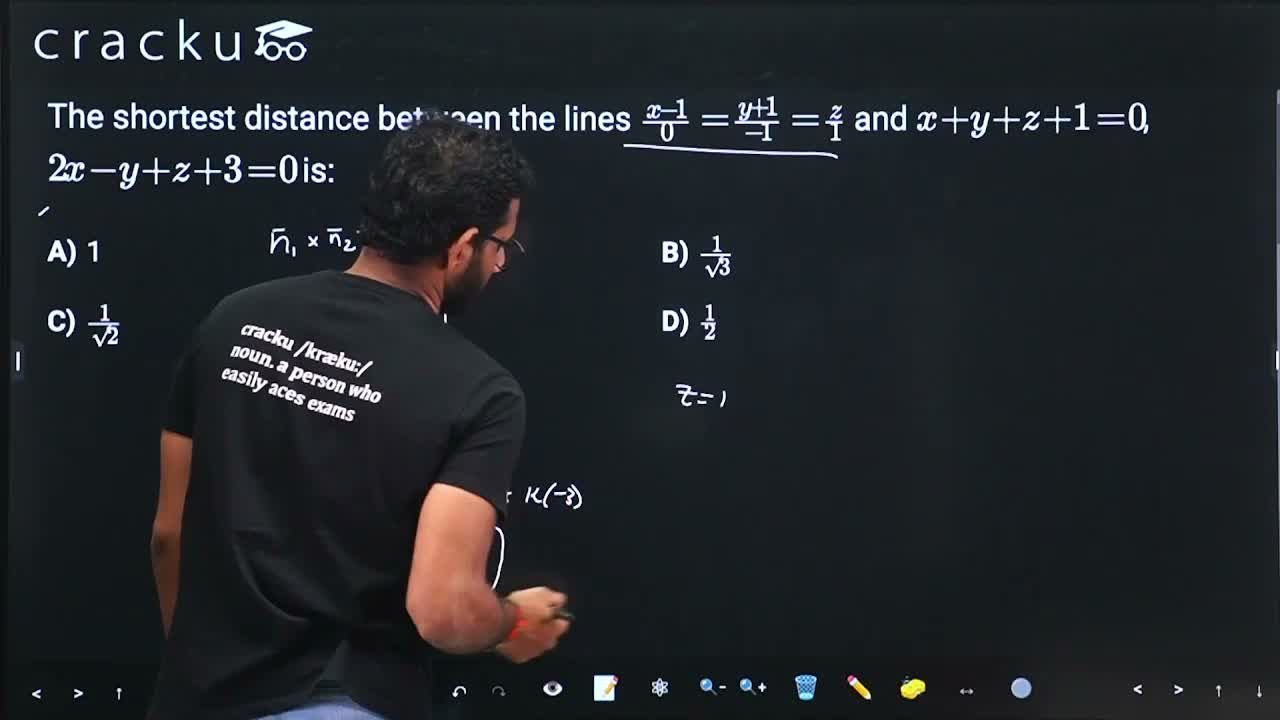
The shortest distance between the lines $$\frac{x-1}{0} = \frac{y+1}{-1} = \frac{z}{1}$$ and $$x + y + z + 1 = 0$$, $$2x - y + z + 3 = 0$$ is:
We begin with the first line, written in symmetric form as $$\dfrac{x-1}{0}=\dfrac{y+1}{-1}=\dfrac{z}{1}\,.$$
The denominator $$0$$ under $$x-1$$ forces $$x-1=0$$, that is $$x=1$$ for every point on the line. Let the common ratio be $$t$$. Stating this explicitly, we have
$$\dfrac{y+1}{-1}=t \quad\text{and}\quad \dfrac{z}{1}=t.$$
So
$$y+1=-t \;\Rightarrow\; y=-1-t,$$
$$z=t.$$
Hence each point of the first line can be parametrised as
$$P_1(t)\;(1,\,-1-t,\,t).$$
Differentiating the position vector with respect to the parameter gives the direction vector of the line. Thus the direction vector is
$$\vec a = (0,\,-1,\,1).$$
Now consider the second line, which is the intersection of the two planes
$$x+y+z+1=0,$$ $$2x-y+z+3=0.$$
The normal vectors of these planes are
$$\vec n_1 = (1,\,1,\,1), \qquad \vec n_2 = (2,\,-1,\,1).$$
The direction vector of the line of intersection equals the cross product of the normals. Using the formula $$\vec n_1\times\vec n_2 =\begin{vmatrix} \mathbf i & \mathbf j & \mathbf k\\ 1 & 1 & 1\\ 2 & -1 & 1 \end{vmatrix},$$ we calculate
$$ \vec b= \mathbf i(1\cdot1-1\cdot(-1))- \mathbf j(1\cdot1-1\cdot2)+ \mathbf k(1\cdot(-1)-1\cdot2) =\mathbf i\,2+\mathbf j\,1+\mathbf k(-3), $$
so
$$\vec b=(2,\,1,\,-3).$$
To obtain one concrete point on this line, we solve the plane equations simultaneously. Put $$z=1$$ to keep numbers integral; then
$$x+y+1+1=0\;\Rightarrow\;x+y=-2,$$ $$2x-y+1+3=0\;\Rightarrow\;2x-y=-4.$$
Solving gives $$x=-2,\;y=0,$$ whence a convenient point is
$$P_2(-2,\,0,\,1).$$
We are now ready to compute the shortest distance between the skew lines. The standard formula is
$$ D=\dfrac{\left|(\overrightarrow{P_2P_1})\cdot(\vec a\times\vec b)\right|} {\lVert\vec a\times\vec b\rVert}, $$
where $$\overrightarrow{P_2P_1}=P_2-P_1(0)$$ and $$P_1(0)=(1,-1,0)$$ is the point on the first line corresponding to $$t=0$$.
Thus
$$\overrightarrow{P_2P_1}=(-2-1,\,0-(-1),\,1-0)=(-3,\,1,\,1).$$
Next, evaluate the cross product $$\vec a\times\vec b$$. Using
$$ \vec a\times\vec b= \begin{vmatrix} \mathbf i & \mathbf j & \mathbf k\\ 0 & -1 & 1\\ 2 & 1 & -3 \end{vmatrix}, $$
we get
$$ \vec a\times\vec b= \mathbf i((-1)(-3)-1\cdot1)+ \mathbf j\!\bigl(-(0\cdot(-3)-1\cdot2)\bigr)+ \mathbf k(0\cdot1-(-1)\cdot2) =(2,\,2,\,2). $$
The dot product appearing in the numerator is
$$ (\overrightarrow{P_2P_1})\cdot(\vec a\times\vec b) =(-3,\,1,\,1)\cdot(2,\,2,\,2) =-3\cdot2+1\cdot2+1\cdot2=-6+2+2=-2. $$
Taking absolute value gives $$|-2|=2.$$
The magnitude of the cross product is
$$ \lVert\vec a\times\vec b\rVert =\sqrt{2^2+2^2+2^2} =\sqrt{12} =2\sqrt3. $$
Substituting these results into the distance formula, we find
$$ D=\dfrac{2}{2\sqrt3} =\dfrac{1}{\sqrt3}. $$
Hence, the correct answer is Option B.
Click on the Email ☝️ to Watch the Video Solution
Create a FREE account and get:
_1.webp)

Educational materials for JEE preparation

Ask our AI anything

AI can make mistakes. Please verify important information.
AI can make mistakes. Please verify important information.


