
Join Our JEE Preparation Group
Prep with like-minded aspirants; Get access to free daily tests and study material.
Sign in
Please select an account to continue using cracku.in
↓ →
Join Our JEE Preparation Group
Prep with like-minded aspirants; Get access to free daily tests and study material.
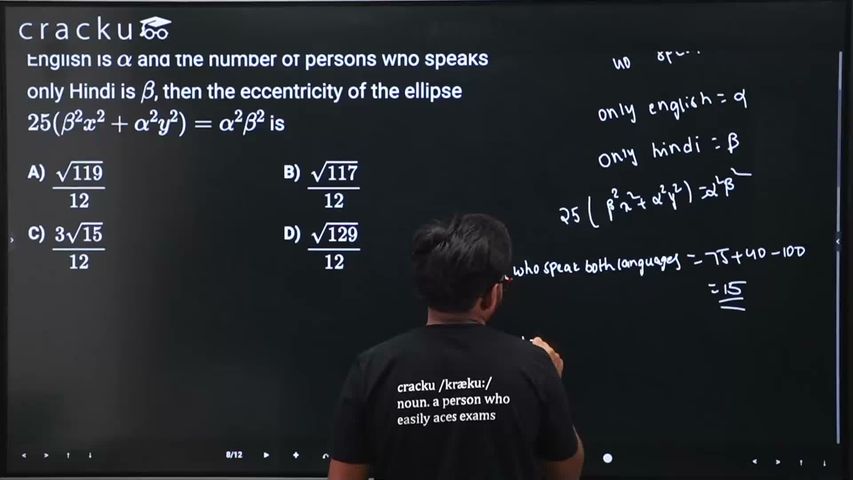
In a group of 100 persons 75 speak English and 40 speak Hindi. Each person speaks at least one of the two languages. If the number of persons who speak only English is $$\alpha$$ and the number of persons who speaks only Hindi is $$\beta$$, then the eccentricity of the ellipse $$25(\beta^2 x^2 + \alpha^2 y^2) = \alpha^2\beta^2$$ is
A total of 100 persons includes 75 English speakers and 40 Hindi speakers, each speaking at least one language. By the inclusion-exclusion principle, the number of persons speaking both languages is 75 + 40 - 100 = 15, so the number speaking only English is $$\alpha$$ = 75 - 15 = 60 and the number speaking only Hindi is $$\beta$$ = 40 - 15 = 25.
The equation of the ellipse can be written as $$25(\beta^2 x^2 + \alpha^2 y^2) = \alpha^2\beta^2$$
which yields $$\frac{x^2}{\alpha^2/25} + \frac{y^2}{\beta^2/25} = 1 \implies \frac{x^2}{144} + \frac{y^2}{25} = 1\ .$$
In this form, $$a^2 = 144$$ and $$b^2 = 25$$ since $$\alpha^2/25 = 3600/25 = 144$$ and $$\beta^2/25 = 625/25 = 25$$.
The eccentricity of the ellipse is given by $$ e = \sqrt{1 - \frac{b^2}{a^2}} = \sqrt{1 - \frac{25}{144}} = \sqrt{\frac{119}{144}} = \frac{\sqrt{119}}{12}\ .$$
The correct answer is $$\dfrac{\sqrt{119}}{12}$$.
Was this solution helpful?
Click on the Email ☝️ to Watch the Video Solution
Create a FREE account and get:
_1.webp)

Educational materials for JEE preparation

Ask our AI anything

AI can make mistakes. Please verify important information.
AI can make mistakes. Please verify important information.


