
Join Our JEE Preparation Group
Prep with like-minded aspirants; Get access to free daily tests and study material.
Sign in
Please select an account to continue using cracku.in
↓ →
Join Our JEE Preparation Group
Prep with like-minded aspirants; Get access to free daily tests and study material.
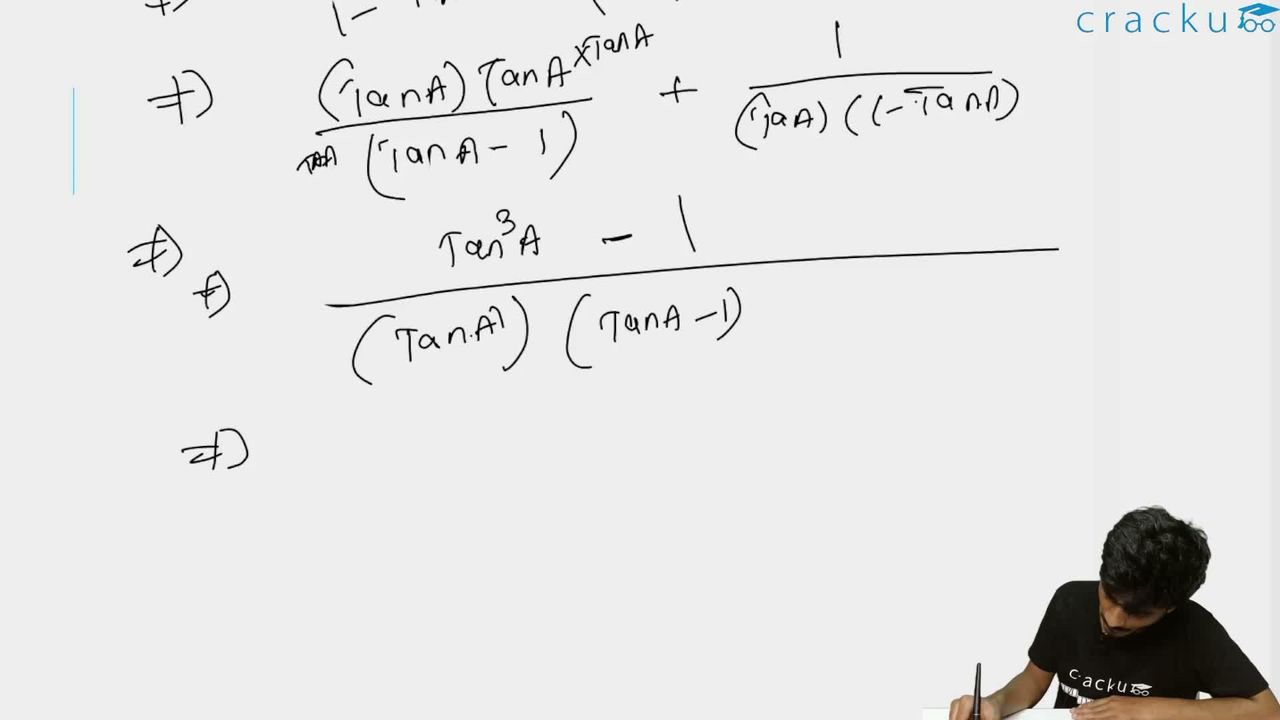
The expression $$\frac{\tan A}{1 - \cot A} + \frac{\cot A}{1 - \tan A}$$ can be written as :
We have to simplify the expression
$$\frac{\tan A}{1-\cot A}+\frac{\cot A}{1-\tan A}$$
To remove the mixed trigonometric functions, we first recall the basic identities
$$\tan A=\frac{\sin A}{\cos A},\qquad \cot A=\frac{\cos A}{\sin A}.$$
Substituting these in the given expression, we treat each fraction separately.
For the first fraction:
$$\frac{\tan A}{1-\cot A} =\frac{\dfrac{\sin A}{\cos A}} {1-\dfrac{\cos A}{\sin A}}.$$
Combining the terms in the denominator we get
$$1-\frac{\cos A}{\sin A} =\frac{\sin A-\cos A}{\sin A}.$$
So the first fraction becomes
$$\frac{\dfrac{\sin A}{\cos A}} {\dfrac{\sin A-\cos A}{\sin A}} =\frac{\sin A}{\cos A}\times\frac{\sin A}{\sin A-\cos A} =\frac{\sin^2 A}{\cos A(\sin A-\cos A)}.$$
Now, for the second fraction:
$$\frac{\cot A}{1-\tan A} =\frac{\dfrac{\cos A}{\sin A}} {1-\dfrac{\sin A}{\cos A}}.$$
The denominator simplifies as
$$1-\frac{\sin A}{\cos A} =\frac{\cos A-\sin A}{\cos A}.$$
Thus the second fraction is
$$\frac{\dfrac{\cos A}{\sin A}} {\dfrac{\cos A-\sin A}{\cos A}} =\frac{\cos A}{\sin A}\times\frac{\cos A}{\cos A-\sin A} =\frac{\cos^2 A}{\sin A(\cos A-\sin A)}.$$
The entire expression is therefore
$$\frac{\sin^2 A}{\cos A(\sin A-\cos A)} +\frac{\cos^2 A}{\sin A(\cos A-\sin A)}.$$
Notice that $$\cos A-\sin A=-(\sin A-\cos A).$$ We can rewrite the second term by inserting this minus sign:
$$\frac{\cos^2 A}{\sin A(\cos A-\sin A)} =-\frac{\cos^2 A}{\sin A(\sin A-\cos A)}.$$
Hence the sum becomes
$$\frac{\sin^2 A}{\cos A(\sin A-\cos A)} -\frac{\cos^2 A}{\sin A(\sin A-\cos A)}.$$
We now take the common denominator $$\sin A\cos A(\sin A-\cos A)$$ and combine the numerators:
$$ \frac{\sin^2 A}{\cos A(\sin A-\cos A)} =\frac{\sin^3 A}{\sin A\cos A(\sin A-\cos A)},$$
$$ -\frac{\cos^2 A}{\sin A(\sin A-\cos A)} =-\frac{\cos^3 A}{\sin A\cos A(\sin A-\cos A)}.$$
Adding these gives
$$\frac{\sin^3 A-\cos^3 A} {\sin A\cos A(\sin A-\cos A)}.$$
Next, we use the algebraic identity for the difference of cubes:
$$a^3-b^3=(a-b)(a^2+ab+b^2).$$
Putting $$a=\sin A,\; b=\cos A$$ we obtain
$$\sin^3 A-\cos^3 A =(\sin A-\cos A)(\sin^2 A+\sin A\cos A+\cos^2 A).$$
But $$\sin^2 A+\cos^2 A=1,$$ so
$$\sin^2 A+\sin A\cos A+\cos^2 A =1+\sin A\cos A.$$
Thus the numerator simplifies to
$$(\sin A-\cos A)(1+\sin A\cos A).$$
Our fraction is now
$$\frac{(\sin A-\cos A)(1+\sin A\cos A)} {\sin A\cos A(\sin A-\cos A)}.$$
The factor $$\sin A-\cos A$$ appears in both numerator and denominator, so it cancels out (assuming $$\sin A\neq\cos A$$):
$$\frac{1+\sin A\cos A}{\sin A\cos A}.$$
We separate the numerator:
$$\frac{1}{\sin A\cos A}+\frac{\sin A\cos A}{\sin A\cos A} =\frac{1}{\sin A\cos A}+1.$$
The reciprocal identities $$\sec A=\dfrac{1}{\cos A}$$ and $$\csc A=\dfrac{1}{\sin A}$$ give
$$\frac{1}{\sin A\cos A} =\frac{1}{\sin A}\times\frac{1}{\cos A} =\csc A\sec A.$$
Therefore the entire expression equals
$$\csc A\sec A+1.$$
This matches option D.
Hence, the correct answer is Option D.
Was this solution helpful?
Click on the Email ☝️ to Watch the Video Solution
Create a FREE account and get:
_1.webp)

Educational materials for JEE preparation

Ask our AI anything

AI can make mistakes. Please verify important information.
AI can make mistakes. Please verify important information.
