
Join Our JEE Preparation Group
Prep with like-minded aspirants; Get access to free daily tests and study material.
Sign in
Please select an account to continue using cracku.in
↓ →
Join Our JEE Preparation Group
Prep with like-minded aspirants; Get access to free daily tests and study material.
The area (in sq. units) of the region $$A = \{(x,y) : (x-1)[x] \leq y \leq 2\sqrt{x},\; 0 \leq x \leq 2\}$$, where $$[t]$$ denotes the greatest integer function, is:
We want the area enclosed by the set $$A=\{(x,y):(x-1)[x]\le y\le 2\sqrt{x},\;0\le x\le 2\},$$ where $$[x]$$ is the greatest integer not exceeding $$x$$. Because $$[x]$$ is piece-wise constant, we first decide its value on the sub-intervals of $$x$$ from $$0$$ to $$2$$.
When $$0\le x<1$$ we have $$[x]=0$$. When $$1\le x<2$$ we have $$[x]=1$$. The single point $$x=2$$, where $$[2]=2$$, contributes no area, so we may ignore it. Thus we treat the two intervals separately.
Interval I : $$0\le x<1$$
Here $$[x]=0$$, so
$$y_{\text{lower}}=(x-1)[x]=(x-1)\cdot0=0,\qquad
y_{\text{upper}}=2\sqrt{x}.$$
Therefore every vertical slice from this interval is a strip of height $$2\sqrt{x}$$, and the area contributed is
$$ \text{Area}_1=\int_{0}^{1}\bigl(2\sqrt{x}-0\bigr)\,dx. $$
We recall the integral formula $$\int x^{n}\,dx=\dfrac{x^{n+1}}{n+1}+C$$. Setting $$n=\tfrac12$$, we get
$$ \text{Area}_1 =2\int_{0}^{1}x^{1/2}\,dx =2\left[\frac{x^{3/2}}{3/2}\right]_{0}^{1} =2\left(\frac{2}{3}\right)(1^{3/2}-0) =\frac{4}{3}. $$
Interval II : $$1\le x<2$$
Here $$[x]=1$$, so
$$y_{\text{lower}}=(x-1)[x]=(x-1)\cdot1=x-1,\qquad
y_{\text{upper}}=2\sqrt{x}.$$
First we must check that $$2\sqrt{x}\ge x-1$$ on this interval so the strip has non-negative height. Squaring the non-negative sides,
$$ (2\sqrt{x})^2\ge(x-1)^2 \;\Longrightarrow\; 4x\ge x^{2}-2x+1 \;\Longrightarrow\; 0\ge x^{2}-6x+1. $$
The quadratic $$x^{2}-6x+1$$ has roots $$3\pm2\sqrt{2}$$, so it is non-positive for $$3-2\sqrt{2}\le x\le3+2\sqrt{2}$$. Since $$1\le x<2$$ lies entirely in this band, the inequality is satisfied everywhere on the interval. The area strip therefore has height $$2\sqrt{x}-(x-1)$$, and the contributed area is
$$ \text{Area}_2 =\int_{1}^{2}\bigl(2\sqrt{x}-(x-1)\bigr)\,dx =\int_{1}^{2}\bigl(2x^{1/2}-x+1\bigr)\,dx. $$
We integrate each term separately, once more using $$\int x^{n}\,dx=\dfrac{x^{n+1}}{n+1}+C$$:
$$ \int2x^{1/2}\,dx =2\left[\frac{x^{3/2}}{3/2}\right] =\frac{4}{3}x^{3/2},\quad \int(-x)\,dx =-\frac{x^{2}}{2},\quad \int1\,dx =x. $$
Combining these, the antiderivative is $$ F(x)=\frac{4}{3}x^{3/2}-\frac{x^{2}}{2}+x. $$ We now evaluate $$F(x)$$ from $$1$$ to $$2$$:
At $$x=2$$,
$$F(2)=\frac{4}{3}(2)^{3/2}-\frac{2^{2}}{2}+2
=\frac{4}{3}\,2\sqrt{2}-2+2
=\frac{8}{3}\sqrt{2}.$$
At $$x=1$$,
$$F(1)=\frac{4}{3}(1)^{3/2}-\frac{1^{2}}{2}+1
=\frac{4}{3}-\frac12+1
=\frac{11}{6}.$$
Hence
$$ \text{Area}_2 =F(2)-F(1) =\frac{8}{3}\sqrt{2}-\frac{11}{6}. $$
Total area is the sum of the parts:
$$ \text{Area} =\text{Area}_1+\text{Area}_2 =\frac{4}{3}+\left(\frac{8}{3}\sqrt{2}-\frac{11}{6}\right) =\frac{8}{6}+\frac{8}{3}\sqrt{2}-\frac{11}{6} =\left(\frac{8}{3}\sqrt{2}\right)-\frac12. $$
Thus the required area is $$\dfrac{8}{3}\sqrt{2}-\dfrac12$$ square units.
Hence, the correct answer is Option A.
Was this solution helpful?
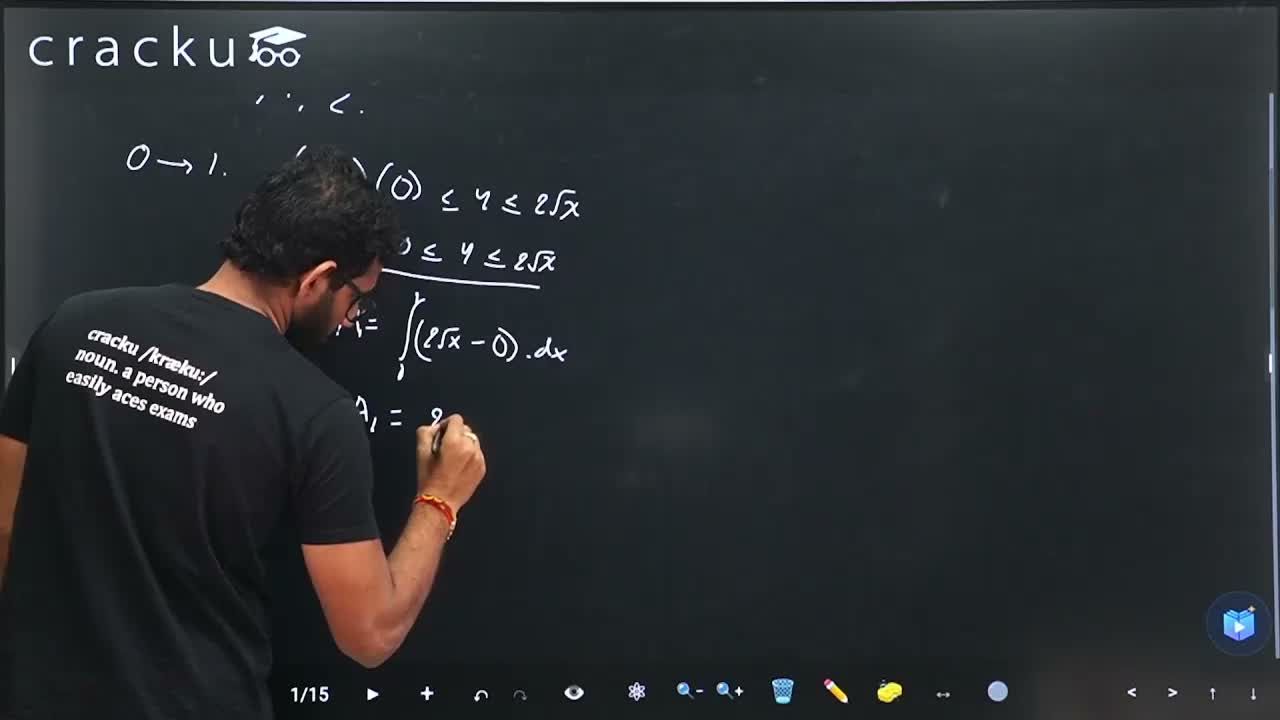
Click on the Email ☝️ to Watch the Video Solution
Create a FREE account and get:
_1.webp)

Educational materials for JEE preparation

Ask our AI anything

AI can make mistakes. Please verify important information.
AI can make mistakes. Please verify important information.
