
Join Our JEE Preparation Group
Prep with like-minded aspirants; Get access to free daily tests and study material.
Sign in
Please select an account to continue using cracku.in
↓ →
Join Our JEE Preparation Group
Prep with like-minded aspirants; Get access to free daily tests and study material.
Let $$y = y(x)$$ be the solution curve of the differential equation, $$(y^2 - x)\frac{dy}{dx} = 1$$, satisfying $$y(0) = 1$$. This curve intersects the X-axis at a point whose abscissa is
We are given the differential equation
$$ (y^2 - x)\,\frac{dy}{dx}=1 $$
together with the initial condition
$$ y(0)=1. $$
Our aim is to find the point where the solution curve meets the X-axis, i.e. the point where $$y=0$$, and hence obtain the required abscissa (the $$x$$-coordinate).
First, we rewrite the differential equation so that $$x$$ becomes the dependent variable and $$y$$ the independent variable. We have
$$ (y^2 - x)\,\frac{dy}{dx}=1. $$
Dividing both sides by $$\dfrac{dy}{dx}$$ (which is non-zero along the smooth solution curve) gives
$$ y^2 - x = \frac{dx}{dy}. $$
So we can write
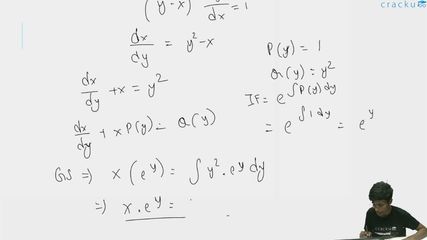
$$ \frac{dx}{dy} = y^2 - x. $$
This is a first-order linear differential equation in the variable $$x(y)$$. The standard linear form is
$$ \frac{dx}{dy} + x = y^2. $$
For a linear equation of the form $$\dfrac{dx}{dy}+P(y)\,x=Q(y)$$ the integrating factor is $$\mu(y)=e^{\int P(y)\,dy}$$. In our case, $$P(y)=1$$, so
$$ \mu(y)=e^{\int 1\,dy}=e^{y}. $$
Multiplying the entire equation by this integrating factor, we obtain
$$ e^{y}\,\frac{dx}{dy} + e^{y}\,x = y^2\,e^{y}. $$
The left-hand side is the derivative of the product $$e^{y}x$$, because
$$ \frac{d}{dy}\bigl(e^{y}x\bigr)=e^{y}\frac{dx}{dy}+e^{y}x. $$
Therefore, our equation becomes
$$ \frac{d}{dy}\bigl(e^{y}x\bigr)=y^2\,e^{y}. $$
We now integrate both sides with respect to $$y$$:
$$ e^{y}x = \int y^2\,e^{y}\,dy + C, $$
where $$C$$ is the constant of integration.
To evaluate the integral $$\displaystyle\int y^2 e^{y} \, dy$$, we use repeated integration by parts. The result, which can be verified step by step, is
$$ \int y^2 e^{y}\,dy = e^{y}\,(y^2 - 2y + 2) + C_1, $$
where $$C_1$$ is another constant. We may absorb $$C_1$$ into the general constant $$C$$ already present, so substituting the evaluated integral gives
$$ e^{y}x = e^{y}\,(y^2 - 2y + 2) + C. $$
Dividing by $$e^{y}$$ (which is never zero) yields the explicit relation between $$x$$ and $$y$$:
$$ x = y^2 - 2y + 2 + C\,e^{-y}. $$
We now determine the constant $$C$$ from the initial condition $$y(0)=1$$. At $$x=0$$ and $$y=1$$ we substitute into the above expression:
$$ 0 = (1)^2 - 2(1) + 2 + C\,e^{-1}. $$
Simplifying inside the parentheses, we get
$$ 0 = 1 - 2 + 2 + \frac{C}{e}. $$
$$ 0 = 1 + \frac{C}{e}. $$
Therefore,
$$ \frac{C}{e} = -1 \quad\Longrightarrow\quad C = -e. $$
Substituting this value of $$C$$ back into the relation for $$x$$ gives the particular solution:
$$ x = y^2 - 2y + 2 - e\,e^{-y}. $$
Since $$e\,e^{-y}=e^{1-y}$$, we can write more compactly
$$ x = y^2 - 2y + 2 - e^{1-y}. $$
To find where the curve crosses the X-axis, we set $$y=0$$ (because any point on the X-axis has ordinate zero):
$$ x = (0)^2 - 2(0) + 2 - e^{1-0}. $$
$$ x = 2 - e^{1}. $$
$$ x = 2 - e. $$
Thus, the required abscissa is $$2 - e$$.
Hence, the correct answer is Option A.
Was this solution helpful?
Click on the Email ☝️ to Watch the Video Solution
Create a FREE account and get:
_1.webp)

Educational materials for JEE preparation

Ask our AI anything

AI can make mistakes. Please verify important information.
AI can make mistakes. Please verify important information.
