
Join Our JEE Preparation Group
Prep with like-minded aspirants; Get access to free daily tests and study material.
Sign in
Please select an account to continue using cracku.in
↓ →
Join Our JEE Preparation Group
Prep with like-minded aspirants; Get access to free daily tests and study material.
Let the equation of the pair of lines, $$y = px$$ and $$y = qx$$, can be written as $$(y - px)(y - qx) = 0$$. Then the equation of the pair of the angle bisectors of the lines $$x^2 - 4xy - 5y^2 = 0$$ is:
We start with the given pair of lines
$$x^{2}-4xy-5y^{2}=0.$$
Because the constant term is zero, the curve passes through the origin, so it must represent two straight lines through the origin. We factor the quadratic:
$$x^{2}-4xy-5y^{2}= (x-5y)(x+y)=0.$$
Hence the two individual lines are
$$L_{1}:x-5y=0 \quad\Longrightarrow\quad y=\frac{1}{5}x,$$
$$L_{2}:x+y=0 \quad\Longrightarrow\quad y=-x.$$
Now we wish to obtain the equations of the angle-bisector lines of these two lines. For two lines through the origin,
$$a_{1}x+b_{1}y=0 \quad\text{and}\quad a_{2}x+b_{2}y=0,$$
the angle-bisectors are obtained from the formula
$$\frac{a_{1}x+b_{1}y}{\sqrt{a_{1}^{2}+b_{1}^{2}}}= \pm \frac{a_{2}x+b_{2}y}{\sqrt{a_{2}^{2}+b_{2}^{2}}}.$$
Here we have
$$L_{1}:a_{1}=1,\;b_{1}=-5, \qquad L_{2}:a_{2}=1,\;b_{2}=1.$$
Therefore
$$\frac{x-5y}{\sqrt{1^{2}+(-5)^{2}}}= \pm \frac{x+y}{\sqrt{1^{2}+1^{2}}}.$$
Simplifying the square-roots,
$$\frac{x-5y}{\sqrt{26}} = \pm \frac{x+y}{\sqrt{2}}.$$
Cross-multiplying gives
$$\sqrt{2}\,(x-5y)= \pm \sqrt{26}\,(x+y).$$
To obtain a single equation containing both bisectors, we square both sides and then bring all terms to one side:
$$\bigl[\sqrt{2}\,(x-5y)\bigr]^{2} - \bigl[\sqrt{26}\,(x+y)\bigr]^{2}=0.$$
That is,
$$2\,(x-5y)^{2} - 26\,(x+y)^{2}=0.$$
Dividing every term by $$2$$ for convenience,
$$(x-5y)^{2} - 13\,(x+y)^{2}=0.$$
Now we expand each square separately:
First square: $$ (x-5y)^{2}=x^{2}-10xy+25y^{2}. $$
Second square: $$ (x+y)^{2}=x^{2}+2xy+y^{2}. $$
Substituting these into the equation, we get
$$x^{2}-10xy+25y^{2}-13\bigl(x^{2}+2xy+y^{2}\bigr)=0.$$
Distribute the $$-13$$:
$$x^{2}-10xy+25y^{2}-13x^{2}-26xy-13y^{2}=0.$$
Combine like terms for each power:
For $$x^{2}: \;\; x^{2}-13x^{2}= -12x^{2},$$
For $$xy:\;\; -10xy-26xy= -36xy,$$
For $$y^{2}:\;\; 25y^{2}-13y^{2}= 12y^{2}.$$
Thus the equation becomes
$$-12x^{2}-36xy+12y^{2}=0.$$
Every coefficient is divisible by $$-12$$. Dividing through by $$-12$$ gives the simplest form:
$$x^{2}+3xy-y^{2}=0.$$
This is exactly the required combined equation of the two angle-bisector lines. Matching this with the options, we see it corresponds to Option C.
Hence, the correct answer is Option C.
Was this solution helpful?
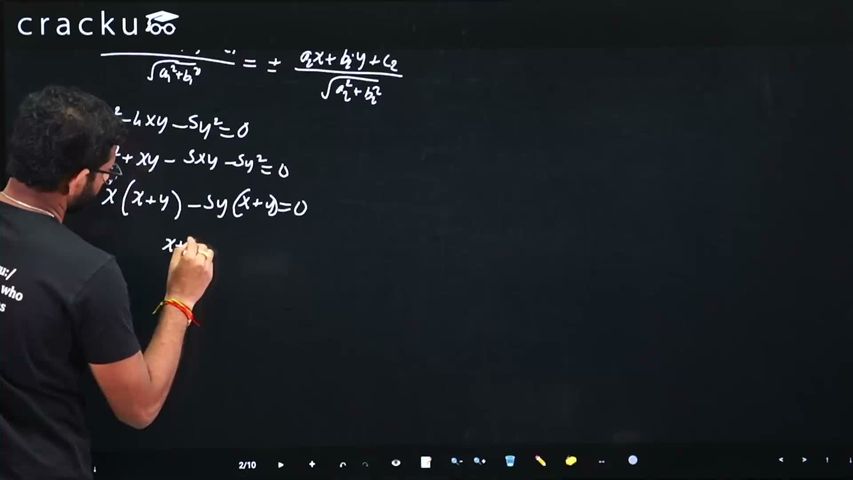
Click on the Email ☝️ to Watch the Video Solution
Create a FREE account and get:
_1.webp)

Educational materials for JEE preparation

Ask our AI anything

AI can make mistakes. Please verify important information.
AI can make mistakes. Please verify important information.
