
Join Our JEE Preparation Group
Prep with like-minded aspirants; Get access to free daily tests and study material.
Sign in
Please select an account to continue using cracku.in
↓ →
Join Our JEE Preparation Group
Prep with like-minded aspirants; Get access to free daily tests and study material.
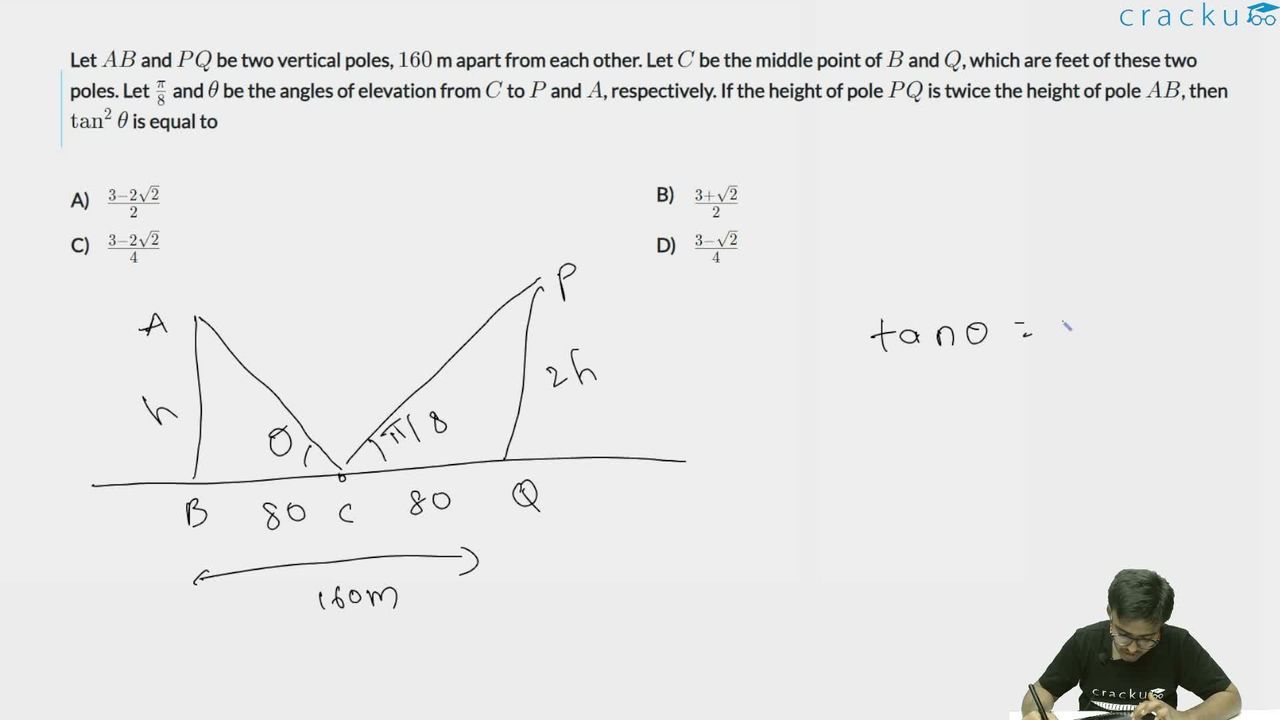
Let $$AB$$ and $$PQ$$ be two vertical poles, $$160$$ m apart from each other. Let $$C$$ be the middle point of $$B$$ and $$Q$$, which are feet of these two poles. Let $$\frac{\pi}{8}$$ and $$\theta$$ be the angles of elevation from $$C$$ to $$P$$ and $$A$$, respectively. If the height of pole $$PQ$$ is twice the height of pole $$AB$$, then $$\tan^2\theta$$ is equal to
Let $$AB$$ and $$PQ$$ be two vertical poles standing 160 m apart, with heights $$AB = h$$ and $$PQ = 2h$$. Point $$C$$ is the midpoint of the segment joining the feet $$B$$ and $$Q$$ of the poles, so that $$BC = CQ = 80$$ m.
Since the angle of elevation from $$C$$ to the top $$P$$ of the taller pole is $$\frac{\pi}{8}$$, and the vertical height of that pole is $$PQ = 2h$$ over a horizontal distance $$CQ = 80$$ m, we have
$$\tan\left(\frac{\pi}{8}\right) = \frac{PQ}{CQ} = \frac{2h}{80},$$
which gives
$$h = 40\tan\left(\frac{\pi}{8}\right)\quad\cdots(1)$$
To evaluate $$\tan\left(\frac{\pi}{8}\right)$$, set $$t = \tan\left(\frac{\pi}{8}\right)$$. Noting that $$\frac{\pi}{8} = \tfrac12\cdot\tfrac{\pi}{4}$$ and applying the double‐angle formula,
$$\tan\left(\frac{\pi}{4}\right) = \frac{2t}{1 - t^2} = 1,$$
so
$$1 - t^2 = 2t,\quad t^2 + 2t - 1 = 0.$$
By the quadratic formula one finds
$$t = \frac{-2 \pm \sqrt{4 + 4}}{2} = -1 \pm \sqrt{2},$$
and since $$t>0$$ in the first quadrant,
$$\tan\left(\frac{\pi}{8}\right) = \sqrt{2} - 1.$$
Substituting this into (1) yields
$$h = 40(\sqrt{2} - 1).$$
Now, let $$\theta$$ be the angle of elevation from $$C$$ to the top $$A$$ of the shorter pole. Since $$AB = h$$ and $$BC = 80$$ m,
$$\tan\theta = \frac{AB}{BC} = \frac{h}{80} = \frac{40(\sqrt{2} - 1)}{80} = \frac{\sqrt{2} - 1}{2}.$$
Therefore,
$$\tan^2\theta = \left(\frac{\sqrt{2} - 1}{2}\right)^2 = \frac{(\sqrt{2} - 1)^2}{4},$$
and since $$(\sqrt{2} - 1)^2 = 2 - 2\sqrt{2} + 1 = 3 - 2\sqrt{2},$$
we get
$$\tan^2\theta = \frac{3 - 2\sqrt{2}}{4}.$$
Hence the correct answer is Option C: $$\dfrac{3 - 2\sqrt{2}}{4}$$.
Was this solution helpful?
Click on the Email ☝️ to Watch the Video Solution
Create a FREE account and get:
_1.webp)

Educational materials for JEE preparation

Ask our AI anything

AI can make mistakes. Please verify important information.
AI can make mistakes. Please verify important information.
