
Join Our JEE Preparation Group
Prep with like-minded aspirants; Get access to free daily tests and study material.
Sign in
Please select an account to continue using cracku.in
↓ →
Join Our JEE Preparation Group
Prep with like-minded aspirants; Get access to free daily tests and study material.
Choose the incorrect statement about the two circles whose equations are given below:
$$x^2 + y^2 - 10x - 10y + 41 = 0$$ and $$x^2 + y^2 - 16x - 10y + 80 = 0$$
The two circles are $$x^2 + y^2 - 10x - 10y + 41 = 0$$ and $$x^2 + y^2 - 16x - 10y + 80 = 0$$.
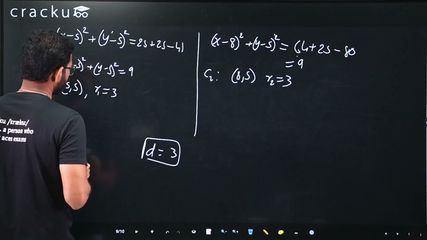
For the first circle, completing the square: $$(x-5)^2 + (y-5)^2 = 25 + 25 - 41 = 9$$. So centre $$C_1 = (5, 5)$$ and radius $$r_1 = 3$$.
For the second circle: $$(x-8)^2 + (y-5)^2 = 64 + 25 - 80 = 9$$. So centre $$C_2 = (8, 5)$$ and radius $$r_2 = 3$$.
The distance between centres is $$d = \sqrt{(8-5)^2 + (5-5)^2} = 3$$.
Now let us check each statement:
Option A: "Distance between centres is the average of radii." The average of $$r_1$$ and $$r_2$$ is $$\frac{3+3}{2} = 3 = d$$. This is TRUE.
Option B: "Both circles' centres lie inside the region of one another." For $$C_2 = (8,5)$$ to be inside circle 1, we need $$(8-5)^2 + (5-5)^2 = 9 < r_1^2 = 9$$. Since $$9$$ is not strictly less than $$9$$, $$C_2$$ lies ON circle 1, not inside it. Similarly $$C_1$$ lies ON circle 2. So this statement is INCORRECT.
Option C: "Both circles pass through the centre of each other." Substituting $$C_2 = (8,5)$$ into circle 1: $$(8-5)^2 + (5-5)^2 = 9 = r_1^2$$. Yes, $$C_2$$ lies on circle 1. Similarly $$(5-8)^2 + (5-5)^2 = 9 = r_2^2$$, so $$C_1$$ lies on circle 2. This is TRUE.
Option D: "Circles have two intersection points." Since $$|r_1 - r_2| < d < r_1 + r_2$$ becomes $$0 < 3 < 6$$, which is true, the circles intersect at two points. This is TRUE.
The incorrect statement is Option B, since the centres lie ON the other circle, not inside it.
Was this solution helpful?
Click on the Email ☝️ to Watch the Video Solution
Create a FREE account and get:
_1.webp)

Educational materials for JEE preparation

Ask our AI anything

AI can make mistakes. Please verify important information.
AI can make mistakes. Please verify important information.
