Join WhatsApp Icon JEE WhatsApp Group
Question 66

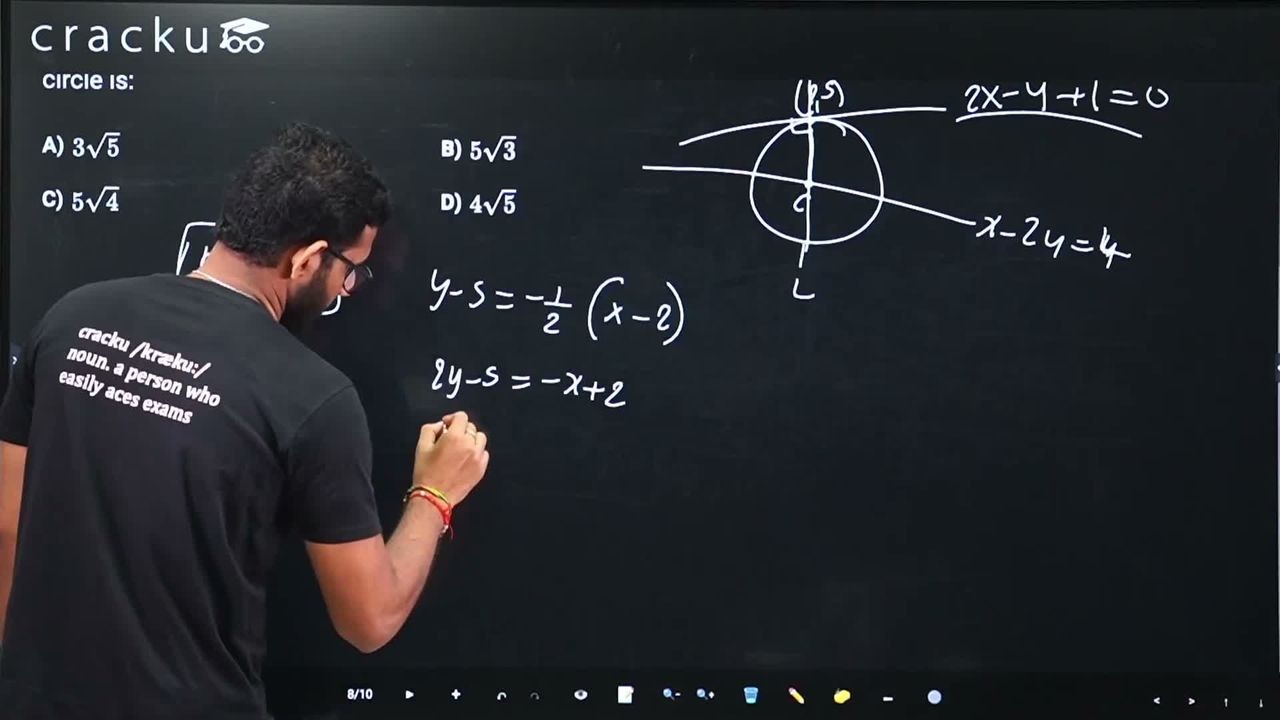
The line $$2x - y + 1 = 0$$ is a tangent to the circle at the point $$(2, 5)$$ and the centre of the circle lies on $$x - 2y = 4$$. Then, the radius of the circle is:

The tangent to the circle at point $$(2, 5)$$ is $$2x - y + 1 = 0$$. The centre of the circle lies on the line $$x - 2y = 4$$.

The radius at the point of tangency is perpendicular to the tangent line. The tangent $$2x - y + 1 = 0$$ has slope $$2$$, so the radius through $$(2, 5)$$ has slope $$-\frac{1}{2}$$.

The equation of the line through $$(2, 5)$$ with slope $$-\frac{1}{2}$$ is: $$y - 5 = -\frac{1}{2}(x - 2)$$, which simplifies to $$x + 2y = 12$$ $$-(1)$$.

The centre lies on both this line and $$x - 2y = 4$$ $$-(2)$$.

Adding $$(1)$$ and $$(2)$$: $$2x = 16$$, so $$x = 8$$. From $$(2)$$: $$8 - 2y = 4$$, so $$y = 2$$. The centre is $$(8, 2)$$.

The radius is the distance from the centre $$(8, 2)$$ to the point of tangency $$(2, 5)$$: $$r = \sqrt{(8-2)^2 + (2-5)^2} = \sqrt{36 + 9} = \sqrt{45} = 3\sqrt{5}$$.

This matches Option A: $$3\sqrt{5}$$.

Get AI Help

Video Solution

video

Create a FREE account and get:

  • Free JEE Mains Previous Papers PDF
  • Take JEE Mains paper tests

JEE Quant Questions | JEE Quantitative Ability

JEE DILR Questions | LRDI Questions For JEE

JEE Verbal Ability Questions | VARC Questions For JEE

Free JEE Topicwise Questions

JEE Rotational MotionJEE Units & MeasurementsJEE Atomic StructureJEE GravitationJEE Periodic Table & PeriodicityJEE StatisticsJEE Inverse Trigonometric FunctionsJEE Magnetism & Magnetic MaterialsJEE Sequences & SeriesJEE MatricesJEE Alternating CurrentsJEE Carboxylic AcidsJEE Permutations & CombinationsJEE Work, Energy & PowerJEE Electromagnetic InductionJEE Electronic DevicesJEE d and f-Block ElementsJEE Chemical KineticsJEE Heat TransferJEE Three Dimensional GeometryJEE Magnetic Effects of CurrentJEE Hydrocarbons - AromaticJEE Electromagnetic WavesJEE Aldehydes & KetonesJEE Hydrocarbons - AlkanesJEE Applications of DerivativesJEE EquilibriumJEE Indefinite IntegrationJEE Chemical ThermodynamicsJEE ElectrochemistryJEE ProbabilityJEE BiomoleculesJEE Continuity & DifferentiabilityJEE Kinetic Theory of GasesJEE Vector AlgebraJEE Hydrocarbons - AlkynesJEE Differential EquationsJEE Current & ResistanceJEE Straight LinesJEE WavesJEE Redox ReactionsJEE Hydrocarbons - AlkenesJEE DeterminantsJEE SolutionsJEE Ray OpticsJEE Dual Nature of Matter & RadiationJEE Chemical Bonding & Molecular StructureJEE Complex NumbersJEE Sets, Relations & FunctionsJEE Electric Charges & FieldsJEE Laws of MotionJEE Fluid MechanicsJEE Basic Concepts in ChemistryJEE Trigonometric FunctionsJEE LimitsJEE Laws of ThermodynamicsJEE Kinematics - 2D MotionJEE p-Block Elements (Groups 13-18)JEE Simple Harmonic MotionJEE Electric Potential & CapacitanceJEE Coordination CompoundsJEE JEE 2D GeometryJEE CirclesJEE Definite IntegrationJEE EMF & Circuit AnalysisJEE Surface TensionJEE Atoms & NucleiJEE Laboratory Experiments - XIJEE Number SystemJEE Basic Principles of Organic ChemistryJEE Wave OpticsJEE Quadratic EquationsJEE Alcohols, Phenols & EthersJEE Organic Compounds with HalogensJEE DifferentiationJEE Conic SectionsJEE Nitrogen-Containing CompoundsJEE ElasticityJEE Practical Organic ChemistryJEE Kinematics - 1D MotionJEE Purification & CharacterisationJEE Binomial Theorem
Ask AI