
Join Our JEE Preparation Group
Prep with like-minded aspirants; Get access to free daily tests and study material.
Sign in
Please select an account to continue using cracku.in
↓ →
Join Our JEE Preparation Group
Prep with like-minded aspirants; Get access to free daily tests and study material.
The locus of the centroid of the triangle formed by any point P on the hyperbola $$16x^2 - 9y^2 + 32x + 36y - 164 = 0$$ and its foci is
We start from the given hyperbola
$$16x^{2}-9y^{2}+32x+36y-164=0.$$
First we bring it to its standard form by completing the squares. We collect the $$x$$-terms together and the $$y$$-terms together:
$$16x^{2}+32x-\,9y^{2}+36y-164=0.$$
Taking $$16$$ common from the $$x$$-terms and $$-9$$ common from the $$y$$-terms, we get
$$16\bigl(x^{2}+2x\bigr)-9\bigl(y^{2}-4y\bigr)-164=0.$$
We now complete the square in each bracket.
For $$x^{2}+2x$$ we use $$x^{2}+2x=\bigl(x+1\bigr)^{2}-1.$$
For $$y^{2}-4y$$ we use $$y^{2}-4y=\bigl(y-2\bigr)^{2}-4.$$
Substituting these we have
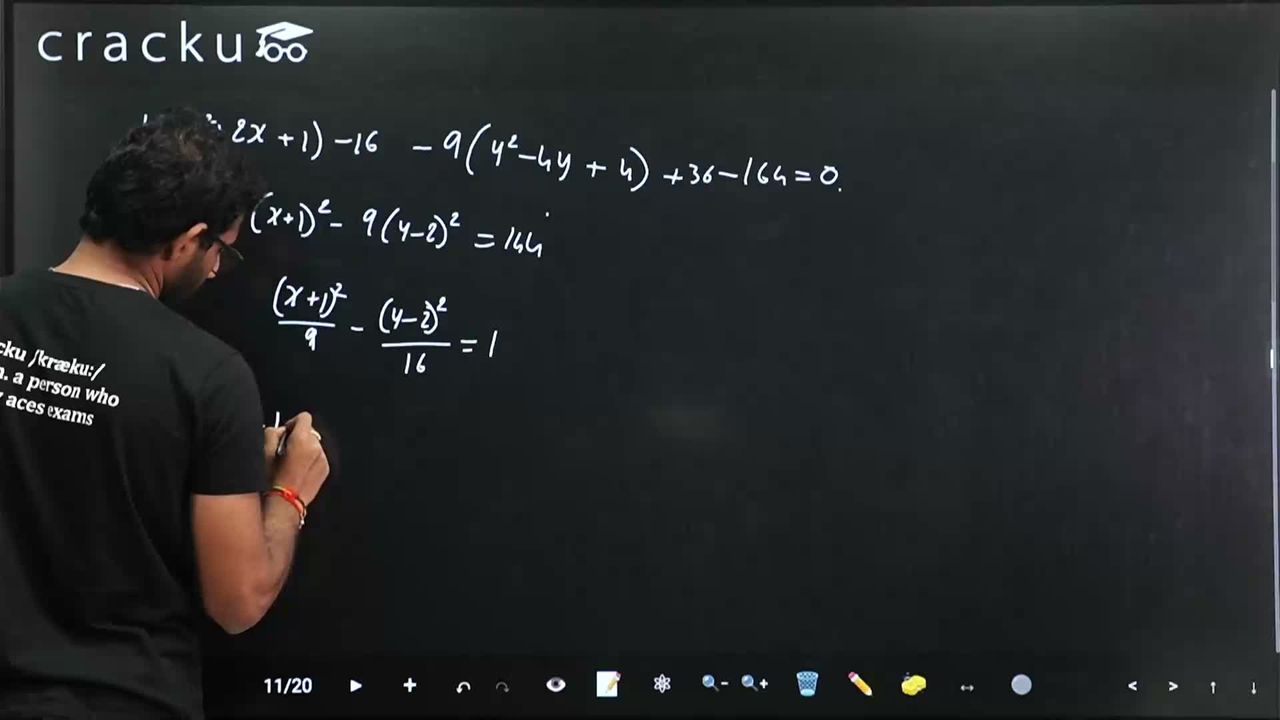
$$16\Bigl[\bigl(x+1\bigr)^{2}-1\Bigr] \;-\;9\Bigl[\bigl(y-2\bigr)^{2}-4\Bigr]\;-\;164=0.$$
Expanding the constants:
$$16\bigl(x+1\bigr)^{2}-16-9\bigl(y-2\bigr)^{2}+36-164=0.$$
The constant terms combine to $$-16+36-164=-144$$, hence
$$16\bigl(x+1\bigr)^{2}-9\bigl(y-2\bigr)^{2}-144=0.$$
We divide by $$144$$ so that the right-hand side becomes $$1$$:
$$\frac{(x+1)^{2}}{9}-\frac{(y-2)^{2}}{16}=1.$$
Thus the hyperbola is centered at $$C(-1,\,2)$$ with
$$a^{2}=9,\; a=3,\qquad b^{2}=16,\; b=4.$$
Because the $$x$$-term is positive, the transverse axis is along the $$x$$-direction. For a hyperbola of the form $$\dfrac{(x-h)^{2}}{a^{2}}-\dfrac{(y-k)^{2}}{b^{2}}=1$$ the distance of each focus from the centre is given by
$$c^{2}=a^{2}+b^{2}.$$
So here
$$c^{2}=9+16=25 \;\Longrightarrow\; c=5.$$
Hence the two foci are
$$F_{1}\bigl(-1-c,\,2\bigr)=(-6,\,2),\qquad F_{2}\bigl(-1+c,\,2\bigr)=(4,\,2).$$
Let $$P(x,\,y)$$ be any point on the hyperbola. The centroid $$G(h,\,k)$$ of the triangle with vertices $$P$$, $$F_{1}$$ and $$F_{2}$$ is obtained by the formula
$$h=\frac{x_{P}+x_{F_{1}}+x_{F_{2}}}{3}, \qquad k=\frac{y_{P}+y_{F_{1}}+y_{F_{2}}}{3}.$$
Substituting the coordinates, we obtain
$$h=\frac{x-6+4}{3}=\frac{x-2}{3},\qquad k=\frac{y+2+2}{3}=\frac{y+4}{3}.$$
This immediately gives $$x$$ and $$y$$ in terms of $$h$$ and $$k$$:
$$x=3h+2,\qquad y=3k-4.$$
Because $$P(x,y)$$ lies on the hyperbola, it must satisfy
$$\frac{(x+1)^{2}}{9}-\frac{(y-2)^{2}}{16}=1.$$
We now substitute $$x=3h+2$$ and $$y=3k-4$$ into this equation.
The $$x$$-part becomes
$$x+1=3h+2+1=3h+3=3(h+1).$$
Hence
$$\frac{(x+1)^{2}}{9}=\frac{\bigl(3(h+1)\bigr)^{2}}{9} =\frac{9(h+1)^{2}}{9}= (h+1)^{2}.$$
Similarly, the $$y$$-part is
$$y-2=3k-4-2=3k-6=3(k-2),$$
so that
$$\frac{(y-2)^{2}}{16}=\frac{\bigl(3(k-2)\bigr)^{2}}{16} =\frac{9(k-2)^{2}}{16}.$$
Putting these back into the hyperbola equation we get
$$(h+1)^{2}-\frac{9(k-2)^{2}}{16}=1.$$
To remove the denominator, we multiply by $$16$$:
$$16(h+1)^{2}-9(k-2)^{2}=16.$$
Next we expand each square. First,
$$16(h+1)^{2}=16(h^{2}+2h+1)=16h^{2}+32h+16,$$
and
$$9(k-2)^{2}=9(k^{2}-4k+4)=9k^{2}-36k+36.$$
Substituting these expansions, the equation becomes
$$\bigl(16h^{2}+32h+16\bigr)-\bigl(9k^{2}-36k+36\bigr)=16.$$
We now open the bracket with the minus sign:
$$16h^{2}+32h+16-9k^{2}+36k-36=16.$$
Finally, we bring the $$16$$ on the right over to the left so that the whole expression equals zero:
$$16h^{2}+32h-9k^{2}+36k-36=0.$$
The centroid coordinates are merely dummy variables, so we rename them $$(x,y)$$ to state the locus in the usual form:
$$16x^{2}-9y^{2}+32x+36y-36=0.$$
This equation matches Option A. Hence, the correct answer is Option A.
Was this solution helpful?
Click on the Email ☝️ to Watch the Video Solution
Create a FREE account and get:
_1.webp)

Educational materials for JEE preparation

Ask our AI anything

AI can make mistakes. Please verify important information.
AI can make mistakes. Please verify important information.
