
Join Our JEE Preparation Group
Prep with like-minded aspirants; Get access to free daily tests and study material.
Sign in
Please select an account to continue using cracku.in
↓ →
Join Our JEE Preparation Group
Prep with like-minded aspirants; Get access to free daily tests and study material.
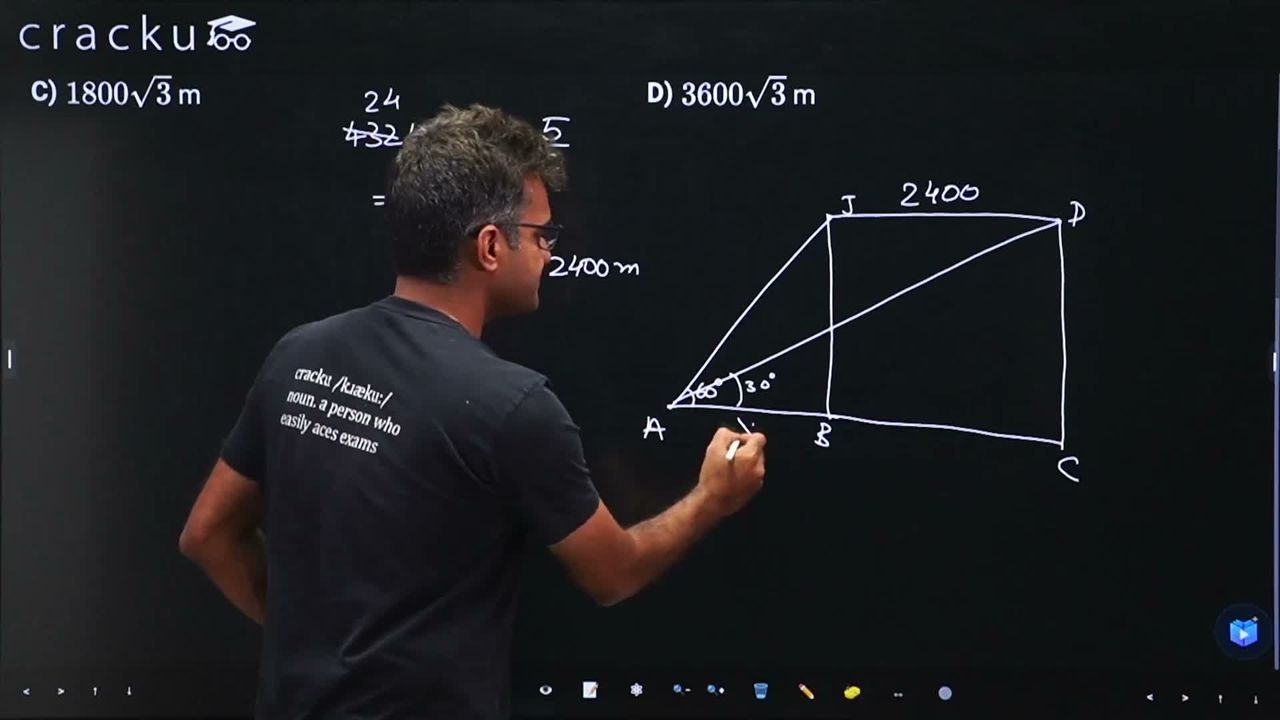
The angle of elevation of a jet plane from a point A on the ground is 60°. After a flight of 20 seconds at the speed of 432 km/hour, the angle of elevation changes to 30°. If the jet plane is flying at a constant height, then its height is:
Let the height of the jet plane be $$h$$ metres, and let $$A$$ be the point on the ground. Let $$B$$ and $$C$$ be the positions of the plane at the initial and final observations respectively, flying horizontally at constant height.
The speed of the jet is $$432 \text{ km/h} = 432 \times \frac{1000}{3600} = 120 \text{ m/s}$$. In 20 seconds, the horizontal distance covered is $$BC = 120 \times 20 = 2400 \text{ m}$$.
Let $$D$$ and $$E$$ be the points on the ground directly below $$B$$ and $$C$$ respectively. From the angle of elevation at point $$A$$, we have $$\tan 60° = \frac{h}{AD}$$, giving $$AD = \frac{h}{\sqrt{3}}$$. Similarly, $$\tan 30° = \frac{h}{AE}$$, giving $$AE = h\sqrt{3}$$.
Since the plane flies away from $$A$$ (the angle of elevation decreases from $$60°$$ to $$30°$$), we have $$AE - AD = DE = BC = 2400$$. Therefore, $$h\sqrt{3} - \frac{h}{\sqrt{3}} = 2400$$.
Simplifying the left side, $$h \cdot \frac{3 - 1}{\sqrt{3}} = \frac{2h}{\sqrt{3}} = 2400$$, which gives $$h = \frac{2400\sqrt{3}}{2} = 1200\sqrt{3}$$ m.
Therefore, the height of the jet plane is $$1200\sqrt{3}$$ m.
Was this solution helpful?
Click on the Email ☝️ to Watch the Video Solution
Create a FREE account and get:
_1.webp)

Educational materials for JEE preparation

Ask our AI anything

AI can make mistakes. Please verify important information.
AI can make mistakes. Please verify important information.


