
Join Our JEE Preparation Group
Prep with like-minded aspirants; Get access to free daily tests and study material.
Sign in
Please select an account to continue using cracku.in
↓ →
Join Our JEE Preparation Group
Prep with like-minded aspirants; Get access to free daily tests and study material.
If the sum $$\frac{3}{1^2} + \frac{5}{1^2+2^2} + \frac{7}{1^2+2^2+3^2} + \ldots$$ + up to 20 terms is equal to $$\frac{k}{21}$$, then $$k$$ is equal to:
The given series is: $$\frac{3}{1^2} + \frac{5}{1^2+2^2} + \frac{7}{1^2+2^2+3^2} + \ldots$$ up to 20 terms, and it equals $$\frac{k}{21}$$. We need to find the value of $$k$$.
First, we identify the general term of the series. The numerators are 3, 5, 7, ..., which form an arithmetic sequence. The $$n$$th term of this sequence is $$2n + 1$$, since for $$n = 1$$, $$2(1) + 1 = 3$$; for $$n = 2$$, $$2(2) + 1 = 5$$, and so on.
The denominators are the sums of squares of the first $$n$$ natural numbers. The sum of squares of the first $$n$$ natural numbers is given by $$\frac{n(n+1)(2n+1)}{6}$$. So, for the $$n$$th term, the denominator is $$\frac{n(n+1)(2n+1)}{6}$$.
Therefore, the $$n$$th term of the series is:
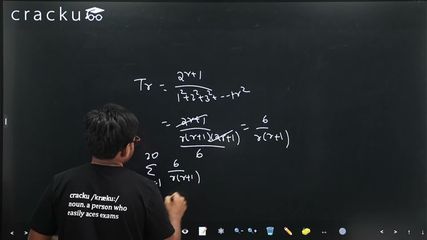
$$t_n = \frac{2n+1}{\frac{n(n+1)(2n+1)}{6}}$$
Simplifying this expression:
$$t_n = (2n+1) \times \frac{6}{n(n+1)(2n+1)}$$
Since $$2n+1 \neq 0$$ for any natural number $$n$$, it cancels out:
$$t_n = \frac{6}{n(n+1)}$$
We can decompose this fraction using partial fractions:
$$\frac{6}{n(n+1)} = 6 \left( \frac{1}{n} - \frac{1}{n+1} \right)$$
Thus, the $$n$$th term is:
$$t_n = 6 \left( \frac{1}{n} - \frac{1}{n+1} \right)$$
The sum $$S$$ of the first 20 terms is:
$$S = \sum_{n=1}^{20} t_n = \sum_{n=1}^{20} 6 \left( \frac{1}{n} - \frac{1}{n+1} \right)$$
This is a telescoping series, where most terms cancel each other. Writing out the sum explicitly:
$$S = 6 \left[ \left( \frac{1}{1} - \frac{1}{2} \right) + \left( \frac{1}{2} - \frac{1}{3} \right) + \left( \frac{1}{3} - \frac{1}{4} \right) + \ldots + \left( \frac{1}{20} - \frac{1}{21} \right) \right]$$
Observing the terms, $$-\frac{1}{2}$$ cancels with $$+\frac{1}{2}$$, $$-\frac{1}{3}$$ cancels with $$+\frac{1}{3}$$, and so on, up to $$-\frac{1}{20}$$ canceling with $$+\frac{1}{20}$$. The only terms that remain are the first positive term $$\frac{1}{1}$$ and the last negative term $$-\frac{1}{21}$$:
$$S = 6 \left( 1 - \frac{1}{21} \right)$$
Simplifying inside the parentheses:
$$1 - \frac{1}{21} = \frac{21}{21} - \frac{1}{21} = \frac{20}{21}$$
So,
$$S = 6 \times \frac{20}{21} = \frac{120}{21}$$
The problem states that this sum equals $$\frac{k}{21}$$. Therefore:
$$\frac{120}{21} = \frac{k}{21}$$
Since the denominators are equal, we equate the numerators:
$$k = 120$$
Hence, the correct answer is Option B.
Was this solution helpful?
Click on the Email ☝️ to Watch the Video Solution
Create a FREE account and get:
_1.webp)

Educational materials for JEE preparation

Ask our AI anything

AI can make mistakes. Please verify important information.
AI can make mistakes. Please verify important information.


