
Join Our JEE Preparation Group
Prep with like-minded aspirants; Get access to free daily tests and study material.
Sign in
Please select an account to continue using cracku.in
↓ →
Join Our JEE Preparation Group
Prep with like-minded aspirants; Get access to free daily tests and study material.
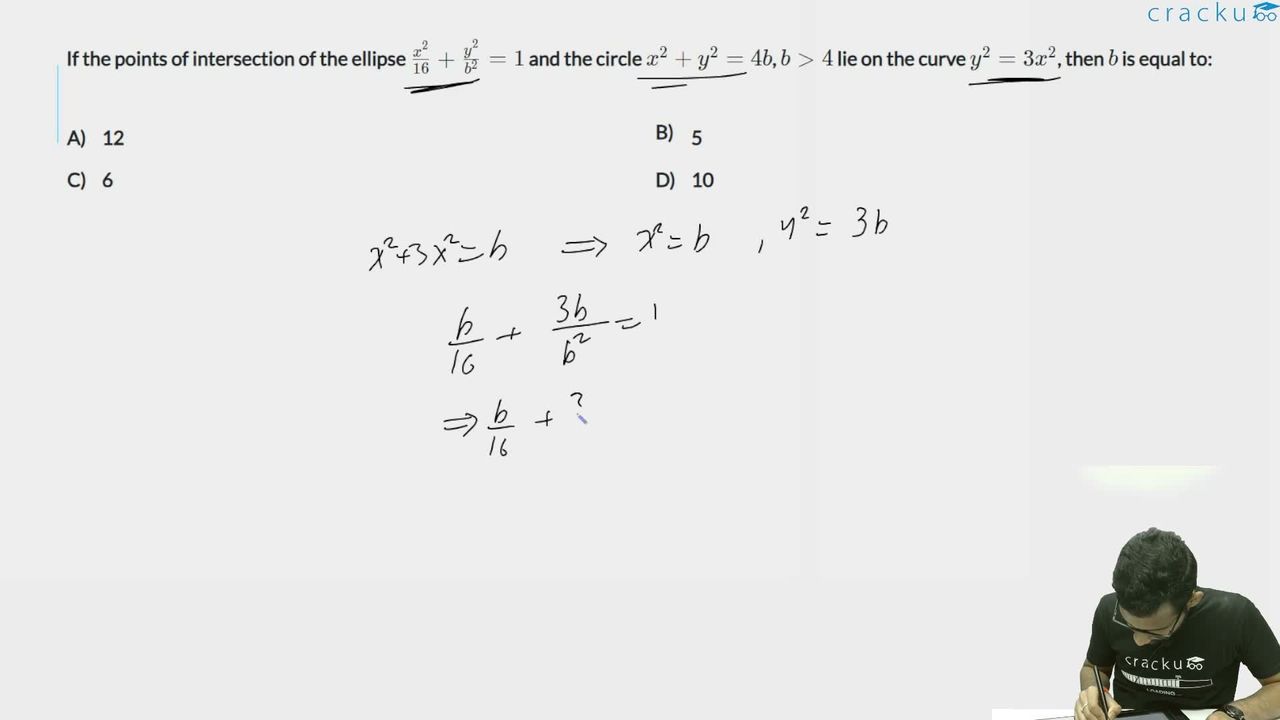
If the points of intersection of the ellipse $$\frac{x^2}{16} + \frac{y^2}{b^2} = 1$$ and the circle $$x^2 + y^2 = 4b$$, $$b > 4$$ lie on the curve $$y^2 = 3x^2$$, then $$b$$ is equal to:
The ellipse is $$\frac{x^2}{16} + \frac{y^2}{b^2} = 1$$, the circle is $$x^2 + y^2 = 4b$$ with $$b > 4$$, and the intersection points lie on $$y^2 = 3x^2$$.
Substituting $$y^2 = 3x^2$$ into the circle equation: $$x^2 + 3x^2 = 4b$$, so $$x^2 = b$$.
Substituting $$x^2 = b$$ and $$y^2 = 3b$$ into the ellipse equation: $$\frac{b}{16} + \frac{3b}{b^2} = 1$$, which gives $$\frac{b}{16} + \frac{3}{b} = 1$$.
Multiplying through by $$16b$$: $$b^2 + 48 = 16b$$, so $$b^2 - 16b + 48 = 0$$.
Using the quadratic formula: $$b = \frac{16 \pm \sqrt{256 - 192}}{2} = \frac{16 \pm 8}{2}$$, giving $$b = 12$$ or $$b = 4$$. Since $$b > 4$$, we have $$b = 12$$.
Click on the Email ☝️ to Watch the Video Solution
Create a FREE account and get:
_1.webp)

Educational materials for JEE preparation

Ask our AI anything

AI can make mistakes. Please verify important information.
AI can make mistakes. Please verify important information.


