
Join Our JEE Preparation Group
Prep with like-minded aspirants; Get access to free daily tests and study material.
Sign in
Please select an account to continue using cracku.in
↓ →
Join Our JEE Preparation Group
Prep with like-minded aspirants; Get access to free daily tests and study material.
Three positive numbers form an increasing G.P. If the middle term in this G.P. is doubled, the new numbers are in A.P. Then the common ratio of the G.P. is:
Let the three positive numbers in increasing geometric progression be denoted by $$\dfrac{a}{r},\;a,\;ar$$ where $$a>0$$ is the geometric mean and $$r>1$$ is the common ratio (because the progression is increasing).
The problem states that the middle term is doubled. Therefore the new three numbers become
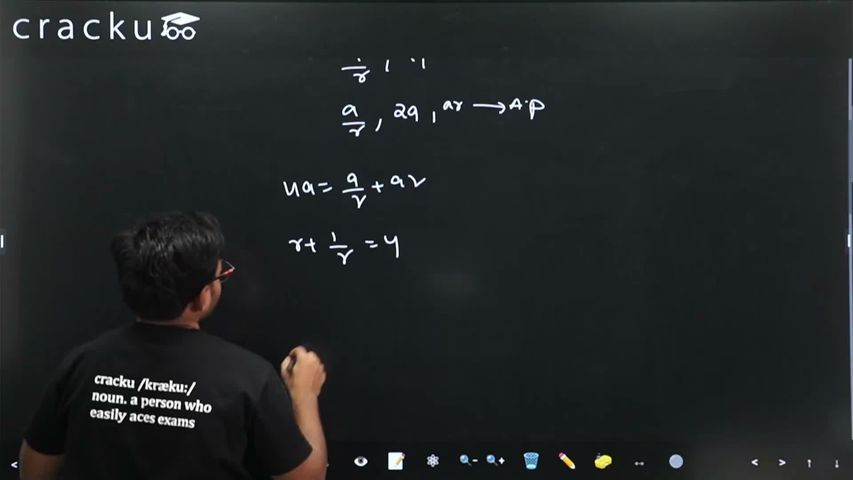
$$\dfrac{a}{r},\;2a,\;ar.$$
These new numbers are said to form an arithmetic progression. For any three numbers $$x,\;y,\;z$$ to be in A.P., the defining condition is
$$2y = x + z.$$
Applying this condition to our sequence $$\dfrac{a}{r},\;2a,\;ar$$ gives
$$2 \times 2a \;=\; \dfrac{a}{r} \;+\; ar.$$
Simplify step by step:
$$4a \;=\; \dfrac{a}{r} + ar.$$
Now divide every term by $$a$$ (recall $$a>0$$):
$$4 \;=\; \dfrac{1}{r} + r.$$
Bring all terms to one side so that zero appears on the other side:
$$4 - r - \dfrac{1}{r} = 0.$$
To clear the fraction, multiply the entire equation by $$r$$:
$$4r - r^2 - 1 = 0.$$
Rewrite in the standard quadratic form $$r^2 - 4r + 1 = 0$$ by multiplying through by $$-1$$:
$$r^2 - 4r + 1 = 0.$$
We now solve this quadratic using the quadratic formula. For an equation $$ur^2 + vr + w = 0,$$ the roots are $$r = \dfrac{-v \pm \sqrt{v^{2} - 4uw}}{2u}.$$
Here $$u = 1,\; v = -4,\; w = 1.$$ Substituting, we obtain
$$r = \dfrac{-(-4) \pm \sqrt{(-4)^2 - 4 \times 1 \times 1}}{2 \times 1} \;=\; \dfrac{4 \pm \sqrt{16 - 4}}{2} \;=\; \dfrac{4 \pm \sqrt{12}}{2}.$$
Simplify $$\sqrt{12} = 2\sqrt{3}$$ and divide numerator and denominator by $$2$$:
$$r = 2 \pm \sqrt{3}.$$
We must choose the value of $$r$$ that preserves the fact that the original G.P. is increasing, i.e.\ $$r > 1.$$
Compute each possibility:
$$2 + \sqrt{3} > 1 \quad\text{(true)},$$
$$2 - \sqrt{3} \approx 2 - 1.732 = 0.268 < 1 \quad\text{(false for an increasing sequence)}.$$
Therefore, the only admissible common ratio is
$$r = 2 + \sqrt{3}.$$
Hence, the correct answer is Option B.
Was this solution helpful?
Click on the Email ☝️ to Watch the Video Solution
Create a FREE account and get:
_1.webp)

Educational materials for JEE preparation

Ask our AI anything

AI can make mistakes. Please verify important information.
AI can make mistakes. Please verify important information.


