
Join Our JEE Preparation Group
Prep with like-minded aspirants; Get access to free daily tests and study material.
Sign in
Please select an account to continue using cracku.in
↓ →
Join Our JEE Preparation Group
Prep with like-minded aspirants; Get access to free daily tests and study material.
If $$x = 1$$ is a critical point of the function $$f(x) = (3x^2 + ax - 2 - a)e^x$$, then:
We are given the function $$f(x)=\bigl(3x^{2}+ax-2-a\bigr)\,e^{x}$$ and we are told that $$x=1$$ is a critical point.
For a point to be critical we must have $$f'(1)=0$$. We therefore begin by differentiating $$f$$.
First recall the product rule: if $$u(x)$$ and $$v(x)$$ are functions of $$x$$, then $$(u\,v)'=u'\,v+u\,v'$$.
Let us set $$u(x)=3x^{2}+ax-2-a$$ and $$v(x)=e^{x}$$. Their derivatives are $$u'(x)=6x+a$$ and $$v'(x)=e^{x}$$. Applying the product rule we get
$$\begin{aligned} f'(x) &= u'(x)\,v(x)+u(x)\,v'(x) \\ &= \bigl(6x+a\bigr)e^{x}+\bigl(3x^{2}+ax-2-a\bigr)e^{x}. \end{aligned}$$
Both terms contain the common factor $$e^{x}$$, so we factor it out:
$$f'(x)=\bigl[\,6x+a+3x^{2}+ax-2-a\,\bigr]\,e^{x}.$$
Simplifying the bracket, we collect like terms:
$$6x+a+3x^{2}+ax-2-a = 3x^{2}+(6x+ax)+\bigl(a-a\bigr)-2 = 3x^{2}+x(6+a)-2.$$
Thus
$$f'(x)=\bigl(3x^{2}+(6+a)x-2\bigr)\,e^{x}.$$
Because $$e^{x}>0$$ for all real $$x$$, the equation $$f'(1)=0$$ is equivalent to setting the polynomial factor to zero at $$x=1$$:
$$3(1)^{2}+(6+a)(1)-2=0.$$
This simplifies to
$$3+6+a-2=0 \quad\Longrightarrow\quad 7+a=0 \quad\Longrightarrow\quad a=-7.$$
So the parameter is fixed as $$a=-7$$. Substituting this value back into $$f(x)$$, we get
$$f(x)=\bigl(3x^{2}-7x-2-(-7)\bigr)e^{x}=\bigl(3x^{2}-7x+5\bigr)e^{x}.$$
To find all critical points we again consider $$f'(x)$$, now with $$a=-7$$. The derivative remains
$$f'(x)=\bigl(3x^{2}-x-2\bigr)\,e^{x}.$$
Setting the bracket to zero, we solve the quadratic
$$3x^{2}-x-2=0.$$
The discriminant is $$\Delta=(-1)^{2}-4(3)(-2)=1+24=25,$$ so
$$x=\frac{1\pm\sqrt{25}}{2\cdot3}=\frac{1\pm5}{6}.$$
This yields the two critical points
$$x_{1}=1, \qquad x_{2}=-\dfrac{2}{3}.$$
Next we determine the nature (maxima or minima) of each point using the second-derivative test.
We have already written $$f'(x)=h(x)\,e^{x}$$ with $$h(x)=3x^{2}-x-2.$$ Differentiating once more, we remember that $$(h\,e^{x})'=(h'+h)\,e^{x}.$$ Therefore
$$f''(x)=\bigl(h'(x)+h(x)\bigr)\,e^{x}.$$
Compute $$h'(x)=6x-1,$$ so
$$h'(x)+h(x)=(6x-1)+(3x^{2}-x-2)=3x^{2}+5x-3.$$
Because $$e^{x}>0,$$ the sign of $$f''(x)$$ is exactly the sign of the quadratic $$3x^{2}+5x-3.$$
Evaluate it at each critical point:
For $$x=1$$:
$$3(1)^{2}+5(1)-3 = 3+5-3 = 5 > 0,$$
so $$f''(1)>0,$$ indicating a local minimum at $$x=1.$$
For $$x=-\dfrac{2}{3}$$:
$$3\left(\!-\dfrac{2}{3}\!\right)^{2}+5\left(\!-\dfrac{2}{3}\!\right)-3 =3\left(\dfrac{4}{9}\right)-\dfrac{10}{3}-3 =\dfrac{4}{3}-\dfrac{10}{3}-3 =-\dfrac{6}{3}-3 =-2-3=-5<0,$$
so $$f''\!\left(-\dfrac{2}{3}\right)<0,$$ indicating a local maximum at $$x=-\dfrac{2}{3}.$$
Therefore, $$x=1$$ is a point of local minima, while $$x=-\dfrac{2}{3}$$ is a point of local maxima.
Comparing with the options, this corresponds exactly to Option D.
Hence, the correct answer is Option D.
Was this solution helpful?
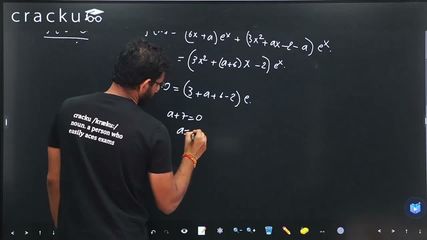
Click on the Email ☝️ to Watch the Video Solution
Create a FREE account and get:
_1.webp)

Educational materials for JEE preparation

Ask our AI anything

AI can make mistakes. Please verify important information.
AI can make mistakes. Please verify important information.
