
Join Our JEE Preparation Group
Prep with like-minded aspirants; Get access to free daily tests and study material.
Sign in
Please select an account to continue using cracku.in
↓ →
Join Our JEE Preparation Group
Prep with like-minded aspirants; Get access to free daily tests and study material.
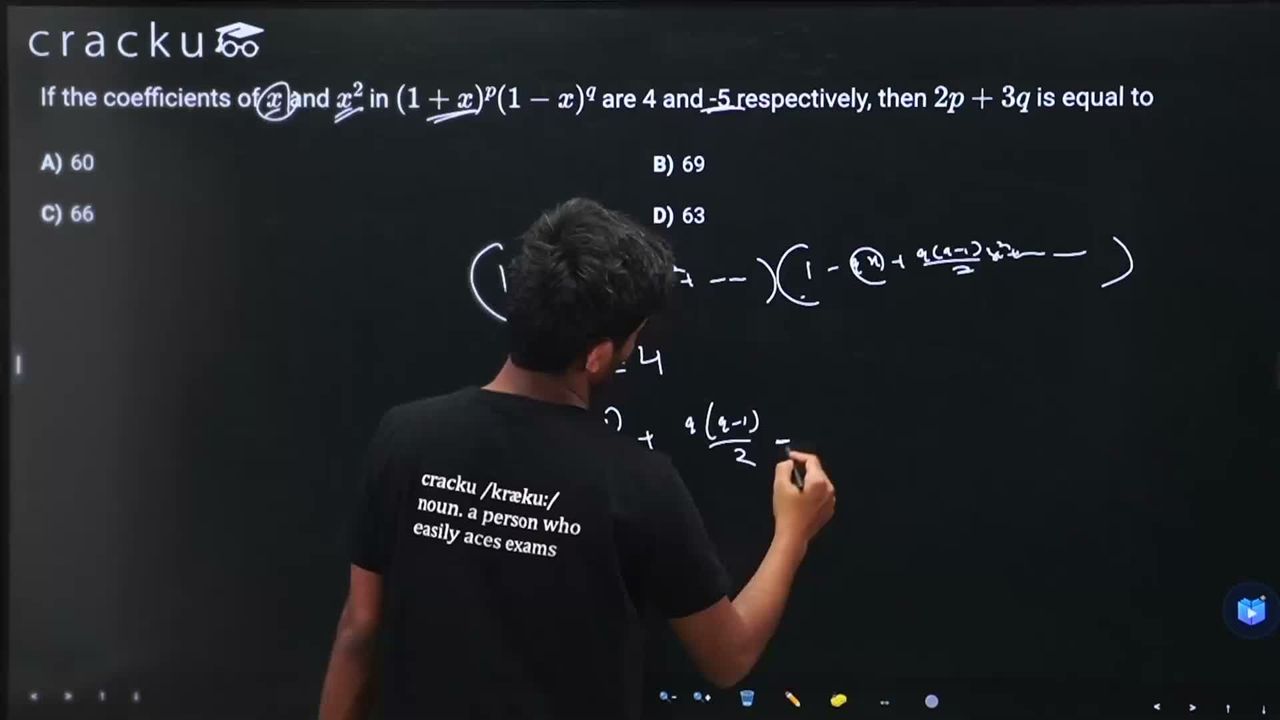
If the coefficients of $$x$$ and $$x^2$$ in $$(1 + x)^p(1 - x)^q$$ are 4 and -5 respectively, then $$2p + 3q$$ is equal to
To determine 2p + 3q, consider the expansion of (1+x)p (1−x)q up to the x² term, given that the coefficient of x is 4 and that of x² is −5.
Using the binomial theorem gives $$(1+x)^p = 1 + px + \frac{p(p-1)}{2}x^2 + \cdots$$ $$(1-x)^q = 1 - qx + \frac{q(q-1)}{2}x^2 + \cdots$$ Multiplying these series and collecting terms up to x² leads to an x-coefficient of $$p \cdot 1 + 1 \cdot (-q) = p - q,$$ so $$p - q = 4.$$
The coefficient of x² arises from three contributions: $$\frac{p(p-1)}{2} \cdot 1 + p \cdot (-q) + 1 \cdot \frac{q(q-1)}{2} = \frac{p(p-1)}{2} - pq + \frac{q(q-1)}{2} = \frac{p^2 - p + q^2 - q - 2pq}{2} = \frac{(p-q)^2 - (p+q)}{2},$$ and this must equal −5: $$\frac{(p-q)^2 - (p+q)}{2} = -5.$$
Since p − q = 4 implies (p − q)² = 16, substitution gives $$\frac{16 - (p+q)}{2} = -5 \quad\Longrightarrow\quad 16 - (p+q) = -10 \quad\Longrightarrow\quad p + q = 26.$$
Solving the system $$p - q = 4$$ $$p + q = 26$$ by addition gives 2p = 30, hence p = 15, and by subtraction gives 2q = 22, hence q = 11. Substituting these into 2p + 3q yields $$2p + 3q = 2(15) + 3(11) = 30 + 33 = 63.$$
The correct answer is Option 4: 63.
Was this solution helpful?
Click on the Email ☝️ to Watch the Video Solution
Create a FREE account and get:
_1.webp)

Educational materials for JEE preparation

Ask our AI anything

AI can make mistakes. Please verify important information.
AI can make mistakes. Please verify important information.


