
Join Our JEE Preparation Group
Prep with like-minded aspirants; Get access to free daily tests and study material.
Sign in
Please select an account to continue using cracku.in
↓ →
Join Our JEE Preparation Group
Prep with like-minded aspirants; Get access to free daily tests and study material.
'W' g of a non-volatile electrolyte solid solute of molar mass 'M' g $$mol^{-1}$$ when dissolved in 100 mL water, decreases vapour pressure of water from 640 mm Hg to 600 mm Hg. If aqueous solution of the electrolyte boils at 375 K and $$K_{b}$$ for water is 0.52 K kg $$mol^{-1}$$, then the mole fraction of the electrolyte solute ($$x_{2}$$) in the solution can be expressed as
(Given : density of water= 1 g/mL and boiling point of water= 3 73 K)
We need to find the mole fraction of the electrolyte solute in terms of W and M.
Mass of solute = W g, Molar mass = M g/mol. Volume of water = 100 mL → mass of water = 100 g. Vapour pressure drops from 640 to 600 mm Hg. Solution boils at 375 K, $$K_b = 0.52$$ K kg/mol. Boiling point of water = 373 K.
According to Raoult's law for vapour pressure lowering, $$\frac{P_0 - P}{P_0} = x_2 \cdot i$$ where $$i$$ is the van't Hoff factor. Substituting the given pressures, $$\frac{640 - 600}{640} = i \cdot x_2$$ which gives $$i \cdot x_2 = \frac{40}{640} = \frac{1}{16}$$.
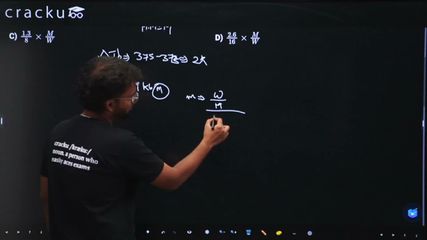
The boiling point elevation is given by $$\Delta T_b = i \cdot K_b \cdot m$$ where $$\Delta T_b = 375 - 373 = 2$$ K and molality $$m = \frac{W/M}{100/1000} = \frac{10W}{M}$$. Substituting, $$2 = i \times 0.52 \times \frac{10W}{M}$$ which leads to $$i = \frac{2M}{5.2W} = \frac{M}{2.6W}$$.
From the expression for vapour pressure lowering, $$x_2 = \frac{1}{16i}$$. Substituting the value of $$i$$ yields $$x_2 = \frac{1}{16} \times \frac{2.6W}{M} = \frac{2.6W}{16M} = \frac{1.3W}{8M} = \frac{1.3}{8} \times \frac{W}{M}$$.
Therefore, the mole fraction of the solute is $$\frac{1.3}{8} \times \frac{W}{M}$$.
Was this solution helpful?
Click on the Email ☝️ to Watch the Video Solution
Create a FREE account and get:
_1.webp)

Educational materials for JEE preparation

Ask our AI anything

AI can make mistakes. Please verify important information.
AI can make mistakes. Please verify important information.
