
Join Our JEE Preparation Group
Prep with like-minded aspirants; Get access to free daily tests and study material.
Sign in
Please select an account to continue using cracku.in
↓ →
Join Our JEE Preparation Group
Prep with like-minded aspirants; Get access to free daily tests and study material.
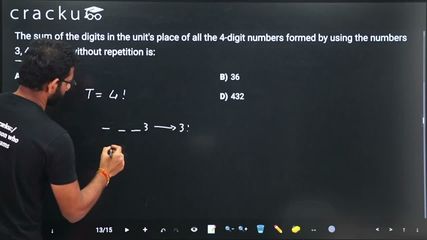
The sum of the digits in the unit's place of all the 4-digit numbers formed by using the numbers 3, 4, 5 and 6, without repetition is:
We need to find the sum of the digits in the unit's place of all 4-digit numbers formed using the digits 3, 4, 5, and 6 without repetition. Since no digit repeats, each number uses all four digits exactly once.
First, the total number of such 4-digit numbers is the number of permutations of 4 distinct digits, which is 4! = 24. So, there are 24 numbers in total.
Now, we want the sum of the digits in the unit's place. For this sum, we need to determine how many times each digit (3, 4, 5, 6) appears in the unit's place across all 24 numbers.
Consider a fixed digit, say 3, in the unit's place. If the unit digit is fixed as 3, then the remaining three digits (4, 5, 6) can be arranged in the thousands, hundreds, and tens places. The number of ways to arrange these three digits is 3! = 6. Therefore, the digit 3 appears in the unit's place in 6 numbers.
Similarly, by symmetry, each digit (3, 4, 5, 6) will appear in the unit's place exactly 6 times.
Now, we calculate the contribution of each digit to the sum:
Adding these contributions together: 18 + 24 = 42, then 42 + 30 = 72, and finally 72 + 36 = 108.
Therefore, the sum of the digits in the unit's place is 108.
Hence, the correct answer is Option C.
Was this solution helpful?
Click on the Email ☝️ to Watch the Video Solution
Create a FREE account and get:
_1.webp)

Educational materials for JEE preparation

Ask our AI anything

AI can make mistakes. Please verify important information.
AI can make mistakes. Please verify important information.


