
Join Our JEE Preparation Group
Prep with like-minded aspirants; Get access to free daily tests and study material.
Sign in
Please select an account to continue using cracku.in
↓ →
Join Our JEE Preparation Group
Prep with like-minded aspirants; Get access to free daily tests and study material.
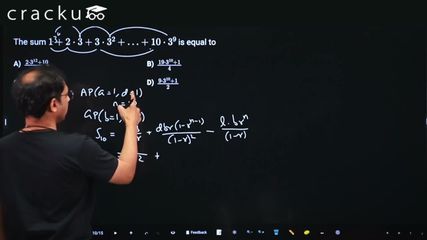
We write the given series in sigma notation as $$S = \sum_{k=1}^{10} k \cdot 3^{k-1}$$. Since it is an arithmetic-geometric progression, multiplying both sides by the common ratio 3 gives $$3S = 1\cdot 3 + 2\cdot 3^2 + 3\cdot 3^3 + \ldots + 10\cdot 3^{10}\,.$$
Subtracting this from the original series eliminates the arithmetic factor: $$S - 3S = (1 + 2\cdot 3 + 3\cdot 3^2 + \ldots + 10\cdot 3^9) - (1\cdot 3 + 2\cdot 3^2 + \ldots + 10\cdot 3^{10})\,.$$ Grouping like powers of 3 yields $$-2S = 1 + (2-1)\cdot3 + (3-2)\cdot3^2 + \ldots + (10-9)\cdot3^9 - 10\cdot3^{10} = 1 + 3 + 3^2 + \ldots + 3^9 - 10\cdot 3^{10}\,.$$
The finite geometric series $$1 + 3 + 3^2 + \ldots + 3^9$$ sums to $$\frac{3^{10}-1}{3-1} = \frac{3^{10}-1}{2}\,. $$ Substituting this back gives $$-2S = \frac{3^{10}-1}{2} - 10\cdot3^{10} = \frac{3^{10}-1 - 20\cdot3^{10}}{2} = \frac{-19\cdot3^{10} - 1}{2}\,.$$
Finally, solving for $$S$$ yields $$S = \frac{19\cdot3^{10} + 1}{4}\,. $$ Therefore, the sum equals $$\dfrac{19 \cdot 3^{10} + 1}{4}$$, which is Option B.
Was this solution helpful?
Click on the Email ☝️ to Watch the Video Solution
Create a FREE account and get:
_1.webp)

Educational materials for JEE preparation

Ask our AI anything

AI can make mistakes. Please verify important information.
AI can make mistakes. Please verify important information.


