
Join Our JEE Preparation Group
Prep with like-minded aspirants; Get access to free daily tests and study material.
Sign in
Please select an account to continue using cracku.in
↓ →
Join Our JEE Preparation Group
Prep with like-minded aspirants; Get access to free daily tests and study material.
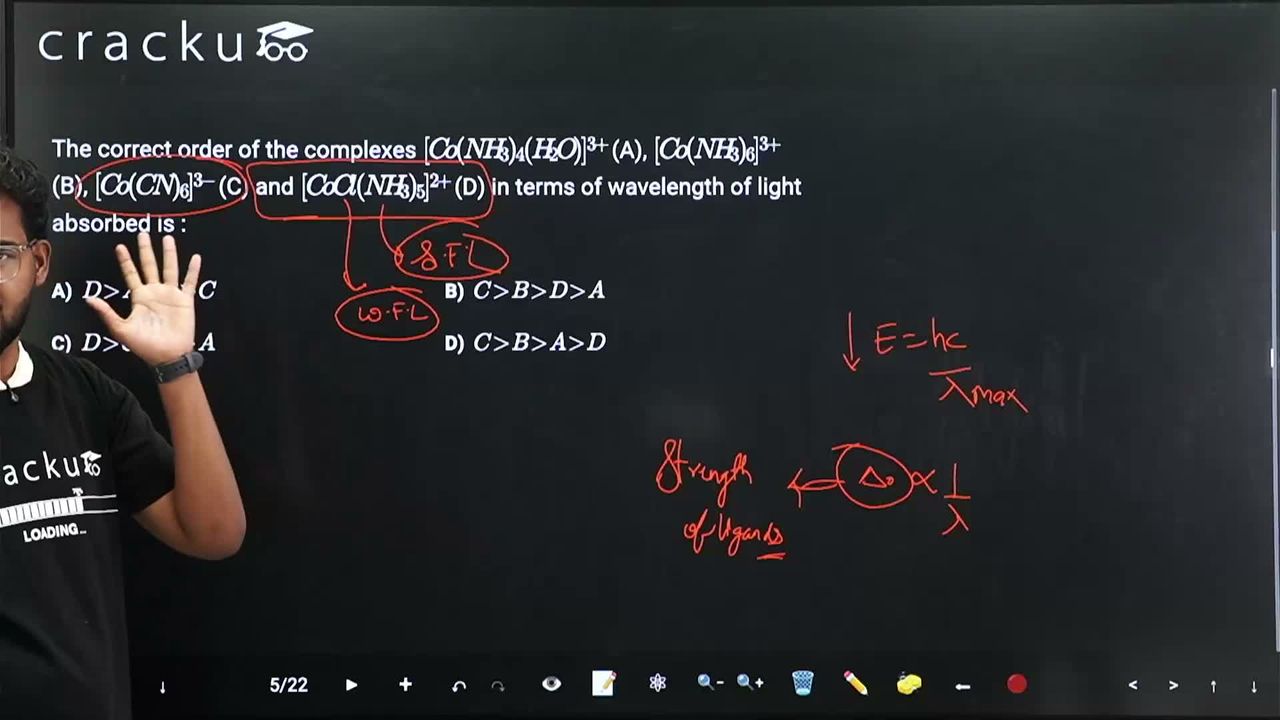
The correct order of the complexes $$[Co(NH_3)_4(H_2O)]^{3+}$$ (A), $$[Co(NH_3)_6]^{3+}$$ (B), $$[Co(CN)_6]^{3-}$$ (C) and $$[CoCl(NH_3)_5]^{2+}$$ (D) in terms of wavelength of light absorbed is :
The colour shown by a coordination compound depends on the energy gap $$\Delta_{0}$$ between its $$t_{2g}$$ and $$e_{g}$$ levels.
When white light strikes the complex, a photon of energy exactly equal to $$\Delta_{0}$$ is absorbed and the complementary colour is observed.
Energy of a photon $$E$$ and the wavelength absorbed $$\lambda_{\text{abs}}$$ are related by the Planck relation
$$E = h\nu = \frac{hc}{\lambda_{\text{abs}}}$$.
Therefore, a larger crystal-field splitting $$\Delta_{0}$$ means a larger photon energy and hence a smaller wavelength absorbed, and vice-versa:
$$\boxed{\Delta_{0} \propto \dfrac{1}{\lambda_{\text{abs}}}}$$.
The magnitude of $$\Delta_{0}$$ depends mainly on the nature of the ligands present. The spectrochemical series (from weak field to strong field) is
$$Cl^- \lt H_2O \lt NH_3 \lt \dots \lt CN^-$$.
Now compare the four cobalt(III) complexes (all are low-spin $$d^6$$ species so the metal ion contribution to $$\Delta_{0}$$ is the same):
Case A:
$$[Co(NH_3)_4(H_2O)]^{3+}$$ contains four $$NH_3$$ and one $$H_2O$$.
Average ligand strength is slightly weaker than that in the all-ammine complex.
Case B:
$$[Co(NH_3)_6]^{3+}$$ contains six $$NH_3$$ ligands - stronger than $$H_2O$$ but weaker than $$CN^-$$.
Case C:
$$[Co(CN)_6]^{3-}$$ contains six $$CN^-$$ ligands - the strongest field; hence the largest $$\Delta_{0}$$.
Case D:
$$[CoCl(NH_3)_5]^{2+}$$ contains one $$Cl^-$$, the weakest field ligand of all; therefore it gives the smallest $$\Delta_{0}$$.
Thus the order of crystal-field splitting is
$$[Co(CN)_6]^{3-} \; (C) \;\gt\; [Co(NH_3)_6]^{3+} \; (B) \;\gt\; [Co(NH_3)_4(H_2O)]^{3+} \; (A) \;\gt\; [CoCl(NH_3)_5]^{2+} \; (D).$$
Converting this to wavelength absorbed (inverse relation):
$$\lambda_{\text{abs}}(D) \;\gt\; \lambda_{\text{abs}}(A) \;\gt\; \lambda_{\text{abs}}(B) \;\gt\; \lambda_{\text{abs}}(C).$$
Hence the correct order asked in the question is
$$D \gt A \gt B \gt C.$$
The matching option is Option A.
Was this solution helpful?
Click on the Email ☝️ to Watch the Video Solution
Create a FREE account and get:
_1.webp)

Educational materials for JEE preparation

Ask our AI anything

AI can make mistakes. Please verify important information.
AI can make mistakes. Please verify important information.


