
Join Our JEE Preparation Group
Prep with like-minded aspirants; Get access to free daily tests and study material.
Sign in
Please select an account to continue using cracku.in
↓ →
Join Our JEE Preparation Group
Prep with like-minded aspirants; Get access to free daily tests and study material.
If the tangents drawn at the point $$O(0,0)$$ and $$P(1+\sqrt{5}, 2)$$ on the circle $$x^2 + y^2 - 2x - 4y = 0$$ intersect at the point $$Q$$, then the area of the triangle $$OPQ$$ is equal to
The circle is $$x^2 + y^2 - 2x - 4y = 0$$, which has center $$(1, 2)$$ and radius $$r = \sqrt{1 + 4} = \sqrt{5}$$.
First, we verify that the points $$O(0,0)$$ and $$P(1+\sqrt{5},2)$$ lie on this circle. For $$O(0,0)$$, substitution gives $$0 + 0 - 0 - 0 = 0$$ ✓. For $$P(1+\sqrt{5},2)$$, we compute $$(1+\sqrt{5})^2 + 4 - 2(1+\sqrt{5}) - 8 = 1 + 2\sqrt{5} + 5 + 4 - 2 - 2\sqrt{5} - 8 = 0$$ ✓.
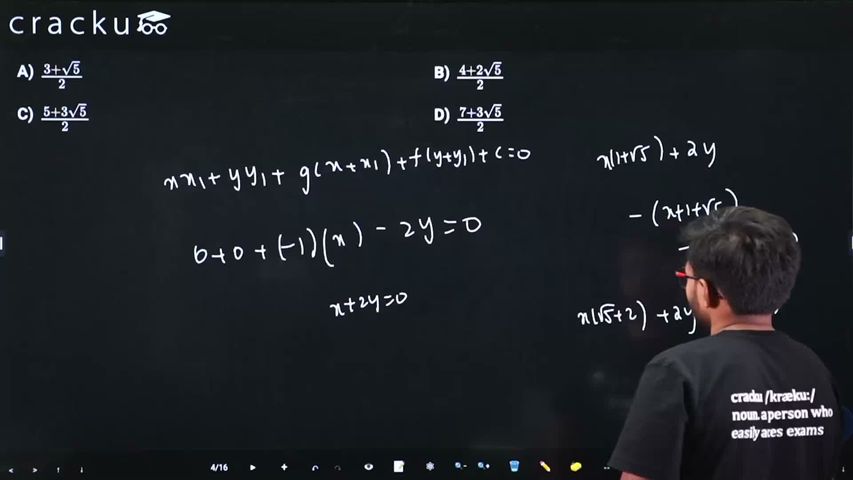
The tangent to the circle $$x^2 + y^2 - 2x - 4y = 0$$ at a general point $$(x_1,y_1)$$ is given by $$xx_1 + yy_1 - (x + x_1) - 2(y + y_1) = 0$$. At $$O(0,0)$$ this becomes $$0 + 0 - (x + 0) - 2(y + 0) = 0$$, which simplifies to $$x + 2y = 0\quad\cdots(1)$$.
At $$P(1+\sqrt{5},2)$$ the same formula yields $$x(1+\sqrt{5}) + 2y - (x + 1 + \sqrt{5}) - 2(y + 2) = 0$$ $$x + x\sqrt{5} + 2y - x - 1 - \sqrt{5} - 2y - 4 = 0$$ $$x\sqrt{5} - 5 - \sqrt{5} = 0$$ $$\sqrt{5}(x - 1 - \sqrt{5}) = 0$$ so $$x = 1 + \sqrt{5}\quad\cdots(2)$$.
Solving equations (1) and (2), from (2) we have $$x = 1 + \sqrt{5}$$. Substituting into (1) gives $$1 + \sqrt{5} + 2y = 0\quad\Rightarrow\quad y = -\frac{1 + \sqrt{5}}{2}$$ so the point of intersection is $$Q = \left(1 + \sqrt{5},\; -\frac{1 + \sqrt{5}}{2}\right)\,.$$
Finally, the area of triangle $$OPQ$$ is given by Area $$= \frac{1}{2}\bigl|x_O(y_P - y_Q) + x_P(y_Q - y_O) + x_Q(y_O - y_P)\bigr|$$ $$= \frac{1}{2}\left|0 + (1+\sqrt{5})\Bigl(-\frac{1+\sqrt{5}}{2} - 0\Bigr) + (1+\sqrt{5})(0 - 2)\right|$$ $$= \frac{1}{2}\left|(1+\sqrt{5})\Bigl(-\frac{1+\sqrt{5}}{2} - 2\Bigr)\right|$$ $$= \frac{1}{2}\left|(1+\sqrt{5}) \cdot \Bigl(-\frac{5+\sqrt{5}}{2}\Bigr)\right| = \frac{(1+\sqrt{5})(5+\sqrt{5})}{4}\,.$$ Expanding the numerator, $$(1+\sqrt{5})(5+\sqrt{5}) = 5 + \sqrt{5} + 5\sqrt{5} + 5 = 10 + 6\sqrt{5}\,,$$ so Area $$= \frac{10 + 6\sqrt{5}}{4} = \frac{5 + 3\sqrt{5}}{2}\,.$$ Therefore, the correct answer is Option C: $$\frac{5 + 3\sqrt{5}}{2}\,.$$
Was this solution helpful?
Click on the Email ☝️ to Watch the Video Solution
Create a FREE account and get:
_1.webp)

Educational materials for JEE preparation

Ask our AI anything

AI can make mistakes. Please verify important information.
AI can make mistakes. Please verify important information.
