
Join Our JEE Preparation Group
Prep with like-minded aspirants; Get access to free daily tests and study material.
Sign in
Please select an account to continue using cracku.in
↓ →
Join Our JEE Preparation Group
Prep with like-minded aspirants; Get access to free daily tests and study material.
If $$\sum_{k=1}^{31} \left(^{31}C_{k}\right) \left(^{31}C_{k-1} \right) - \sum_{k=1}^{30} \left(^{30}C_{k}\right) \left(^{30}C_{k-1} \right)= \frac{\alpha(60!)}{(30!)(31!)}$$, where $$\alpha \in R$$, then the value of $$16\alpha$$ is equal to
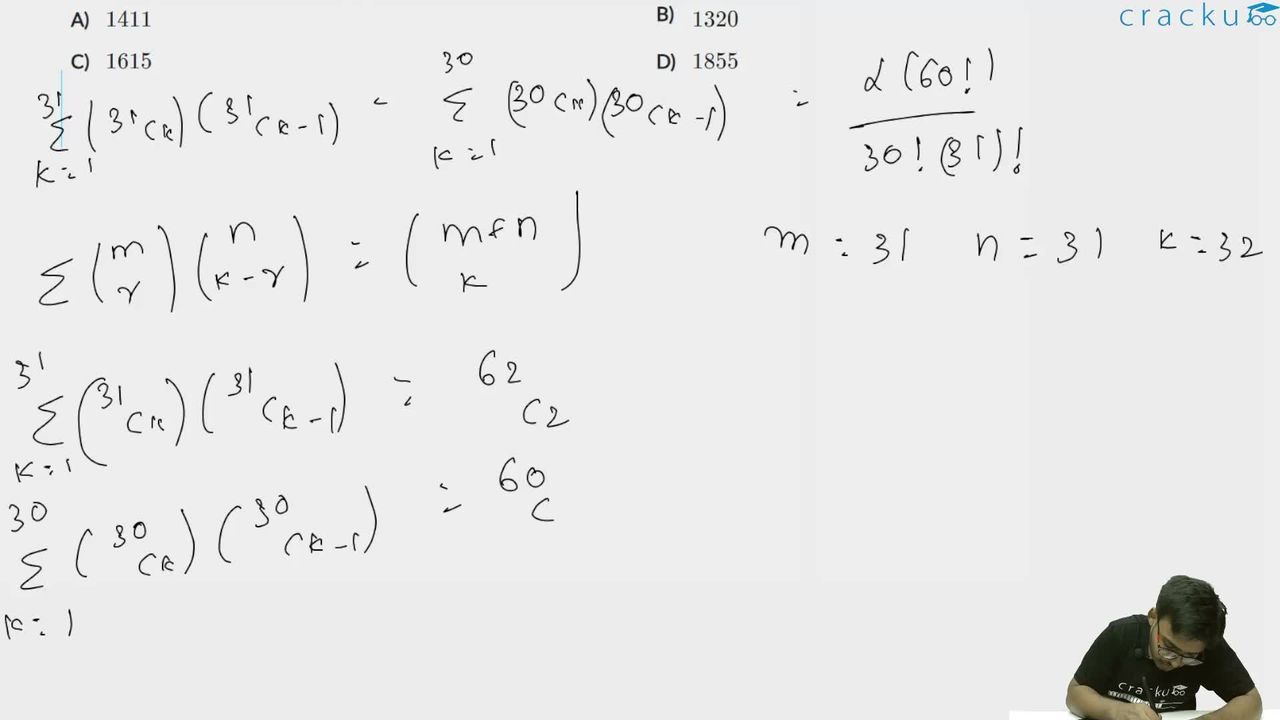
We need to evaluate $$\sum_{k=1}^{31} \binom{31}{k}\binom{31}{k-1} - \sum_{k=1}^{30} \binom{30}{k}\binom{30}{k-1}$$ and express it as $$\frac{\alpha \cdot 60!}{30! \cdot 31!}$$, then find $$16\alpha$$.
Noting that $$\binom{31}{k-1} = \binom{31}{32-k}$$ and applying the Vandermonde identity $$\sum_{k} \binom{m}{k}\binom{n}{r-k} = \binom{m+n}{r}$$ with $$m=n=31$$ and $$r=32$$, we obtain
$$\sum_{k=1}^{31} \binom{31}{k}\binom{31}{32-k} = \binom{62}{32}\,. $$
Similarly, since $$\binom{30}{k-1} = \binom{30}{31-k}$$ and using Vandermonde with $$m=n=30$$ and $$r=31$$, we get
$$\sum_{k=1}^{30} \binom{30}{k}\binom{30}{31-k} = \binom{60}{31}\,. $$
Therefore the left-hand side simplifies to
$$\binom{62}{32} - \binom{60}{31}\,. $$
We set this equal to $$\frac{\alpha \cdot 60!}{30! \cdot 31!}$$, so that
$$\alpha = \bigl(\binom{62}{32} - \binom{60}{31}\bigr)\frac{30! \cdot 31!}{60!}\,.$$
For the first term,
$$\binom{62}{32}\times\frac{30! \cdot 31!}{60!} =\frac{62!}{32! \cdot 30!}\times\frac{30! \cdot 31!}{60!} =\frac{62! \cdot 31!}{32! \cdot 60!} =\frac{62 \cdot 61}{32} =\frac{3782}{32} =\frac{1891}{16}\,. $$
For the second term,
$$\binom{60}{31}\times\frac{30! \cdot 31!}{60!} =\frac{60!}{31! \cdot 29!}\times\frac{30! \cdot 31!}{60!} =\frac{30!}{29!} =30\,. $$
Hence
$$\alpha = \frac{1891}{16} - 30 = \frac{1891 - 480}{16} = \frac{1411}{16},$$
so
$$16\alpha = 1411\,. $$
Therefore, the correct answer is Option A: 1411.
Was this solution helpful?
Click on the Email ☝️ to Watch the Video Solution
Create a FREE account and get:
_1.webp)

Educational materials for JEE preparation

Ask our AI anything

AI can make mistakes. Please verify important information.
AI can make mistakes. Please verify important information.
