
Join Our JEE Preparation Group
Prep with like-minded aspirants; Get access to free daily tests and study material.
Sign in
Please select an account to continue using cracku.in
↓ →
Join Our JEE Preparation Group
Prep with like-minded aspirants; Get access to free daily tests and study material.
If $$p$$ and $$q$$ are the lengths of the perpendiculars from the origin on the lines, $$x\text{cosec}\alpha - y\sec\alpha = k\cot 2\alpha$$ and $$x\sin\alpha + y\cos\alpha = k\sin 2\alpha$$ respectively, then $$k^2$$ is equal to:
The first line is $$x\csc\alpha - y\sec\alpha = k\cot 2\alpha.$$ We rewrite it in the standard straight-line form $$Ax+By+C=0$$ by bringing the right hand side to the left:
$$x\csc\alpha - y\sec\alpha - k\cot 2\alpha = 0.$$
Here $$A=\csc\alpha,\; B=-\sec\alpha,\; C=-k\cot 2\alpha.$$
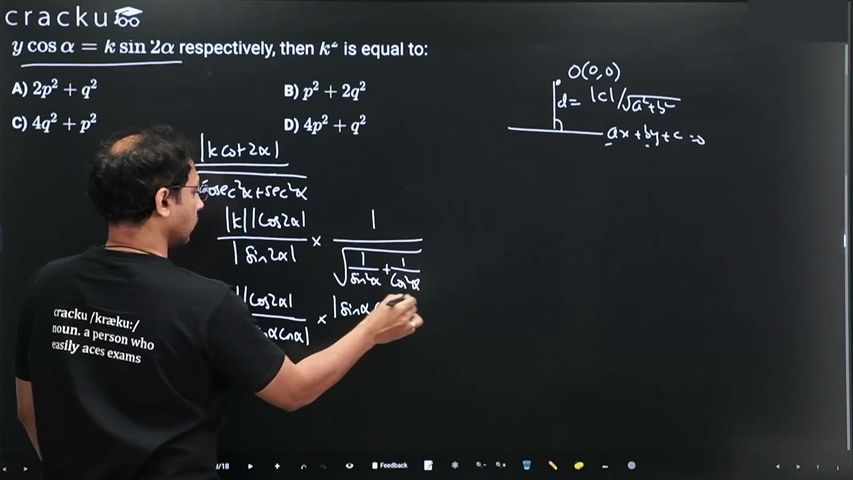
For a line $$Ax+By+C=0,$$ the perpendicular distance of the origin $$(0,0)$$ from the line is given by the well-known formula $$\displaystyle d=\frac{|C|}{\sqrt{A^{2}+B^{2}}}\;.$$ Stating this first keeps every step clear.
Applying the formula to the first line, the length of the perpendicular from the origin is
$$p=\frac{|\, -k\cot 2\alpha\, |}{\sqrt{\csc^{2}\alpha+(-\sec\alpha)^{2}}} =\frac{|k|\;|\cot 2\alpha|}{\sqrt{\csc^{2}\alpha+\sec^{2}\alpha}}.$$
Now we express the denominator completely in $$\sin\alpha$$ and $$\cos\alpha$$:
$$\csc^{2}\alpha=\frac{1}{\sin^{2}\alpha},\qquad \sec^{2}\alpha=\frac{1}{\cos^{2}\alpha}.$$
Therefore
$$\csc^{2}\alpha+\sec^{2}\alpha =\frac{1}{\sin^{2}\alpha}+\frac{1}{\cos^{2}\alpha} =\frac{\cos^{2}\alpha+\sin^{2}\alpha}{\sin^{2}\alpha\cos^{2}\alpha} =\frac{1}{\sin^{2}\alpha\cos^{2}\alpha}.$$
So
$$\sqrt{\csc^{2}\alpha+\sec^{2}\alpha} =\frac{1}{\sin\alpha\cos\alpha}.$$
Substituting this back, we obtain
$$p=|k|\;|\cot 2\alpha|\;(\sin\alpha\cos\alpha).$$
But $$\sin\alpha\cos\alpha=\dfrac{\sin 2\alpha}{2}$$ and also $$\cot 2\alpha=\dfrac{\cos 2\alpha}{\sin 2\alpha}.$$ Hence
$$p=|k|\;\Bigl|\frac{\cos 2\alpha}{\sin 2\alpha}\Bigr|\;\frac{\sin 2\alpha}{2} =\frac{|k|\;|\cos 2\alpha|}{2}.$$
Squaring to remove the absolute value,
$$p^{2}=\frac{k^{2}\cos^{2}2\alpha}{4}.\qquad(1)$$
Now we treat the second line $$x\sin\alpha+y\cos\alpha=k\sin 2\alpha.$$ Writing it as $$x\sin\alpha+y\cos\alpha-k\sin 2\alpha=0,$$ we have
$$A=\sin\alpha,\;B=\cos\alpha,\;C=-k\sin 2\alpha.$$
The distance formula gives
$$q=\frac{|\, -k\sin 2\alpha\, |}{\sqrt{\sin^{2}\alpha+\cos^{2}\alpha}} =\frac{|k|\;|\sin 2\alpha|}{\sqrt{1}} =|k|\;|\sin 2\alpha|.$$
Squaring,
$$q^{2}=k^{2}\sin^{2}2\alpha.\qquad(2)$$
We now possess two equations connecting $$p^{2},q^{2}$$ and $$k^{2}$$:
$$p^{2}=\dfrac{k^{2}\cos^{2}2\alpha}{4},\qquad q^{2}=k^{2}\sin^{2}2\alpha.$$
From the first, $$k^{2}=4p^{2}/\cos^{2}2\alpha,$$ and from the second, $$k^{2}=q^{2}/\sin^{2}2\alpha.$$ Equating these two expressions for $$k^{2}$$ (because they are the same quantity) we have
$$\frac{4p^{2}}{\cos^{2}2\alpha}=\frac{q^{2}}{\sin^{2}2\alpha}.$$
Cross-multiplying,
$$4p^{2}\sin^{2}2\alpha=q^{2}\cos^{2}2\alpha.$$
Bring the terms involving $$\sin^{2}2\alpha$$ to one side:
$$4p^{2}\sin^{2}2\alpha+q^{2}\sin^{2}2\alpha=q^{2}.$$
Factorising,
$$\sin^{2}2\alpha\,(4p^{2}+q^{2})=q^{2}.$$
Solve for $$\sin^{2}2\alpha$$:
$$\sin^{2}2\alpha=\frac{q^{2}}{4p^{2}+q^{2}}.$$
Finally, substitute this value into $$k^{2}=q^{2}/\sin^{2}2\alpha$$ obtained from equation (2):
$$k^{2}=\frac{q^{2}}{\dfrac{q^{2}}{4p^{2}+q^{2}}} =q^{2}\;\frac{4p^{2}+q^{2}}{q^{2}} =4p^{2}+q^{2}.$$
Thus we have reached the required result:
$$k^{2}=4p^{2}+q^{2}.$$
Hence, the correct answer is Option D.
Click on the Email ☝️ to Watch the Video Solution
Create a FREE account and get:
_1.webp)

Educational materials for JEE preparation

Ask our AI anything

AI can make mistakes. Please verify important information.
AI can make mistakes. Please verify important information.


