
Join Our JEE Preparation Group
Prep with like-minded aspirants; Get access to free daily tests and study material.
Sign in
Please select an account to continue using cracku.in
↓ →
Join Our JEE Preparation Group
Prep with like-minded aspirants; Get access to free daily tests and study material.
Let us denote $$\theta = 18^\circ$$ and write the number we are interested in as $$x = \csc 18^\circ.$$ Our task is to find an equation with integer coefficients that has this value of $$x$$ as a root.
Because trigonometric identities for $$18^\circ$$ are most easily obtained through $$36^\circ$$, we begin by finding $$\cos 36^\circ.$$ Observe that $$5 \times 36^\circ = 180^\circ,$$ so $$\cos 5(36^\circ) = \cos 180^\circ = -1.$$
The standard multiple-angle formula for cosine is
$$\cos 5\theta = 16\cos^5\theta - 20\cos^3\theta + 5\cos\theta.$$
Putting $$\theta = 36^\circ$$ and writing $$c = \cos 36^\circ,$$ we obtain
$$16c^5 - 20c^3 + 5c + 1 = 0.$$
This quintic has a quadratic factor which can be found by inspection (or long division); that factor is $$4c^2 - 2c - 1.$$ Hence
$$4c^2 - 2c - 1 = 0.$$
Solving the quadratic with the quadratic formula,
$$c = \dfrac{2 \pm \sqrt{4 + 16}}{8} = \dfrac{2 \pm 4\sqrt5}{8} = \dfrac{1 \pm \sqrt5}{4}.$$
Since $$\cos 36^\circ$$ is positive, we choose the positive root:
$$\cos 36^\circ = \dfrac{1 + \sqrt5}{4}.$$
Now we convert this to $$\sin 18^\circ$$ using the half-angle relation
$$\sin^2 18^\circ = \dfrac{1 - \cos 36^\circ}{2}.$$
Substituting the value of $$\cos 36^\circ,$$ we get
$$\sin^2 18^\circ = \dfrac{1 - \dfrac{1 + \sqrt5}{4}}{2} = \dfrac{\dfrac{4 - 1 - \sqrt5}{4}}{2} = \dfrac{3 - \sqrt5}{8}.$$
Taking the positive square root (because $$\sin 18^\circ$$ is positive),
$$\sin 18^\circ = \sqrt{\dfrac{3 - \sqrt5}{8}}.$$
A more familiar exact form arises by rationalising:
$$\sin 18^\circ = \dfrac{\sqrt5 - 1}{4}.$$
We can check this quickly, because
$$\left(\dfrac{\sqrt5 - 1}{4}\right)^2 = \dfrac{5 + 1 - 2\sqrt5}{16} = \dfrac{6 - 2\sqrt5}{16} = \dfrac{3 - \sqrt5}{8},$$
matching the value found earlier. Now we are ready to obtain $$\csc 18^\circ.$$ Since $$\csc 18^\circ = \dfrac{1}{\sin 18^\circ},$$ we have
$$x = \csc 18^\circ = \dfrac{1}{\dfrac{\sqrt5 - 1}{4}} = \dfrac{4}{\sqrt5 - 1}.$$
To eliminate the radical from the denominator we multiply numerator and denominator by $$\sqrt5 + 1$$:
$$x = \dfrac{4(\sqrt5 + 1)}{(\sqrt5 - 1)(\sqrt5 + 1)} = \dfrac{4(\sqrt5 + 1)}{5 - 1} = \dfrac{4(\sqrt5 + 1)}{4} = \sqrt5 + 1.$$
Therefore
$$x = \sqrt5 + 1.$$
Let us now examine which of the given quadratic equations is satisfied by $$x.$$ We compute the left-hand side of each candidate equation, starting with
$$x^2 - 2x - 4.$$
First, we find $$x^2$$ and $$2x$$:
$$x^2 = (\sqrt5 + 1)^2 = 5 + 1 + 2\sqrt5 = 6 + 2\sqrt5,$$
$$2x = 2(\sqrt5 + 1) = 2\sqrt5 + 2.$$
Now substitute these into the expression:
$$x^2 - 2x - 4 = (6 + 2\sqrt5) - (2\sqrt5 + 2) - 4.$$
Simplifying term by term, the $$2\sqrt5$$ terms cancel:
$$= 6 + 2\sqrt5 - 2\sqrt5 - 2 - 4 = 6 - 2 - 4 = 0.$$
Thus $$x = \csc 18^\circ$$ satisfies
$$x^2 - 2x - 4 = 0.$$
Checking the other options is unnecessary, because we have already found an equation with integer coefficients that our number satisfies, and only one such equation appears in the list.
Hence, the correct answer is Option A.
Was this solution helpful?
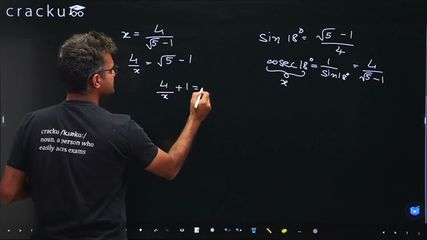
Click on the Email ☝️ to Watch the Video Solution
Create a FREE account and get:
_1.webp)

Educational materials for JEE preparation

Ask our AI anything

AI can make mistakes. Please verify important information.
AI can make mistakes. Please verify important information.
