
Join Our JEE Preparation Group
Prep with like-minded aspirants; Get access to free daily tests and study material.
Sign in
Please select an account to continue using cracku.in
↓ →
Join Our JEE Preparation Group
Prep with like-minded aspirants; Get access to free daily tests and study material.
Let $$a, ar, ar^2, \ldots$$ be an infinite G.P. If $$\sum_{n=0}^{\infty} ar^n = 57$$ and $$\sum_{n=0}^{\infty} a^3 r^{3n} = 9747$$, then $$a + 18r$$ is equal to
Here is the step-by-step solution, breaking down the algebraic manipulation clearly for your students:
1. Set up the equations from the given infinite G.P. sums:
For an infinite Geometric Progression with first term $$a$$ and common ratio $$r$$ (where $$|r| < 1$$), the sum is $$\frac{a}{1-r}$$.
From the first given sum:
$$\frac{a}{1-r} = 57 \implies a = 57(1-r)$$ --- (Equation 1)
The second series is $$\sum_{n=0}^{\infty} a^3 r^{3n} = a^3 + a^3r^3 + a^3r^6 + \dots$$
This is another infinite G.P. where the first term is $$a^3$$ and the common ratio is $$r^3$$.
$$\frac{a^3}{1-r^3} = 9747$$ --- (Equation 2)
2. Substitute and simplify:
Recall the algebraic identity $$1 - r^3 = (1-r)(1 + r + r^2)$$.
Substitute this and Equation 1 into Equation 2:
$$\frac{[57(1-r)]^3}{(1-r)(1+r+r^2)} = 9747$$
$$\frac{57^3(1-r)^3}{(1-r)(1+r+r^2)} = 9747$$
$$\frac{57^3(1-r)^2}{1+r+r^2} = 9747$$
To avoid massive calculations, let's factor the right side. Notice that $$9747 \div 57 = 171$$, and $$171 \div 57 = 3$$. So, $$9747 = 57^2 \times 3$$.
$$\frac{57^3(1-r)^2}{1+r+r^2} = 57^2 \times 3$$
$$\frac{57(1-r)^2}{1+r+r^2} = 3$$
$$\frac{19(1 - 2r + r^2)}{1+r+r^2} = 1$$
3. Solve the resulting quadratic equation:
Cross-multiply to get:
$$19 - 38r + 19r^2 = 1 + r + r^2$$
$$18r^2 - 39r + 18 = 0$$
Divide the entire equation by 3 to simplify:
$$6r^2 - 13r + 6 = 0$$
Factorize by splitting the middle term (sum = -13, product = 36):
$$6r^2 - 9r - 4r + 6 = 0$$
$$3r(2r - 3) - 2(2r - 3) = 0$$
$$(3r - 2)(2r - 3) = 0$$
This gives two possible values for the common ratio: $$r = \frac{2}{3}$$ or $$r = \frac{3}{2}$$.
Since an infinite G.P. only has a finite sum when $$|r| < 1$$, we must reject $$\frac{3}{2}$$. Therefore, $$r = \frac{2}{3}$$.
4. Find $$a$$ and calculate the final expression:
Substitute $$r = \frac{2}{3}$$ back into Equation 1:
$$a = 57\left(1 - \frac{2}{3}\right) = 57\left(\frac{1}{3}\right) = 19$$
Finally, calculate the required value for $$a + 18r$$:
$$a + 18r = 19 + 18\left(\frac{2}{3}\right)$$
$$a + 18r = 19 + 12 = 31$$
Was this solution helpful?
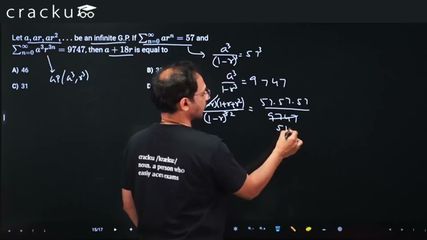
Click on the Email ☝️ to Watch the Video Solution
Create a FREE account and get:
_1.webp)

Educational materials for JEE preparation

Ask our AI anything

AI can make mistakes. Please verify important information.
AI can make mistakes. Please verify important information.
