
Join Our JEE Preparation Group
Prep with like-minded aspirants; Get access to free daily tests and study material.
Sign in
Please select an account to continue using cracku.in
↓ →
Join Our JEE Preparation Group
Prep with like-minded aspirants; Get access to free daily tests and study material.
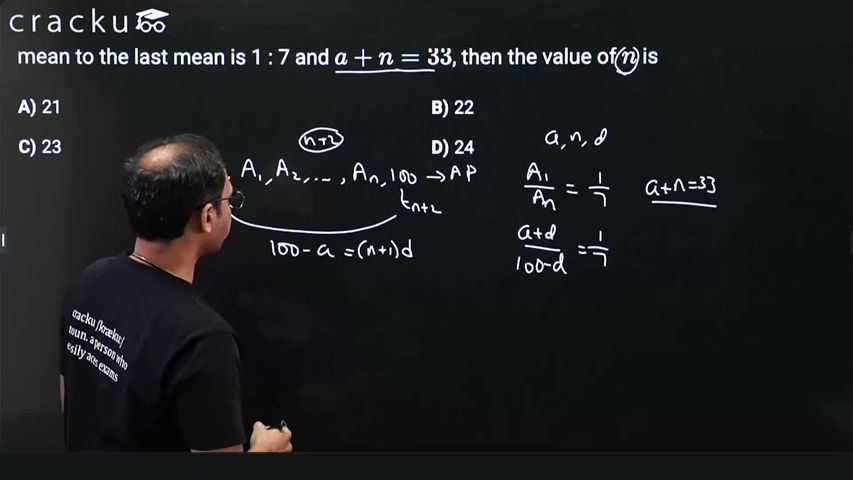
If $$n$$ arithmetic means are inserted between a and 100 such that the ratio of the first mean to the last mean is 1 : 7 and $$a + n = 33$$, then the value of $$n$$ is
Let $$n$$ arithmetic means be inserted between $$a$$ and $$100$$.
Express the common difference and means:
The resulting AP has first term $$a$$, last term $$100$$, and $$(n + 2)$$ terms total.
$$d = \frac{100 - a}{n + 1}$$
First mean $$= a + d$$, Last mean $$= a + nd$$
Apply the ratio condition:
$$\frac{a + d}{a + nd} = \frac{1}{7}$$
$$7(a + d) = a + nd$$
$$7a + 7d = a + nd$$
$$6a = d(n - 7) \quad \cdots (1)$$
Substitute $$d$$ and $$a = 33 - n$$:
From $$a + n = 33$$, we get $$a = 33 - n$$.
$$d = \frac{100 - (33 - n)}{n + 1} = \frac{67 + n}{n + 1}$$
Substituting into equation (1):
$$6(33 - n) = \frac{(67 + n)(n - 7)}{n + 1}$$
$$6(33 - n)(n + 1) = (67 + n)(n - 7)$$
Expand and solve:
Left side: $$6(33n + 33 - n^2 - n) = 6(32n + 33 - n^2) = -6n^2 + 192n + 198$$
Right side: $$67n - 469 + n^2 - 7n = n^2 + 60n - 469$$
Setting them equal:
$$-6n^2 + 192n + 198 = n^2 + 60n - 469$$
$$7n^2 - 132n - 667 = 0$$
Using the quadratic formula:
$$n = \frac{132 \pm \sqrt{132^2 + 4 \times 7 \times 667}}{2 \times 7} = \frac{132 \pm \sqrt{17424 + 18676}}{14} = \frac{132 \pm \sqrt{36100}}{14} = \frac{132 \pm 190}{14}$$
Taking the positive root: $$n = \frac{322}{14} = 23$$
The correct answer is Option C: $$23$$.
Was this solution helpful?
Click on the Email ☝️ to Watch the Video Solution
Create a FREE account and get:
_1.webp)

Educational materials for JEE preparation

Ask our AI anything

AI can make mistakes. Please verify important information.
AI can make mistakes. Please verify important information.
