
Join Our JEE Preparation Group
Prep with like-minded aspirants; Get access to free daily tests and study material.
Sign in
Please select an account to continue using cracku.in
↓ →
Join Our JEE Preparation Group
Prep with like-minded aspirants; Get access to free daily tests and study material.
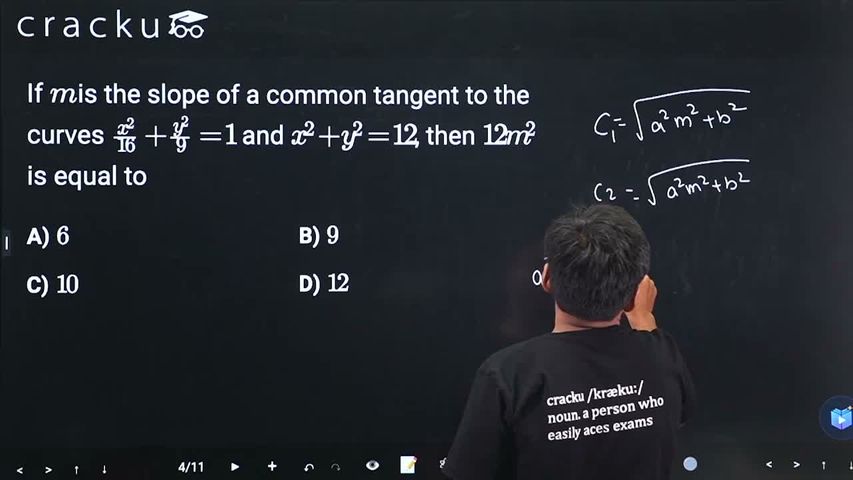
If $$m$$ is the slope of a common tangent to the curves $$\frac{x^2}{16} + \frac{y^2}{9} = 1$$ and $$x^2 + y^2 = 12$$, then $$12m^2$$ is equal to
We need to find $$12m^2$$ where $$m$$ is the slope of a common tangent to the ellipse $$\frac{x^2}{16} + \frac{y^2}{9} = 1$$ and the circle $$x^2 + y^2 = 12$$.
For the ellipse $$\frac{x^2}{a^2} + \frac{y^2}{b^2} = 1$$ with $$a^2 = 16$$ and $$b^2 = 9$$, the equation of a tangent line with slope $$m$$ can be written as
$$y = mx \pm \sqrt{a^2 m^2 + b^2} = mx \pm \sqrt{16m^2 + 9}$$
This follows from the condition that a line $$y = mx + c$$ is tangent to the ellipse when $$c^2 = a^2 m^2 + b^2$$.
For the circle $$x^2 + y^2 = 12$$ (with center at the origin and radius $$2\sqrt{3}$$), the tangent line with slope $$m$$ has the form
$$y = mx \pm \sqrt{12(1 + m^2)}$$
This follows from the requirement that the perpendicular distance from the center to the line equals the radius, namely $$\frac{|c|}{\sqrt{1+m^2}} = 2\sqrt{3}$$, which leads to $$c^2 = 12(1+m^2)$$.
For a common tangent, the value of $$c^2$$ must satisfy both conditions simultaneously, so we set
$$16m^2 + 9 = 12(1 + m^2)\,.$$
Rewriting this gives
$$16m^2 + 9 = 12 + 12m^2$$
Subtracting terms yields
$$4m^2 = 3\quad\text{and}\quad m^2 = \frac{3}{4}\,.$$
Substituting into $$12m^2$$ gives
$$12m^2 = 12 \times \frac{3}{4} = 9$$
Therefore, the required value is $$9$$.
Was this solution helpful?
Click on the Email ☝️ to Watch the Video Solution
Create a FREE account and get:
_1.webp)

Educational materials for JEE preparation

Ask our AI anything

AI can make mistakes. Please verify important information.
AI can make mistakes. Please verify important information.
