
Join Our JEE Preparation Group
Prep with like-minded aspirants; Get access to free daily tests and study material.
Sign in
Please select an account to continue using cracku.in
↓ →
Join Our JEE Preparation Group
Prep with like-minded aspirants; Get access to free daily tests and study material.
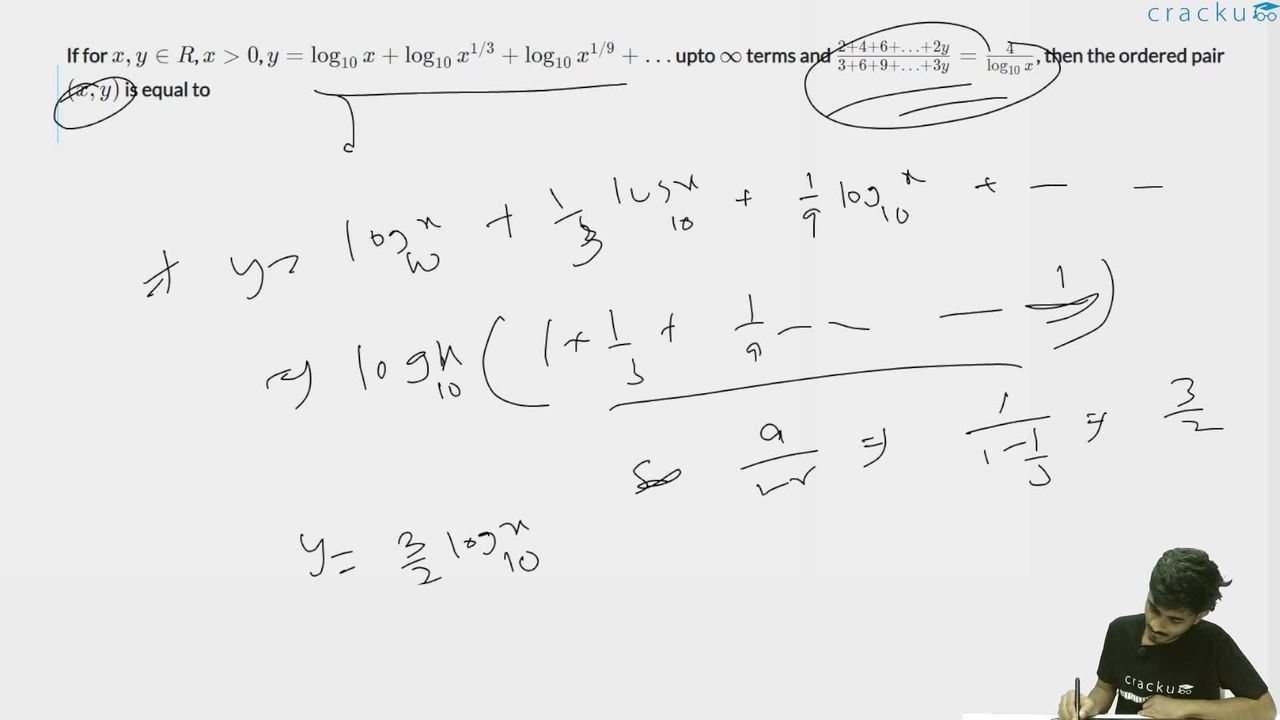
If for $$x, y \in R$$, $$x > 0$$, $$y = \log_{10} x + \log_{10} x^{1/3} + \log_{10} x^{1/9} + \ldots$$ upto $$\infty$$ terms and $$\frac{2+4+6+\ldots+2y}{3+6+9+\ldots+3y} = \frac{4}{\log_{10} x}$$, then the ordered pair $$(x, y)$$ is equal to
We have the infinite sum
$$y = \log_{10} x + \log_{10} x^{1/3} + \log_{10} x^{1/9} + \ldots$$
First we write every term with the same base-10 logarithm.
The basic logarithm rule is:
$$\log_{10} a^{k} = k\,\log_{10} a.$$
Applying it term by term, we obtain
$$\log_{10} x^{1/3} = \frac{1}{3}\,\log_{10} x,$$
$$\log_{10} x^{1/9} = \frac{1}{9}\,\log_{10} x,$$
and so on. Hence every term is really a constant multiple of the first term $$\log_{10} x.$$ So we can factor $$\log_{10} x$$ out of the whole series:
$$y \;=\; \log_{10} x\;\Bigl(1 + \frac13 + \frac1{3^{2}} + \frac1{3^{3}} + \ldots\Bigr).$$
The bracket now is an infinite geometric series with first term $$a = 1$$ and common ratio $$r = \frac13.$$ For an infinite geometric series, the sum formula is
$$S_\infty = \frac{a}{1-r}, \qquad\text{when } |r| < 1.$$
Substituting $$a = 1$$ and $$r = \dfrac13$$ we get
$$S_\infty = \frac{1}{1-\dfrac13} = \frac{1}{\dfrac23} = \frac32.$$
Therefore
$$y = \log_{10} x \times \frac32 = \frac32\,\log_{10} x.$$
Now we move to the second given condition
$$\frac{2+4+6+\ldots+2y}{3+6+9+\ldots+3y} \;=\; \frac{4}{\log_{10} x}.$$
We notice that the numerator is the list of even numbers up to $$2y$$, and the denominator is the list of multiples of $$3$$ up to $$3y$$. Because every term is an exact multiple of the index, these series each contain exactly $$y$$ terms (we are told that $$y$$ will be an integer by this construction).
First let us evaluate the numerator. The $$k^{\text{th}}$$ term is $$2k$$ and $$k$$ runs from $$1$$ to $$y$$, so
$$\text{Sum}_\text{num} = 2(1 + 2 + 3 + \ldots + y).$$
The standard formula for the sum of the first $$n$$ natural numbers is
$$1 + 2 + 3 + \ldots + n = \frac{n(n+1)}{2}.$$
Putting $$n = y$$ we get
$$1 + 2 + 3 + \ldots + y = \frac{y(y+1)}{2},$$
so
$$\text{Sum}_\text{num} = 2 \times \frac{y(y+1)}{2} = y(y+1).$$
Next the denominator. The $$k^{\text{th}}$$ term is $$3k$$, again with $$k = 1$$ to $$y$$, so
$$\text{Sum}_\text{den} = 3(1 + 2 + 3 + \ldots + y) = 3 \times \frac{y(y+1)}{2} = \frac{3y(y+1)}{2}.$$
Hence the entire fraction becomes
$$\frac{\text{Sum}_\text{num}}{\text{Sum}_\text{den}} = \frac{y(y+1)}{\dfrac{3y(y+1)}{2}} = \frac{y(y+1)}{1}\times\frac{2}{3y(y+1)} = \frac{2}{3}.$$
The problem states that this same ratio equals $$\dfrac{4}{\log_{10} x}$$, so we equate the two values:
$$\frac{2}{3} \;=\; \frac{4}{\log_{10} x}.$$
Cross-multiplying gives
$$2\,\log_{10} x = 12,$$
and dividing by $$2$$ gives
$$\log_{10} x = 6.$$
Converting from logarithmic form to exponential form (using $$\log_{10} a = b \Longleftrightarrow a = 10^{b}$$) we get
$$x = 10^{6}.$$
Finally we substitute this value of $$\log_{10} x$$ into our earlier expression for $$y$$:
$$y = \frac32\,\log_{10} x = \frac32 \times 6 = 9.$$
So the ordered pair is
$$(x,\,y) = (10^{6},\,9).$$
Hence, the correct answer is Option B.
Click on the Email ☝️ to Watch the Video Solution
Create a FREE account and get:
_1.webp)

Educational materials for JEE preparation

Ask our AI anything

AI can make mistakes. Please verify important information.
AI can make mistakes. Please verify important information.


