
Join Our JEE Preparation Group
Prep with like-minded aspirants; Get access to free daily tests and study material.
Sign in
Please select an account to continue using cracku.in
↓ →
Join Our JEE Preparation Group
Prep with like-minded aspirants; Get access to free daily tests and study material.
If $$S = \left\{z \in C : \frac{z-i}{z+2i} \in R\right\}$$, then
We write the complex number in Cartesian form. Let $$z = x + iy$$ where $$x, y \in \mathbb R$$. Then
$$z - i \;=\; x + i(y - 1), \qquad z + 2i \;=\; x + i(y + 2).$$
We have the condition that the quotient $$\dfrac{z-i}{\,z+2i\,}$$ is a real number. A complex number is real exactly when its imaginary part is zero. So we require the imaginary part of the fraction to vanish.
To isolate the imaginary part, we multiply numerator and denominator by the conjugate of the denominator:
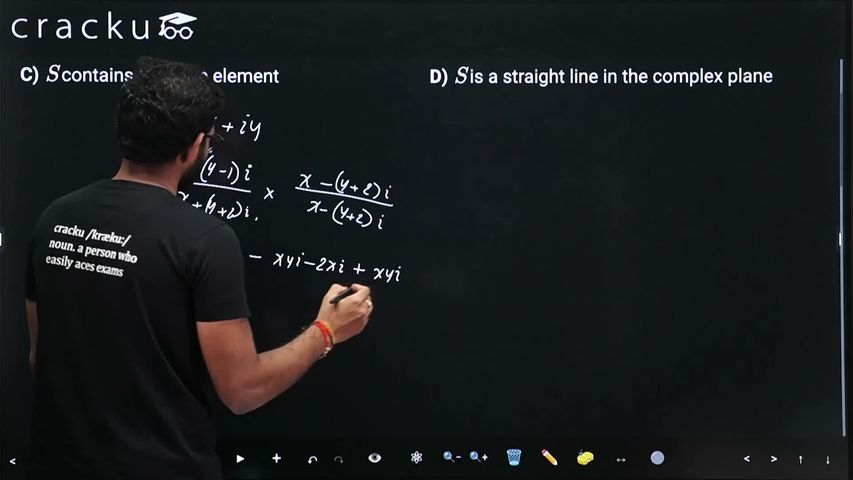
$$ \dfrac{z-i}{\,z+2i\,} = \dfrac{\,x + i(y-1)\,}{\,x + i(y+2)\,}\; = \dfrac{\,\bigl(x + i(y-1)\bigr)\,\bigl(x - i(y+2)\bigr)}{\,\bigl(x + i(y+2)\bigr)\,\bigl(x - i(y+2)\bigr)} = \dfrac{\,\bigl(x + i(y-1)\bigr)\,\bigl(x - i(y+2)\bigr)}{\,x^{2} + (y+2)^{2}}. $$
The denominator $$x^{2} + (y+2)^{2}$$ is real and positive (except at the point where it is zero, which we shall mention later). Therefore the entire fraction is real if and only if the numerator
$$\bigl(x + i(y-1)\bigr)\,\bigl(x - i(y+2)\bigr)$$
is itself a real number. Let us expand this product step by step. We recall the formula $$(a+ib)(c+id)=(ac-bd)+i(ad+bc).$$ Here we identify
$$a = x, \quad b = y-1, \quad c = x, \quad d = -(y+2).$$
First, the real part:
$$ac - bd \;=\; x\cdot x \;-\; (y-1)\bigl(-(y+2)\bigr) = x^{2} - \bigl(-(y^{2}+y-2)\bigr) = x^{2} + y^{2} + y - 2.$$
Next, the imaginary part:
$$ad + bc \;=\; x\bigl(-(y+2)\bigr) + (y-1)\,x = -x(y+2) + x(y-1) = x\bigl(-(y+2) + (y-1)\bigr) = x(-y-2+y-1) = -3x.$$
So the numerator equals
$$\bigl(x^{2} + y^{2} + y - 2\bigr) \;+\; i(-3x).$$
The imaginary part of the fraction is therefore $$-3x/(x^{2} + (y+2)^{2}).$$ For this to be zero we need
$$-3x = 0 \;\;\Longrightarrow\;\; x = 0.$$\
Thus every point in $$S$$ must satisfy $$x = 0$$, which is the equation of the imaginary axis. We must also ensure that the original denominator $$z + 2i$$ is not zero; this happens only when $$z = -2i$$. Hence
$$S = \bigl\{\,z = iy \;:\; y \in \mathbb R,\; y \neq -2\,\bigr\}.$$\
This set is a straight line (the imaginary axis) in the complex plane, missing a single point. A deleted point does not change the nature of the locus—it is still a straight line rather than a circle or a finite set.
Hence, the correct answer is Option D.
Click on the Email ☝️ to Watch the Video Solution
Create a FREE account and get:
_1.webp)

Educational materials for JEE preparation

Ask our AI anything

AI can make mistakes. Please verify important information.
AI can make mistakes. Please verify important information.


