
Join Our JEE Preparation Group
Prep with like-minded aspirants; Get access to free daily tests and study material.
Sign in
Please select an account to continue using cracku.in
↓ →
Join Our JEE Preparation Group
Prep with like-minded aspirants; Get access to free daily tests and study material.
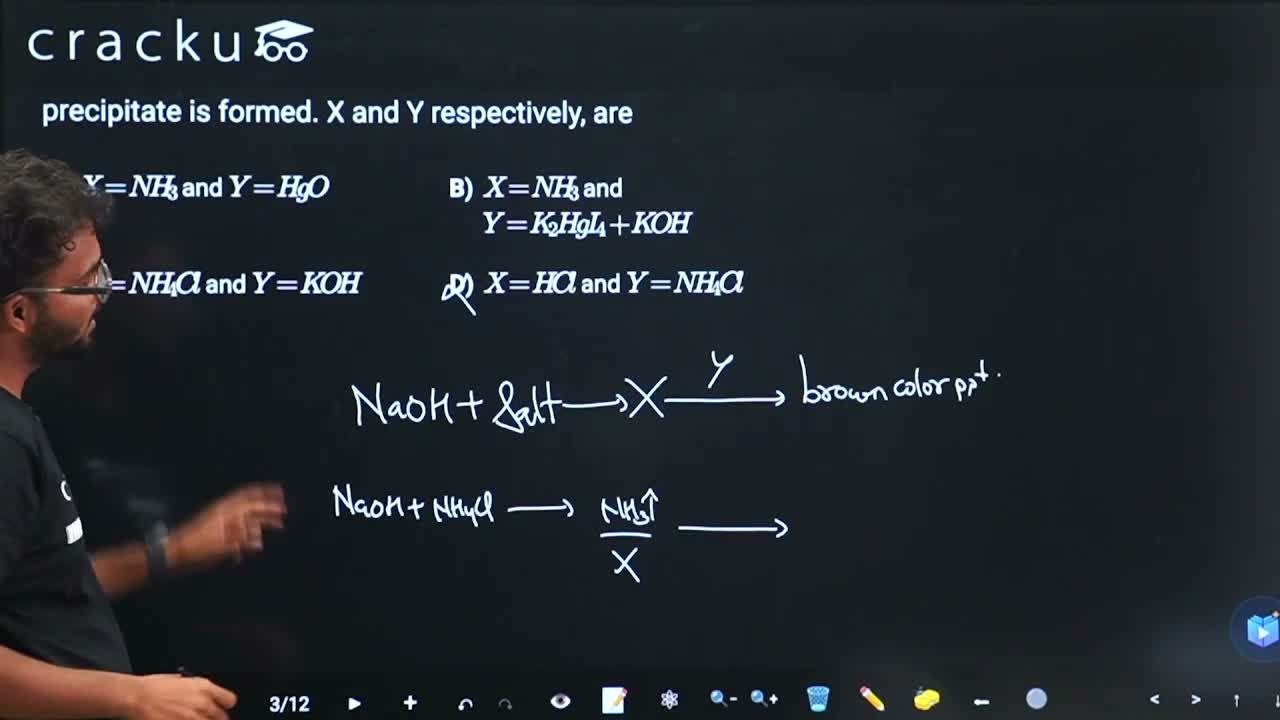
When a salt is treated with sodium hydroxide solution it gives gas X. On passing gas X through reagent Y a brown coloured precipitate is formed. X and Y respectively, are
When an ammonium salt (for example $$NH_4Cl$$) is warmed with aqueous $$NaOH$$, the hydroxide ion removes a proton from the ammonium ion.
$$NH_4^+ + OH^- \rightarrow NH_3 \uparrow + H_2O$$ $$-(1)$$
Thus the evolved gas $$X$$ is ammonia, $$NH_3$$.
To identify ammonia, Nessler’s reagent is commonly used. Nessler’s reagent is a strongly alkaline solution of $$K_2HgI_4$$ in excess $$KOH$$. In the presence of ammonia, it undergoes a redox-complex reaction to give a brown precipitate of Millon’s base $$\left(Hg_2O\;.\;NH_2I\right)$$.
Overall (simplified) reaction with excess alkali:
$$2\,K_2HgI_4 + NH_3 + 3\,KOH \rightarrow Hg_2O.NH_2I \downarrow\;(\text{brown}) + 7\,KI + 2\,H_2O$$ $$-(2)$$
Therefore, when gas $$X$$ ($$NH_3$$) is passed through reagent $$Y$$ (Nessler’s reagent: $$K_2HgI_4 + KOH$$), a brown coloured precipitate forms.
Hence:
$$X = NH_3, \qquad Y = K_2HgI_4 + KOH$$
Option B is correct.
Was this solution helpful?
Click on the Email ☝️ to Watch the Video Solution
Create a FREE account and get:
_1.webp)

Educational materials for JEE preparation

Ask our AI anything

AI can make mistakes. Please verify important information.
AI can make mistakes. Please verify important information.
