
Join Our JEE Preparation Group
Prep with like-minded aspirants; Get access to free daily tests and study material.
Sign in
Please select an account to continue using cracku.in
↓ →
Join Our JEE Preparation Group
Prep with like-minded aspirants; Get access to free daily tests and study material.
Let $$\alpha$$ and $$\beta$$ be the roots of equation $$px^2 + qx + r = 0$$, $$p \neq 0$$. If $$p$$, $$q$$, $$r$$ are in A.P. and $$\frac{1}{\alpha} + \frac{1}{\beta} = 4$$, then the value of $$|\alpha - \beta|$$ is:
For the quadratic equation $$px^2 + qx + r = 0 \;,\; p \neq 0$$ we denote its roots by $$\alpha$$ and $$\beta$$. From the standard relations between coefficients and roots we have
$$\alpha + \beta = -\dfrac{q}{p} \quad\text{and}\quad \alpha\beta = \dfrac{r}{p}.$$
It is given that $$p$$, $$q$$ and $$r$$ are in arithmetic progression. By definition of an A.P. the middle term is the average of its neighbours, so
$$2q = p + r.$$
We are also told that
$$\dfrac{1}{\alpha} + \dfrac{1}{\beta} = 4.$$
First we rewrite the reciprocal condition in terms of the roots and coefficients. We know
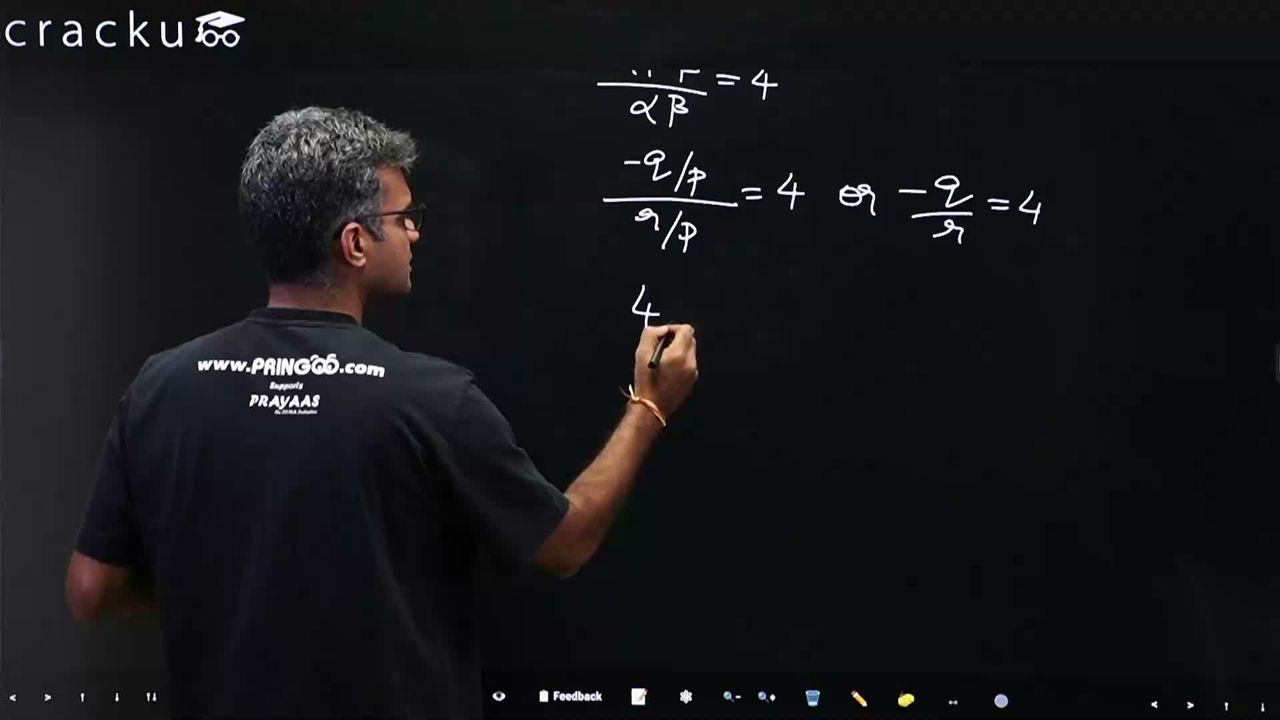
$$\dfrac{1}{\alpha} + \dfrac{1}{\beta} = \dfrac{\alpha + \beta}{\alpha\beta}.$$
Substituting the sum and product formulas stated earlier gives
$$\dfrac{\alpha + \beta}{\alpha\beta} = \dfrac{-\dfrac{q}{p}}{\dfrac{r}{p}} = -\dfrac{q}{r}.$$
Setting this equal to the given value $$4$$ yields
$$-\dfrac{q}{r} = 4 \;\; \Longrightarrow \;\; q = -4r.$$
Now we incorporate the A.P. condition $$2q = p + r$$. Substituting $$q = -4r$$ into it, we obtain
$$2(-4r) = p + r \;\; \Longrightarrow \;\; -8r = p + r \;\; \Longrightarrow \;\; p = -9r.$$
Thus every coefficient is expressed in terms of $$r$$ alone:
$$p = -9r, \quad q = -4r, \quad r = r.$$
Because these occur only through ratios, the actual numerical value of $$r$$ is immaterial as long as $$r \neq 0$$ (since $$p \neq 0$$ was already stipulated). We now compute the required quantities.
The sum of the roots becomes
$$\alpha + \beta = -\dfrac{q}{p} = -\dfrac{-4r}{-9r} = -\dfrac{4}{9}.$$
The product of the roots is
$$\alpha\beta = \dfrac{r}{p} = \dfrac{r}{-9r} = -\dfrac{1}{9}.$$
To find $$|\alpha - \beta|$$ we use the relationship derived from the quadratic identity
$$|\alpha - \beta| = \sqrt{(\alpha + \beta)^2 - 4\alpha\beta}.$$
Substituting the numerical expressions we just obtained:
$$\begin{aligned} (\alpha + \beta)^2 &= \left(-\dfrac{4}{9}\right)^2 = \dfrac{16}{81},\\[4pt] 4\alpha\beta &= 4\left(-\dfrac{1}{9}\right) = -\dfrac{4}{9}. \end{aligned}$$
Therefore,
$$|\alpha - \beta| = \sqrt{\dfrac{16}{81} - \left(-\dfrac{4}{9}\right)} = \sqrt{\dfrac{16}{81} + \dfrac{4}{9}} = \sqrt{\dfrac{16}{81} + \dfrac{36}{81}} = \sqrt{\dfrac{52}{81}} = \dfrac{\sqrt{52}}{9} = \dfrac{2\sqrt{13}}{9}.$$
Hence, the correct answer is Option 2.
Was this solution helpful?
Click on the Email ☝️ to Watch the Video Solution
Create a FREE account and get:
_1.webp)

Educational materials for JEE preparation

Ask our AI anything

AI can make mistakes. Please verify important information.
AI can make mistakes. Please verify important information.


