
Join Our JEE Preparation Group
Prep with like-minded aspirants; Get access to free daily tests and study material.
Sign in
Please select an account to continue using cracku.in
↓ →
Join Our JEE Preparation Group
Prep with like-minded aspirants; Get access to free daily tests and study material.
If for $$z = \alpha + i\beta$$, $$|z + 2| = z + 4(1+i)$$, then $$\alpha + \beta$$ and $$\alpha\beta$$ are the roots of the equation
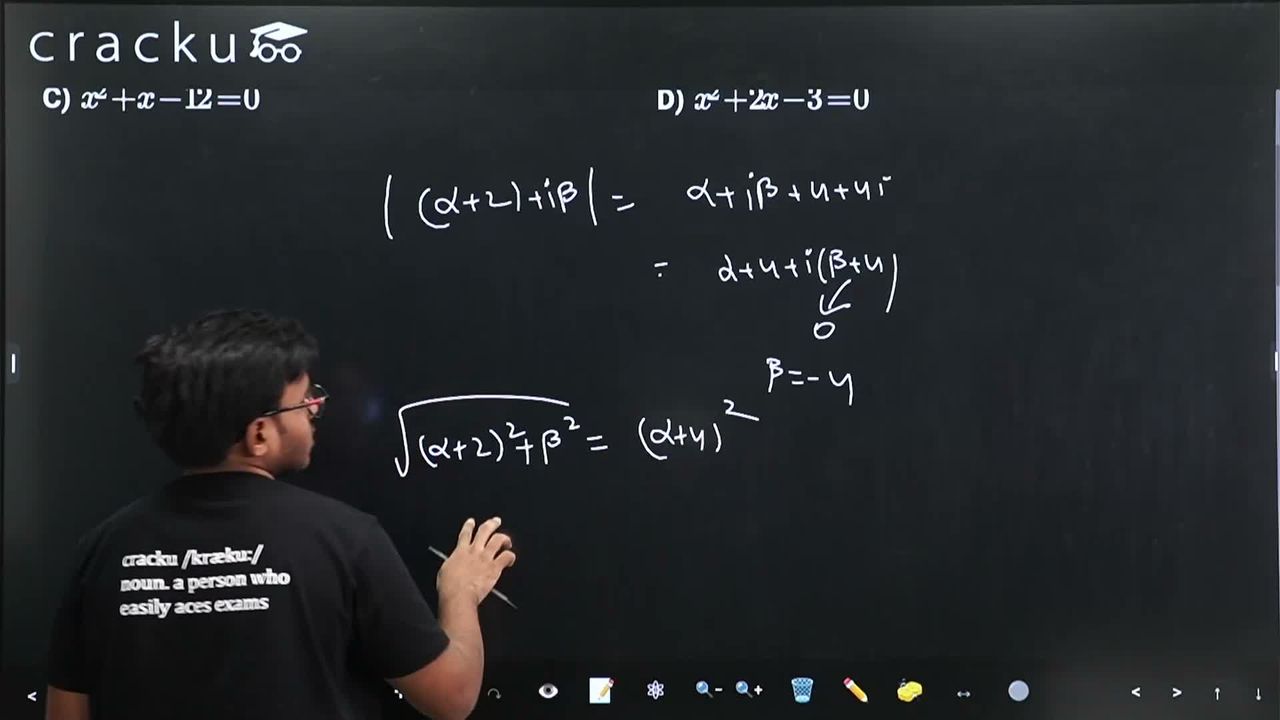
Consider $$z = \alpha + i\beta$$ and impose the condition $$|z + 2| = z + 4(1 + i)$$. Since the left side is real, the imaginary part of the right side must be zero. Writing the imaginary part gives $$\text{Im}(z + 4 + 4i) = \beta + 4 = 0$$, which leads to $$\beta = -4$$.
Next, equating the real parts yields $$|z + 2| = \alpha + 4$$, so $$\sqrt{(\alpha + 2)^2 + \beta^2} = \alpha + 4$$.
Squaring both sides and using the fact that $$\alpha + 4 \ge 0$$ gives $$(\alpha + 2)^2 + 16 = (\alpha + 4)^2$$. Expanding produces $$\alpha^2 + 4\alpha + 4 + 16 = \alpha^2 + 8\alpha + 16$$, which simplifies to $$4\alpha + 20 = 8\alpha + 16$$. Solving this equation leads to $$\alpha = 1$$.
With $$\alpha = 1$$ and $$\beta = -4$$ we find $$\alpha + \beta = -3$$ and $$\alpha\beta = -4$$. A quadratic equation having roots $$-3$$ and $$-4$$ can be written as $$x^2 - (-3 - 4)x + (-3)(-4) = 0$$, which simplifies to $$x^2 + 7x + 12 = 0$$.
The required equation is $$x^2 + 7x + 12 = 0$$.
Click on the Email ☝️ to Watch the Video Solution
Create a FREE account and get:
_1.webp)

Educational materials for JEE preparation

Ask our AI anything

AI can make mistakes. Please verify important information.
AI can make mistakes. Please verify important information.


