
Join Our JEE Preparation Group
Prep with like-minded aspirants; Get access to free daily tests and study material.
Sign in
Please select an account to continue using cracku.in
↓ →
Join Our JEE Preparation Group
Prep with like-minded aspirants; Get access to free daily tests and study material.
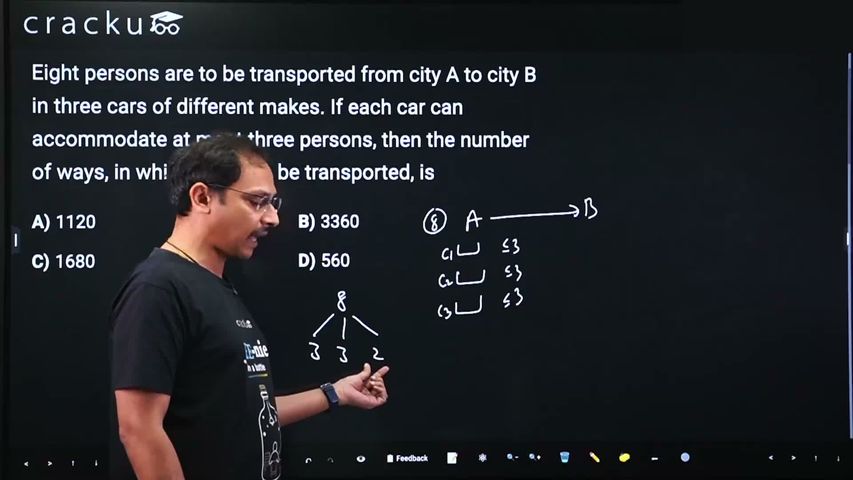
Eight persons are to be transported from city A to city B in three cars of different makes. If each car can accommodate at most three persons, then the number of ways, in which they can be transported, is
We need to find the number of ways to transport 8 persons in 3 cars (of different makes), where each car can hold at most 3 persons.
Since each car holds at most 3 persons and the total is 8, the only valid partition is: 3 + 3 + 2 = 8. No other partition works (e.g., 4+3+1 would require a car with 4, exceeding the limit).
Since the three cars are distinguishable (different makes), we need to decide which car gets 2 persons and which two get 3 persons.
Method: First choose which car carries only 2 persons: there are $$\binom{3}{1} = 3$$ ways.
Then, choose 2 persons for that car: $$\binom{8}{2}$$ ways.
Then, choose 3 persons from the remaining 6 for the next car: $$\binom{6}{3}$$ ways.
The last 3 persons go to the remaining car: $$\binom{3}{3} = 1$$ way.
$$\text{Total} = 3 \times \binom{8}{2} \times \binom{6}{3} \times \binom{3}{3}$$
$$= 3 \times 28 \times 20 \times 1 = 1680$$
Alternative calculation: We can also compute this as $$\frac{8!}{3!3!2!} \times \frac{3!}{2!}$$, where $$\frac{8!}{3!3!2!} = 560$$ counts the ways to partition 8 into groups of (3,3,2), and $$\frac{3!}{2!} = 3$$ assigns distinguishable cars to these groups (dividing by $$2!$$ because the two groups of 3 are interchangeable in the partition, but then multiplied by $$3!$$ for assigning to distinct cars).
$$560 \times 3 = 1680$$
The correct answer is Option 3: 1680.
Was this solution helpful?
Click on the Email ☝️ to Watch the Video Solution
Create a FREE account and get:
_1.webp)

Educational materials for JEE preparation

Ask our AI anything

AI can make mistakes. Please verify important information.
AI can make mistakes. Please verify important information.


