
Join Our JEE Preparation Group
Prep with like-minded aspirants; Get access to free daily tests and study material.
Sign in
Please select an account to continue using cracku.in
↓ →
Join Our JEE Preparation Group
Prep with like-minded aspirants; Get access to free daily tests and study material.
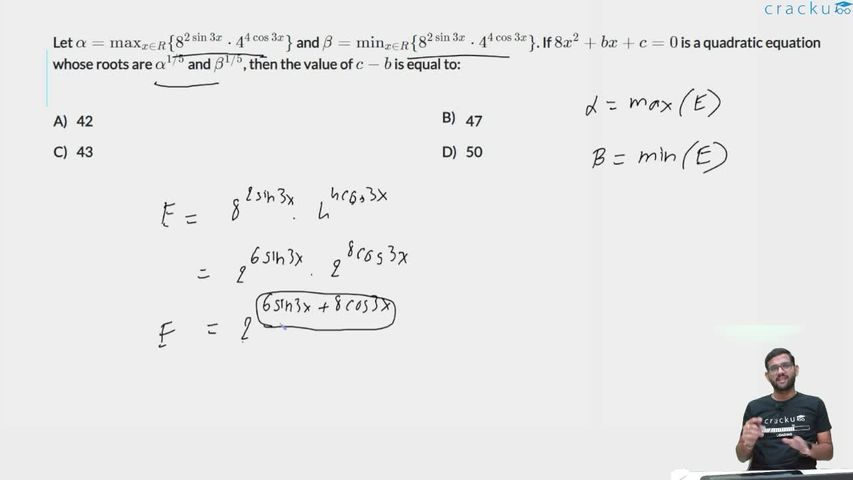
Let $$\alpha = \max_{x \in R}\{8^{2\sin 3x} \cdot 4^{4\cos 3x}\}$$ and $$\beta = \min_{x \in R}\{8^{2\sin 3x} \cdot 4^{4\cos 3x}\}$$. If $$8x^2 + bx + c = 0$$ is a quadratic equation whose roots are $$\alpha^{1/5}$$ and $$\beta^{1/5}$$, then the value of $$c - b$$ is equal to:
First, let us rewrite the given expression in a single base so that the maximisation and minimisation become easier.
We have $$8^{2\sin 3x}\cdot 4^{4\cos 3x}.$$
Recall that $$8 = 2^3 \quad\text{and}\quad 4 = 2^2.$$ Substituting these powers of two, we get
$$\bigl(2^3\bigr)^{2\sin 3x}\cdot\bigl(2^2\bigr)^{4\cos 3x} = 2^{3\cdot 2\sin 3x}\cdot 2^{2\cdot 4\cos 3x} = 2^{6\sin 3x}\cdot 2^{8\cos 3x}.$$
Whenever we multiply two numbers with the same base, we add the exponents, so
$$2^{6\sin 3x}\cdot 2^{8\cos 3x}=2^{\,6\sin 3x+8\cos 3x}.$$ Hence, maximising or minimising the original expression is the same as maximising or minimising the exponent
$$f(t)=6\sin t+8\cos t,$$
where we have set $$t = 3x,$$ because $$\sin 3x$$ and $$\cos 3x$$ both depend only on $$3x.$$
Now, for any expression of the form $$A\sin t + B\cos t,$$ its maximum value is $$\sqrt{A^{2}+B^{2}}$$ and its minimum value is $$-\sqrt{A^{2}+B^{2}}.$$ This comes directly from interpreting the linear combination as a shifted sine wave with amplitude $$\sqrt{A^{2}+B^{2}}.$$ Stating the result clearly,
$$\max(A\sin t+B\cos t)=\sqrt{A^2+B^2},\qquad \min(A\sin t+B\cos t)=-\sqrt{A^2+B^2}.$$
Here, $$A=6$$ and $$B=8,$$ so
$$\sqrt{A^{2}+B^{2}}=\sqrt{6^{2}+8^{2}} =\sqrt{36+64} =\sqrt{100}=10.$$
Therefore
$$\max_{t\in\mathbb R} f(t)=10,\qquad \min_{t\in\mathbb R} f(t)=-10.$$
Remembering that the original quantity is $$2^{f(t)},$$ we get
$$\alpha = 2^{10}=1024,\qquad \beta = 2^{-10}=\dfrac1{1024}.$$
The problem says that $$\alpha^{1/5}$$ and $$\beta^{1/5}$$ are the roots of the quadratic $$8x^{2}+bx+c=0.$$ Let us denote the two roots by
$$r_{1}=\alpha^{1/5},\qquad r_{2}=\beta^{1/5}.$$
We now compute these roots explicitly. Since $$\alpha=1024=2^{10},$$
$$r_{1}=\bigl(2^{10}\bigr)^{1/5}=2^{10/5}=2^{2}=4.$$
Similarly, $$\beta=2^{-10},$$ so
$$r_{2}=\bigl(2^{-10}\bigr)^{1/5}=2^{-10/5}=2^{-2}=\dfrac14.$$
Next, recall the standard relations between the coefficients of a quadratic and its roots. For a quadratic $$ax^{2}+bx+c=0$$ with roots $$r_{1},\,r_{2},$$ we have
$$r_{1}+r_{2}=-\dfrac{b}{a},\qquad r_{1}r_{2}=\dfrac{c}{a}.$$
In our particular equation, $$a=8,$$ so
$$r_{1}+r_{2}=-\dfrac{b}{8},\qquad r_{1}r_{2}=\dfrac{c}{8}.$$
Substituting the numerical values we have found:
Sum of roots: $$r_{1}+r_{2}=4+\dfrac14=\dfrac{16}{4}+\dfrac14=\dfrac{17}{4}.$$
Thus $$-\dfrac{b}{8}=\dfrac{17}{4}\quad\Longrightarrow\quad b=-8\cdot\dfrac{17}{4}=-34.$$
Product of roots: $$r_{1}r_{2}=4\cdot\dfrac14=1.$$
Thus $$\dfrac{c}{8}=1\quad\Longrightarrow\quad c=8.$$
The question finally asks for $$c-b.$$ We compute
$$c-b = 8 - (-34)=8+34=42.$$
Hence, the correct answer is Option A.
Was this solution helpful?
Click on the Email ☝️ to Watch the Video Solution
Create a FREE account and get:
_1.webp)

Educational materials for JEE preparation

Ask our AI anything

AI can make mistakes. Please verify important information.
AI can make mistakes. Please verify important information.
