
Join Our JEE Preparation Group
Prep with like-minded aspirants; Get access to free daily tests and study material.
Sign in
Please select an account to continue using cracku.in
↓ →
Join Our JEE Preparation Group
Prep with like-minded aspirants; Get access to free daily tests and study material.
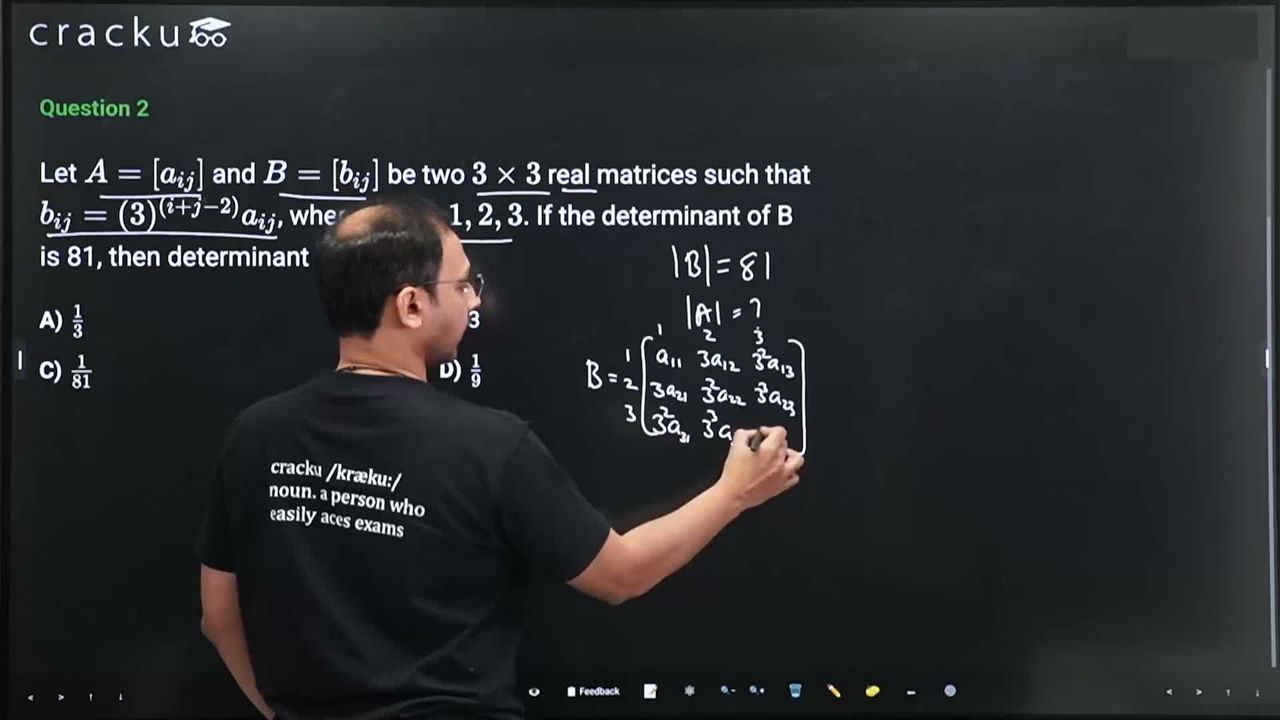
Let $$A = [a_{ij}]$$ and $$B = [b_{ij}]$$ be two $$3 \times 3$$ real matrices such that $$b_{ij} = (3)^{(i+j-2)} a_{ij}$$, where $$i, j = 1, 2, 3$$. If the determinant of B is 81, then determinant of A is
We are told that the two real matrices $$A=[a_{ij}]$$ and $$B=[b_{ij}]$$ of order $$3 \times 3$$ satisfy the relation
$$b_{ij}=3^{\,i+j-2}\,a_{ij},\qquad i,j=1,2,3.$$
First we recognise that the factor $$3^{\,i+j-2}$$ attached to $$a_{ij}$$ can be split into a product of a row-dependent factor and a column-dependent factor:
$$3^{\,i+j-2}=3^{\,i-1}\,3^{\,j-1}.$$
Now let us introduce two diagonal matrices
$$L=\operatorname{diag}\bigl(3^{\,0},3^{\,1},3^{\,2}\bigr),\qquad R=\operatorname{diag}\bigl(3^{\,0},3^{\,1},3^{\,2}\bigr).$$
The entry in the $$i^{\text{th}}$$ row and $$j^{\text{th}}$$ column of the product $$LAR$$ is
$$\bigl(LAR\bigr)_{ij}=L_{ii}\,A_{ij}\,R_{jj}=3^{\,i-1}\,a_{ij}\,3^{\,j-1}=3^{\,i+j-2}\,a_{ij}=b_{ij}.$$
Thus we have the matrix equality
$$B=LAR.$$
We now take determinants on both sides. Using the basic property “determinant of a product equals the product of determinants” we obtain
$$\det(B)=\det(L)\,\det(A)\,\det(R).$$
Because both $$L$$ and $$R$$ are diagonal, their determinants are simply the products of their diagonal entries:
$$\det(L)=3^{\,0}\cdot3^{\,1}\cdot3^{\,2}=1\cdot3\cdot9=27,$$
$$\det(R)=3^{\,0}\cdot3^{\,1}\cdot3^{\,2}=27.$$
Substituting these values we get
$$\det(B)=27\;\times\;\det(A)\;\times\;27 = 729\,\det(A).$$
We are given that $$\det(B)=81$$, so
$$81=729\,\det(A).$$
Dividing both sides by $$729$$ gives
$$\det(A)=\frac{81}{729}=\frac{1}{9}.$$
Hence, the correct answer is Option D.
Was this solution helpful?
Click on the Email ☝️ to Watch the Video Solution
Create a FREE account and get:
_1.webp)

Educational materials for JEE preparation

Ask our AI anything

AI can make mistakes. Please verify important information.
AI can make mistakes. Please verify important information.
