
Join Our JEE Preparation Group
Prep with like-minded aspirants; Get access to free daily tests and study material.
Sign in
Please select an account to continue using cracku.in
↓ →
Join Our JEE Preparation Group
Prep with like-minded aspirants; Get access to free daily tests and study material.
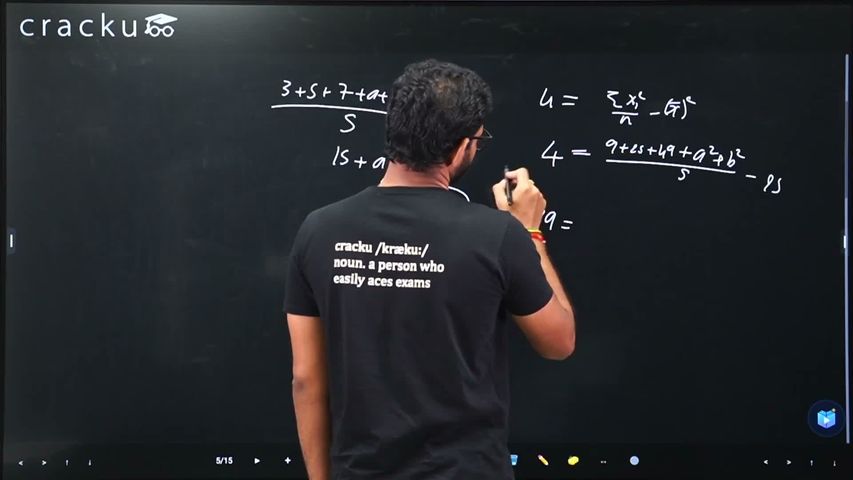
If the mean and the standard deviation of the data $$3, 5, 7, a, b$$ are $$5$$ and $$2$$ respectively, then $$a$$ and $$b$$ are the roots of the equation:
We have the five data values $$3,\;5,\;7,\;a,\;b$$ whose mean is given to be $$5$$.
The formula for the mean of $$n$$ numbers is $$$\text{Mean}=\dfrac{\text{Sum of the observations}}{n}.$$$ So, using $$n=5$$, we write
$$\dfrac{3+5+7+a+b}{5}=5.$$
Multiplying both sides by $$5$$ gives
$$3+5+7+a+b=25.$$
Adding the known numbers, $$3+5+7=15$$, so
$$15+a+b=25.$$
Subtracting $$15$$ from both sides, we obtain the first relation
$$a+b=10.\qquad(1)$$
Next, the standard deviation is given as $$2$$. For a population of size $$n$$, the standard deviation $$\sigma$$ satisfies
$$\sigma=\sqrt{\dfrac{\displaystyle\sum_{i=1}^{n}(x_i-\mu)^2}{n}},$$
where $$\mu$$ is the mean. Squaring both sides yields
$$\sigma^2=\dfrac{\displaystyle\sum_{i=1}^{n}(x_i-\mu)^2}{n}.$$
Here $$\sigma=2$$ and $$n=5$$, so $$\sigma^2=4$$. Hence
$$$\dfrac{(3-5)^2+(5-5)^2+(7-5)^2+(a-5)^2+(b-5)^2}{5}=4.$$$
Calculating the first three squares:
$$$\begin{aligned} (3-5)^2 &= (-2)^2 = 4,\\ (5-5)^2 &= 0^2 = 0,\\ (7-5)^2 &= 2^2 = 4. \end{aligned}$$$
The numerator becomes $$$4+0+4+(a-5)^2+(b-5)^2 = 8+(a-5)^2+(b-5)^2$$$. Therefore,
$$\dfrac{8+(a-5)^2+(b-5)^2}{5}=4.$$
Multiplying both sides by $$5$$ gives
$$8+(a-5)^2+(b-5)^2=20.$$
Subtracting $$8$$ from both sides, we get
$$(a-5)^2+(b-5)^2=12.\qquad(2)$$
Now we expand the squares in (2):
$$$\begin{aligned} (a-5)^2+(b-5)^2 &= \bigl(a^2-10a+25\bigr)+\bigl(b^2-10b+25\bigr)\\ &= a^2+b^2-10(a+b)+50. \end{aligned}$$$
Using the earlier result (1), $$a+b=10$$, so
$$$a^2+b^2-10\cdot10+50 = a^2+b^2-100+50 = a^2+b^2-50.$$$
Equation (2) says this expression equals $$12$$, hence
$$a^2+b^2-50 = 12.$$
Adding $$50$$ to both sides gives
$$a^2+b^2 = 62.\qquad(3)$$
Next, we recall the algebraic identity
$$(a+b)^2 = a^2 + 2ab + b^2.$$
Substituting $$a+b=10$$ and $$a^2+b^2=62$$ into this identity yields
$$10^2 = 62 + 2ab.$$
Calculating $$10^2$$ gives $$100$$, so
$$100 = 62 + 2ab.$$
Subtracting $$62$$ from both sides,
$$38 = 2ab.$$
Dividing by $$2$$, we find
$$ab = 19.\qquad(4)$$
The sum and product of $$a$$ and $$b$$ have now been obtained as
$$$S = a+b = 10, \quad P = ab = 19.$$$
A monic quadratic equation whose roots are $$a$$ and $$b$$ is written as
$$x^2 - Sx + P = 0.$$
Substituting the values of $$S$$ and $$P$$, we arrive at
$$x^2 - 10x + 19 = 0.$$
This matches Option C.
Hence, the correct answer is Option C.
Was this solution helpful?
Click on the Email ☝️ to Watch the Video Solution
Create a FREE account and get:
_1.webp)

Educational materials for JEE preparation

Ask our AI anything

AI can make mistakes. Please verify important information.
AI can make mistakes. Please verify important information.
