
Join Our JEE Preparation Group
Prep with like-minded aspirants; Get access to free daily tests and study material.
Sign in
Please select an account to continue using cracku.in
↓ →
Join Our JEE Preparation Group
Prep with like-minded aspirants; Get access to free daily tests and study material.
A solution is prepared by dissolving 0.3 g of a non-volatile non-electrolyte solute 'A' of molar mass 60 g $$mol^{-1}$$ and 0.9 g of a non-volatile non-electrolyte solute 'B' of molar mass 180 g $$mol^{-1}$$ in 100 mL $$H_{2}O$$ at 27°C. Osmotic pressure of the solution will be
[Given: R = 0.082 L atm $$K^{-1} mol^{-1}$$]
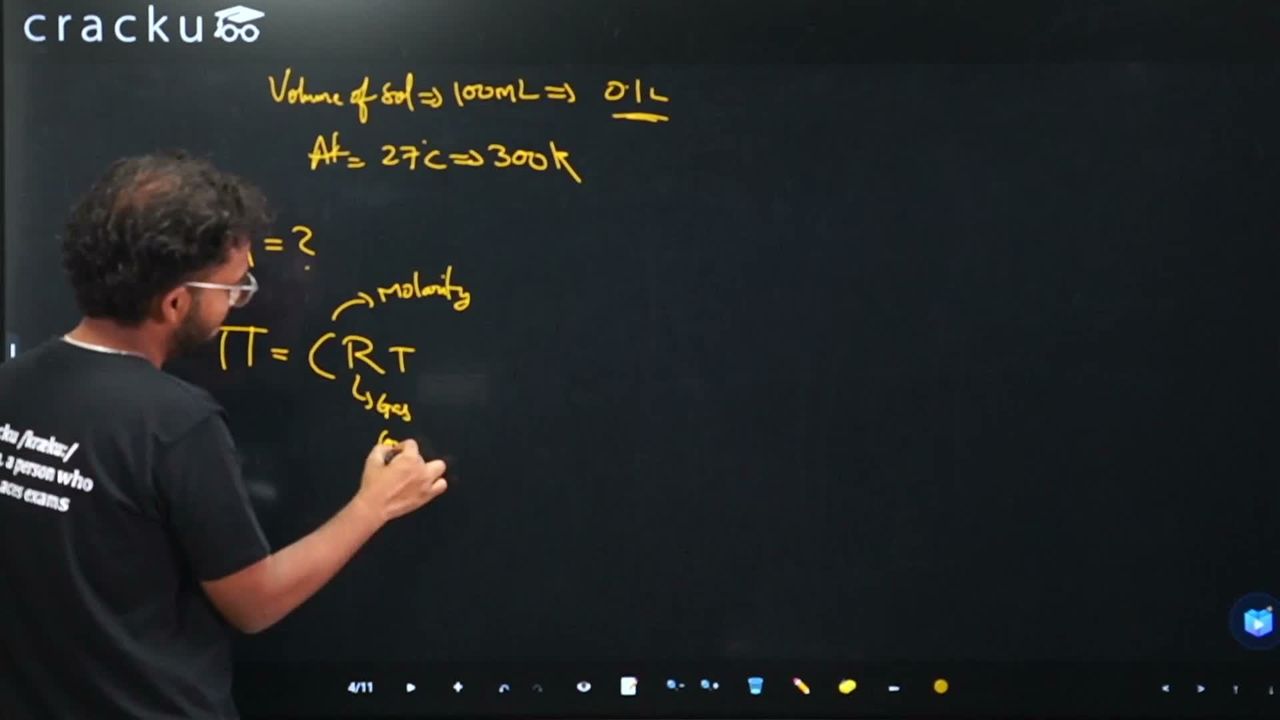
We need to find the osmotic pressure of a solution containing two non-volatile non-electrolyte solutes. Solute A has a mass of 0.3 g (molar mass = 60 g/mol), solute B has a mass of 0.9 g (molar mass = 180 g/mol), and the volume of water is 100 mL (approximately 100 mL of solution for dilute solutions). The temperature is 27°C (300 K) and R = 0.082 L atm K⁻¹ mol⁻¹.
The number of moles of A is $$n_A = \frac{0.3}{60} = 0.005$$ mol and of B is $$n_B = \frac{0.9}{180} = 0.005$$ mol, so the total moles of solute are $$n = 0.005 + 0.005 = 0.01$$ mol.
Using $$\pi = \frac{n}{V}RT$$ with V = 100 mL = 0.1 L gives $$\pi = \frac{0.01}{0.1} \times 0.082 \times 300 = 0.1 \times 24.6 = 2.46 \text{ atm}$$.
Therefore, the osmotic pressure is Option 2: 2.46 atm.
Was this solution helpful?
Click on the Email ☝️ to Watch the Video Solution
Create a FREE account and get:
_1.webp)

Educational materials for JEE preparation

Ask our AI anything

AI can make mistakes. Please verify important information.
AI can make mistakes. Please verify important information.
