
Join Our JEE Preparation Group
Prep with like-minded aspirants; Get access to free daily tests and study material.
Sign in
Please select an account to continue using cracku.in
↓ →
Join Our JEE Preparation Group
Prep with like-minded aspirants; Get access to free daily tests and study material.
Given below are statements about some molecules/ions.
Identify the CORRECT statements.
A The dipole moment value of $$NF_{3}$$ is higher than that of $$NH_{3}$$.
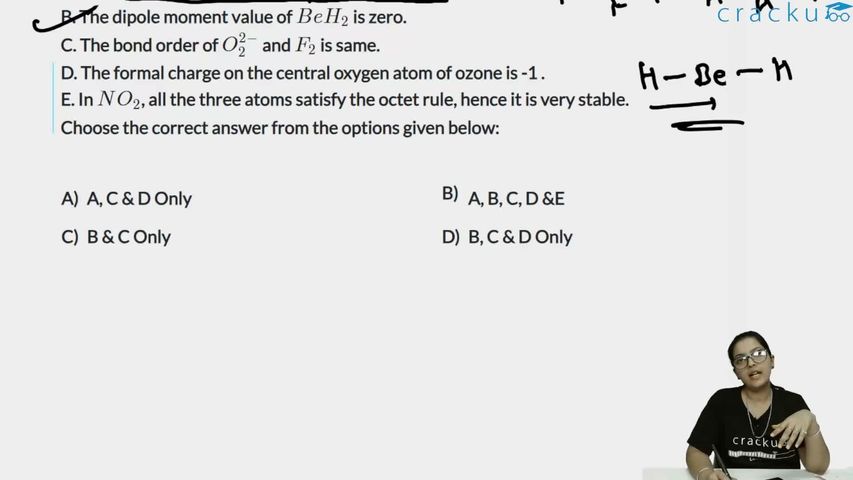
B. The dipole moment value of $$BeH_{2}$$ is zero.
C. The bond order of $$O_{2}^{2-}$$ and $$F_{2}$$ is same.
D. The formal charge on the central oxygen atom of ozone is -1 .
E. In $$NO_{2}$$, all the three atoms satisfy the octet rule, hence it is very stable.
Choose the correct answer from the options given below:
Analyzing each statement:
A. The dipole moment of $$NF_3$$ is higher than that of $$NH_3$$.
False. In $$NH_3$$, the N-H bond dipoles and the lone pair dipole all point in the same direction, giving a large net dipole moment (1.47 D). In $$NF_3$$, the N-F bond dipoles point toward F while the lone pair points in the opposite direction, causing partial cancellation and a small net dipole moment (0.23 D).
B. The dipole moment of $$BeH_2$$ is zero.
True. $$BeH_2$$ is linear ($$sp$$ hybridized), so the two equal Be-H bond dipoles cancel exactly.
C. The bond order of $$O_2^{2-}$$ and $$F_2$$ is the same.
True. Using molecular orbital theory:
$$O_2^{2-}$$: 18 total electrons (8 from each O + 2 extra). MO filling gives 10 bonding and 8 antibonding electrons. Bond order = $$\frac{10-8}{2} = 1$$.
$$F_2$$: 18 total electrons (9 from each F). Same MO filling gives 10 bonding and 8 antibonding electrons. Bond order = $$\frac{10-8}{2} = 1$$.
Both have bond order 1.
D. The formal charge on the central oxygen atom of ozone is -1.
False. In the resonance structures of $$O_3$$, the central oxygen carries a formal charge of +1 (it donates one of its lone pairs to form a coordinate bond), not -1.
E. In $$NO_2$$, all three atoms satisfy the octet rule, hence it is very stable.
False. $$NO_2$$ has 17 valence electrons (odd electron molecule). Nitrogen has an unpaired electron and does not complete its octet, making $$NO_2$$ reactive.
The correct statements are B and C only.
The answer is Option C: B and C Only.
Was this solution helpful?
Click on the Email ☝️ to Watch the Video Solution
Create a FREE account and get:
Educational materials for JEE preparation

Ask our AI anything

AI can make mistakes. Please verify important information.
AI can make mistakes. Please verify important information.

_1.webp)
