
Join Our JEE Preparation Group
Prep with like-minded aspirants; Get access to free daily tests and study material.
Sign in
Please select an account to continue using cracku.in
↓ →
Join Our JEE Preparation Group
Prep with like-minded aspirants; Get access to free daily tests and study material.
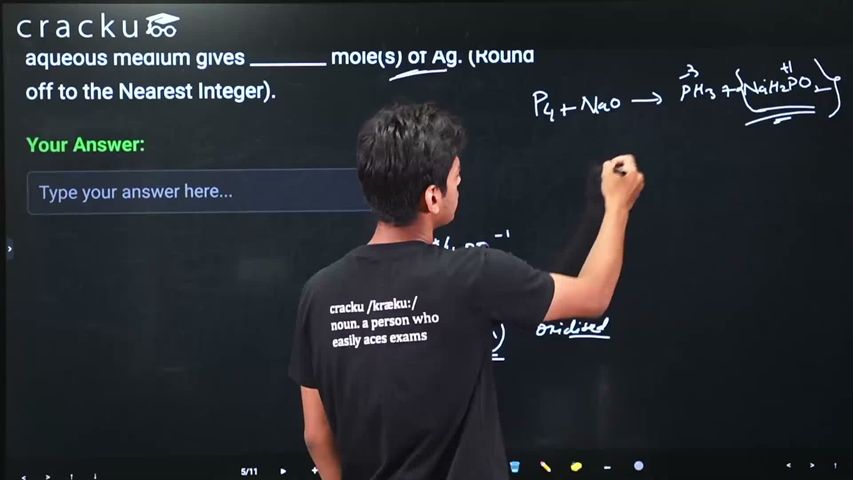
The reaction of white phosphorus on boiling with alkali in inert atmosphere resulted in the formation of product A. The reaction 1 mol of A with excess of AgNO$$_3$$ in aqueous medium gives ________ mole(s) of Ag. (Round off to the Nearest Integer).
Correct Answer: 4
When white phosphorus ($$P_4$$) is boiled with concentrated NaOH solution in an inert atmosphere, it undergoes disproportionation: $$P_4 + 3NaOH + 3H_2O \to PH_3 + 3NaH_2PO_2$$. Two products are formed — phosphine gas ($$PH_3$$) and sodium hypophosphite ($$NaH_2PO_2$$). The product A referred to in the question is the hypophosphite salt $$NaH_2PO_2$$, which remains in the aqueous solution.
In $$NaH_2PO_2$$, phosphorus is in the +1 oxidation state. Hypophosphite is a powerful reducing agent. When 1 mol of $$NaH_2PO_2$$ reacts with excess $$AgNO_3$$ in aqueous medium, the phosphorus gets oxidized from the +1 state to the +5 state (as phosphate), losing 4 electrons per P atom. Each $$Ag^+$$ gains 1 electron to form metallic Ag. Therefore, the balanced reaction is: $$NaH_2PO_2 + 4AgNO_3 + 2H_2O \to NaH_2PO_4 + 4Ag + 4HNO_3$$.
Hence, 1 mol of $$NaH_2PO_2$$ gives 4 moles of Ag. The answer is 4.
Was this solution helpful?
Click on the Email ☝️ to Watch the Video Solution
Create a FREE account and get:
_1.webp)

Educational materials for JEE preparation

Ask our AI anything

AI can make mistakes. Please verify important information.
AI can make mistakes. Please verify important information.
