
Join Our JEE Preparation Group
Prep with like-minded aspirants; Get access to free daily tests and study material.
Sign in
Please select an account to continue using cracku.in
↓ →
Join Our JEE Preparation Group
Prep with like-minded aspirants; Get access to free daily tests and study material.
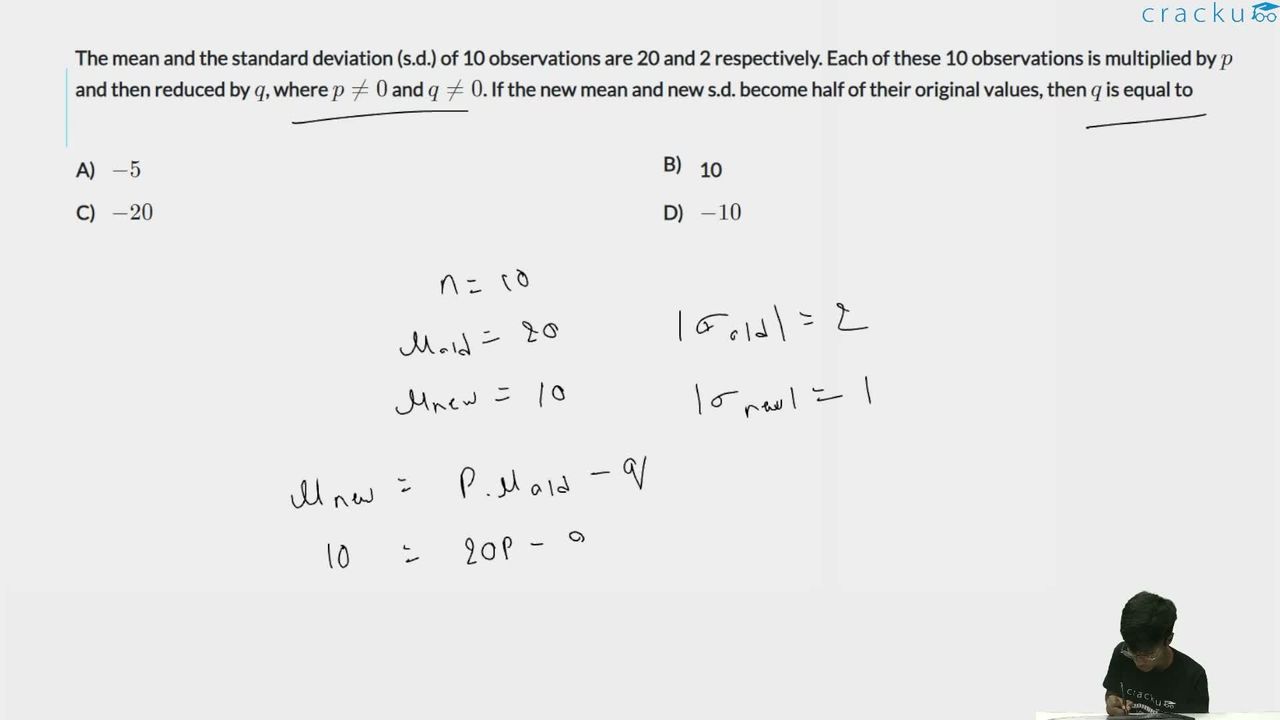
The mean and the standard deviation (s.d.) of 10 observations are 20 and 2 respectively. Each of these 10 observations is multiplied by $$p$$ and then reduced by $$q$$, where $$p \neq 0$$ and $$q \neq 0$$. If the new mean and new s.d. become half of their original values, then $$q$$ is equal to
We are given 10 observations whose original mean is $$\mu = 20$$ and whose original standard deviation is $$\sigma = 2$$.
Each observation $$x$$ is transformed to a new value $$y$$ according to the linear rule
$$y = p\,x - q,$$
where $$p \neq 0$$ and $$q \neq 0$$. We now examine how the mean and standard deviation change under such a transformation.
Formula for the mean after a linear transformation:
If $$y = p\,x + c,$$ then $$\mu_y = p\,\mu_x + c.$$ In our case the constant added is $$c = -q,$$ so
$$\mu_{\text{new}} = p\,\mu - q.$$
Formula for the standard deviation after a linear transformation:
If $$y = p\,x + c,$$ then $$\sigma_y = |p|\,\sigma_x,$$ because adding or subtracting a constant does not affect the spread, while multiplication by $$p$$ scales every deviation by the factor $$|p|$$.
The problem states that the new mean and the new standard deviation are both half of their original values. Therefore
$$\mu_{\text{new}} = \tfrac{1}{2}\,\mu = \tfrac{1}{2}\times 20 = 10,$$
$$\sigma_{\text{new}} = \tfrac{1}{2}\,\sigma = \tfrac{1}{2}\times 2 = 1.$$
We now set up the two equations that arise from these conditions.
From the mean condition:
$$p\,\mu - q = 10.$$
Substituting $$\mu = 20$$ gives
$$20\,p - q = 10 \quad\Longrightarrow\quad q = 20\,p - 10. \quad -(1)$$
From the standard-deviation condition:
$$|p|\,\sigma = 1.$$
Substituting $$\sigma = 2$$ gives
$$|p| \times 2 = 1 \quad\Longrightarrow\quad |p| = \frac{1}{2}.$$
This magnitude equation yields two possibilities for $$p$$:
$$p = \frac{1}{2}\quad\text{or}\quad p = -\frac{1}{2}.$$
We substitute each value of $$p$$ into equation (1) to find $$q$$.
Case 1: $$p = \tfrac{1}{2}$$
$$q = 20\left(\tfrac{1}{2}\right) - 10 = 10 - 10 = 0.$$
But the question stipulates $$q \neq 0,$$ so this case is rejected.
Case 2: $$p = -\tfrac{1}{2}$$
$$q = 20\left(-\tfrac{1}{2}\right) - 10 = -10 - 10 = -20.$$
Here $$q \neq 0,$$ so this value is admissible.
Thus the required value of $$q$$ is $$-20$$.
Hence, the correct answer is Option C.
Was this solution helpful?
Click on the Email ☝️ to Watch the Video Solution
Create a FREE account and get:
_1.webp)

Educational materials for JEE preparation

Ask our AI anything

AI can make mistakes. Please verify important information.
AI can make mistakes. Please verify important information.
