
Join Our JEE Preparation Group
Prep with like-minded aspirants; Get access to free daily tests and study material.
Sign in
Please select an account to continue using cracku.in
↓ →
Join Our JEE Preparation Group
Prep with like-minded aspirants; Get access to free daily tests and study material.
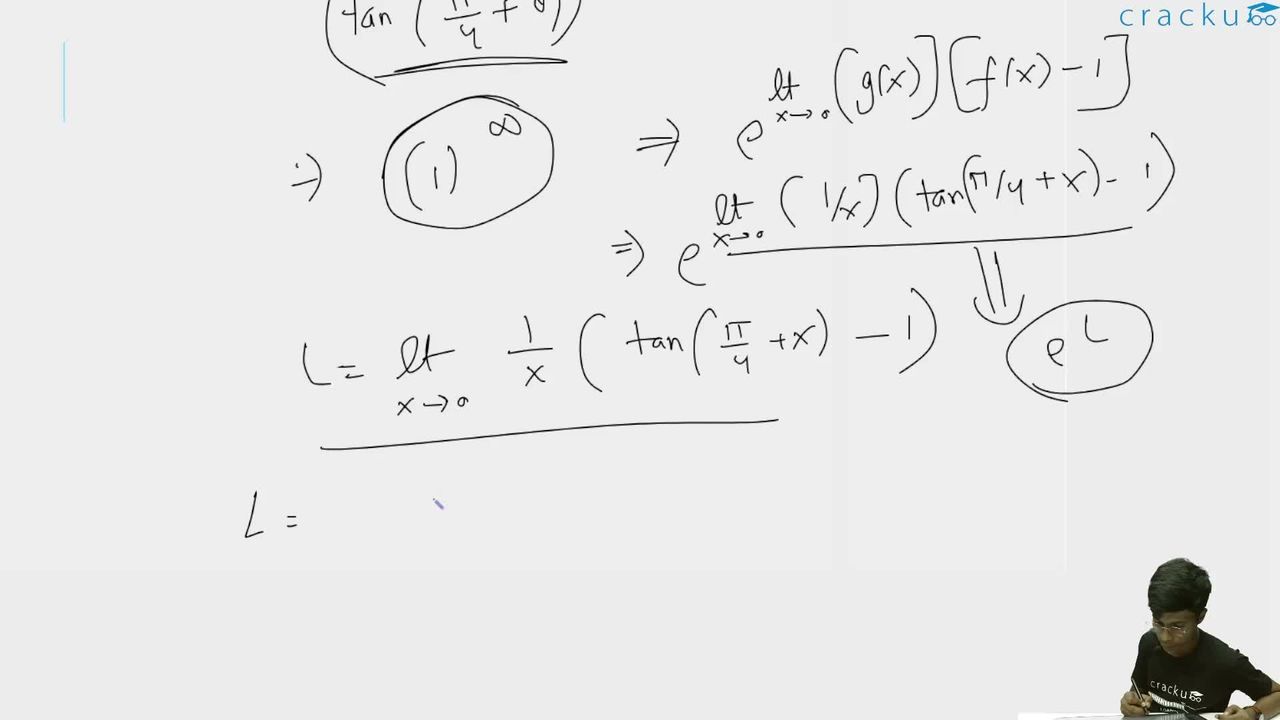
$$\lim_{x \to 0} \left(\tan\left(\frac{\pi}{4} + x\right)\right)^{1/x}$$ is equal to:
We have to evaluate the limit
$$\lim_{x \to 0}\left(\tan\!\left(\frac{\pi}{4}+x\right)\right)^{\;1/x}.$$
First, recall the compound-angle identity for tangent:
$$\tan(A+B)=\frac{\tan A+\tan B}{1-\tan A\;\tan B}.$$
Using this with $$A=\frac{\pi}{4}$$ and $$B=x,$$ we get
$$\tan\!\left(\frac{\pi}{4}+x\right)=\frac{\tan\!\left(\frac{\pi}{4}\right)+\tan x}{1-\tan\!\left(\frac{\pi}{4}\right)\tan x}.$$
Because $$\tan\!\left(\frac{\pi}{4}\right)=1,$$ the expression simplifies to
$$\tan\!\left(\frac{\pi}{4}+x\right)=\frac{1+\tan x}{1-\tan x}.$$
Next, as $$x\to 0,$$ we know the standard small-angle approximation:
$$\tan x = x + \dfrac{x^3}{3}+\dots.$$
Keeping only the first-order term, we may write $$\tan x \approx x.$$ Substituting this approximation gives
$$\tan\!\left(\frac{\pi}{4}+x\right)\approx\frac{1+x}{1-x}.$$
Now we manipulate the fraction algebraically:
$$\frac{1+x}{1-x}=\left(1+x\right)\left(\frac{1}{1-x}\right).$$
Using the binomial expansion $$\frac{1}{1-x}=1+x+x^{2}+\dots,$$ the product becomes
$$\left(1+x\right)\left(1+x+x^{2}+\dots\right)=1+2x+\mathcal O(x^{2}).$$
Thus, very close to $$x=0$$ we may write
$$\tan\!\left(\frac{\pi}{4}+x\right)\approx 1+2x.$$
Returning to the original limit, we now have
$$\left(\tan\!\left(\frac{\pi}{4}+x\right)\right)^{1/x}\approx\left(1+2x\right)^{1/x}.$$
Let us rewrite the right-hand side so that the familiar exponential limit appears clearly. Observe that
$$\left(1+2x\right)^{1/x}=\left[\left(1+2x\right)^{1/(2x)}\right]^{2}.$$
We will now use the well-known limit
$$\lim_{t\to 0}\left(1+t\right)^{1/t}=e.$$
In our expression, set $$t=2x.$$ Then as $$x\to 0,$$ we also have $$t\to 0.$$ Therefore,
$$\lim_{x\to 0}\left(1+2x\right)^{1/(2x)}=e.$$
Substituting this result back, we obtain
$$\lim_{x\to 0}\left(1+2x\right)^{1/x}=\left(\lim_{x\to 0}\left(1+2x\right)^{1/(2x)}\right)^{2}=e^{2}.$$
Hence, the required limit equals $$e^{2}.$$
Hence, the correct answer is Option D.
Was this solution helpful?
Click on the Email ☝️ to Watch the Video Solution
Create a FREE account and get:
_1.webp)

Educational materials for JEE preparation

Ask our AI anything

AI can make mistakes. Please verify important information.
AI can make mistakes. Please verify important information.


