
Join Our JEE Preparation Group
Prep with like-minded aspirants; Get access to free daily tests and study material.
Sign in
Please select an account to continue using cracku.in
↓ →
Join Our JEE Preparation Group
Prep with like-minded aspirants; Get access to free daily tests and study material.
For some $$\theta \in \left(0, \frac{\pi}{2}\right)$$, if the eccentricity of the hyperbola, $$x^2 - y^2\sec^2\theta = 10$$ is $$\sqrt{5}$$ times the eccentricity of the ellipse, $$x^2\sec^2\theta + y^2 = 5$$, then the length of the latus rectum of the ellipse, is:
We have the hyperbola
$$x^{2}-y^{2}\sec^{2}\theta = 10$$
and the ellipse
$$x^{2}\sec^{2}\theta + y^{2}=5,$$
where $$\theta\in\left(0,\dfrac{\pi}{2}\right).$$
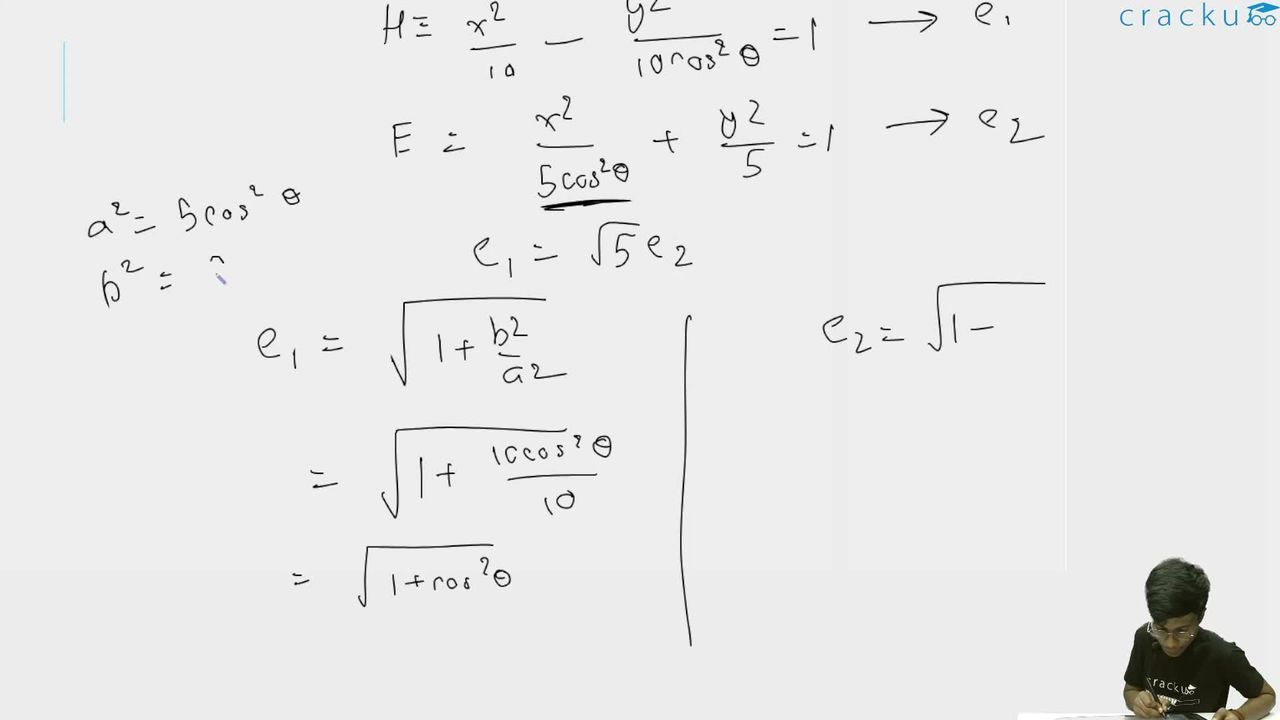
First we rewrite the hyperbola in standard form. Dividing by $$10$$ gives
$$\frac{x^{2}}{10}-\frac{y^{2}\sec^{2}\theta}{10}=1.$$
Comparing with the standard form $$\dfrac{x^{2}}{a^{2}}-\dfrac{y^{2}}{b^{2}}=1,$$ we identify
$$a^{2}=10,\qquad \frac{1}{b^{2}}=\frac{\sec^{2}\theta}{10}\;\Longrightarrow\; b^{2}=\frac{10}{\sec^{2}\theta}=10\cos^{2}\theta.$$
The eccentricity formula for a hyperbola is $$e_{h}^{2}=1+\dfrac{b^{2}}{a^{2}}.$$ Substituting $$a^{2}=10$$ and $$b^{2}=10\cos^{2}\theta$$, we get
$$e_{h}^{2}=1+\frac{10\cos^{2}\theta}{10}=1+\cos^{2}\theta,$$
so
$$e_{h}=\sqrt{1+\cos^{2}\theta}.$$
Now we put the ellipse into standard form. Dividing $$x^{2}\sec^{2}\theta + y^{2}=5$$ by $$5$$ yields
$$\frac{x^{2}\sec^{2}\theta}{5}+\frac{y^{2}}{5}=1.$$
Thus
$$\frac{x^{2}}{5\cos^{2}\theta}+\frac{y^{2}}{5}=1.$$
Here the larger denominator is $$5,$$ so
$$a^{2}=5,\qquad b^{2}=5\cos^{2}\theta,\qquad a=\sqrt5.$$
For an ellipse the eccentricity satisfies $$e_{e}^{2}=1-\dfrac{b^{2}}{a^{2}}.$$ Hence
$$e_{e}^{2}=1-\frac{5\cos^{2}\theta}{5}=1-\cos^{2}\theta=\sin^{2}\theta,$$
giving
$$e_{e}=\sin\theta.$$
According to the condition in the question,
$$e_{h}=\sqrt5\,e_{e}.$$ Substituting $$e_{h}=\sqrt{1+\cos^{2}\theta}$$ and $$e_{e}=\sin\theta,$$ we obtain
$$\sqrt{1+\cos^{2}\theta}=\sqrt5\,\sin\theta.$$
Squaring both sides:
$$1+\cos^{2}\theta=5\sin^{2}\theta.$$
Using $$\sin^{2}\theta=1-\cos^{2}\theta,$$ we get
$$1+\cos^{2}\theta=5(1-\cos^{2}\theta).$$
Expanding and collecting like terms:
$$1+\cos^{2}\theta=5-5\cos^{2}\theta$$ $$\Longrightarrow\;1+\cos^{2}\theta-5+5\cos^{2}\theta=0$$ $$\Longrightarrow\;-4+6\cos^{2}\theta=0$$ $$\Longrightarrow\;6\cos^{2}\theta=4$$ $$\Longrightarrow\;\cos^{2}\theta=\frac{4}{6}=\frac{2}{3}.$$
Since $$0<\theta<\dfrac{\pi}{2},$$ we have
$$\cos\theta=\sqrt{\frac{2}{3}},\qquad \sin\theta=\sqrt{1-\frac{2}{3}}=\sqrt{\frac{1}{3}}=\frac{1}{\sqrt3}.$$
Now we compute the length of the latus rectum of the ellipse. For an ellipse the length of the latus rectum is given by
$$\text{Latus Rectum}= \frac{2b^{2}}{a}.$$
We already have $$b^{2}=5\cos^{2}\theta=5\cdot\frac{2}{3}=\frac{10}{3}$$ and $$a=\sqrt5.$$ Therefore
$$\text{Latus Rectum}= \frac{2\left(\dfrac{10}{3}\right)}{\sqrt5}=\frac{20}{3\sqrt5}.$$
Rationalising the denominator:
$$\frac{20}{3\sqrt5}\times\frac{\sqrt5}{\sqrt5}=\frac{20\sqrt5}{3\cdot5}=\frac{4\sqrt5}{3}.$$
Hence, the correct answer is Option D.
Was this solution helpful?
Click on the Email ☝️ to Watch the Video Solution
Create a FREE account and get:
_1.webp)

Educational materials for JEE preparation

Ask our AI anything

AI can make mistakes. Please verify important information.
AI can make mistakes. Please verify important information.


