
Join Our JEE Preparation Group
Prep with like-minded aspirants; Get access to free daily tests and study material.
Sign in
Please select an account to continue using cracku.in
↓ →
Join Our JEE Preparation Group
Prep with like-minded aspirants; Get access to free daily tests and study material.
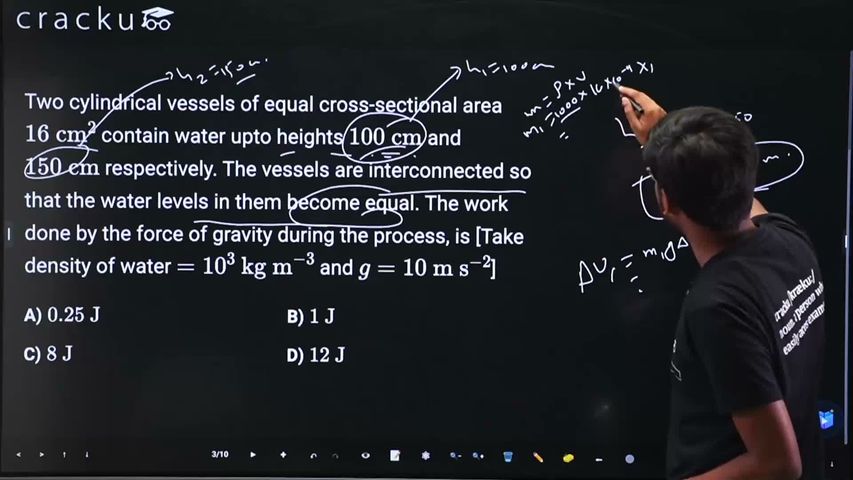
Two cylindrical vessels of equal cross-sectional area $$16 \text{ cm}^2$$ contain water upto heights $$100 \text{ cm}$$ and $$150 \text{ cm}$$ respectively. The vessels are interconnected so that the water levels in them become equal. The work done by the force of gravity during the process, is [Take density of water $$= 10^3 \text{ kg m}^{-3}$$ and $$g = 10 \text{ m s}^{-2}$$]
Two cylindrical vessels of equal cross-section $$A = 16 \text{ cm}^2$$ contain water at heights 100 cm and 150 cm. We need the work done by gravity when they are interconnected.
Since both vessels have equal cross-sectional area, the final height is the average:
$$h_f = \frac{100 + 150}{2} = 125 \text{ cm}$$
Work done by gravity = loss in potential energy of the system.
The centre of mass of water in vessel 1 was at $$h_1/2 = 50$$ cm and goes to $$125/2 = 62.5$$ cm.
The centre of mass of water in vessel 2 was at $$h_2/2 = 75$$ cm and goes to $$62.5$$ cm.
Mass of water in vessel 1: $$m_1 = \rho A h_1 = 1000 \times 16 \times 10^{-4} \times 1 = 1.6 \text{ kg}$$
Mass of water in vessel 2: $$m_2 = \rho A h_2 = 1000 \times 16 \times 10^{-4} \times 1.5 = 2.4 \text{ kg}$$
Change in PE of vessel 1 (rises from 50 cm to 62.5 cm): $$\Delta PE_1 = m_1 g \Delta h_1 = 1.6 \times 10 \times 0.125 = 2 \text{ J}$$
Change in PE of vessel 2 (falls from 75 cm to 62.5 cm): $$\Delta PE_2 = -m_2 g \Delta h_2 = -2.4 \times 10 \times 0.125 = -3 \text{ J}$$
Net change in PE = $$2 + (-3) = -1 \text{ J}$$
Work done by gravity = $$-\Delta PE = -(-1) = 1 \text{ J}$$
The correct answer is Option B: $$1 \text{ J}$$.
Was this solution helpful?
Click on the Email ☝️ to Watch the Video Solution
Create a FREE account and get:
_1.webp)

Educational materials for JEE preparation

Ask our AI anything

AI can make mistakes. Please verify important information.
AI can make mistakes. Please verify important information.
